

Your glutes do not need a complicated routine with twelve bands, a stability ball, and a minor engineering degree.
Glute bridge pulses look small, but they make your glutes work through the part of a bridge where many people let up. If you want stronger, rounder glutes without stretching leg day into three hours, add this simple finisher to your workout.
I started adding bridge pulses when regular glute bridges stopped giving me that “oh, my glutes got the memo” feeling. Five seconds into a set, my backside had strong opinions. A move with barely any travel can still bring plenty of drama.

What are glute bridge pulses?
Glute bridge pulses build on the standard glute bridge with short, controlled reps near the top. Lift your hips, squeeze your glutes, lower them only a few inches, then press back up.
That small range keeps tension on your glutes longer. Your quads have less chance to take over, and your lower back has less opportunity to turn the exercise into something else.
A regular glute bridge gives you the full movement. Glute bridge pulses make the hardest part last longer.
Why the short range matters
Your glutes extend your hips, which means they drive your hips forward and upward. The top half of a bridge challenges that job directly, particularly when you pause and squeeze with control.
Pulses also increase time under tension. Rather than relaxing at the bottom of every rep, you keep your glutes working through a longer set. That is why 20 short pulses can feel tougher than 10 full reps.
Researchers continue to study how hip extension exercises affect glute activity and strength. You can explore exercise research through PubMed’s exercise science database, but your form matters more than any chart.
Glute bridge pulse benefits that matter
Glute bridge pulses can support muscle building workouts, athletic training, and daily movement. They will not build fuller glutes overnight, because no exercise carries a wizard wand. They give your glutes a focused reason to adapt when you train consistently.
- They work your glutes: The exercise emphasizes hip extension and lets you practice a strong glute squeeze.
- They build muscular endurance: Higher rep pulse sets teach your glutes to keep working once the burn arrives.
- They improve mind muscle connection: You learn what a true glute contraction feels like instead of simply driving through your feet.
- They need very little equipment: A mat and some floor space do the job.
- They fit into many workouts: Use them in a warm up, a lower body circuit, or a glute burnout finisher.
- They support stronger hip mechanics: Strong glutes help you control hip extension when you lift, run, jump, and climb stairs.
For overall health, adults should combine strength training with regular aerobic activity. The U.S. Physical Activity Guidelines recommend muscle strengthening work for all major muscle groups on at least two days each week.
Glute bridge pulses cannot replace a complete lower body program, but they work well alongside one. Most workouts benefit from a reliable supporting exercise.
How to do glute bridge pulses with proper form
Good glute bridge pulse form starts before the first rep. Set up carefully, move with purpose, and do not chase a range you cannot control.
- Lie on your back with your knees bent and your feet flat on the floor.
- Set your feet about hip width apart. Bring your heels close enough that your fingertips can almost reach them.
- Rest your arms at your sides with your palms down.
- Gently brace your core as though someone might poke your stomach.
- Press through your whole foot, with extra pressure through your heels, and lift your hips until your torso and thighs form a smooth line.
- Squeeze your glutes hard at the top. Keep your ribs from flaring and your lower back from arching.
- Lower your hips two to four inches.
- Drive your hips up again and repeat for your chosen rep count.
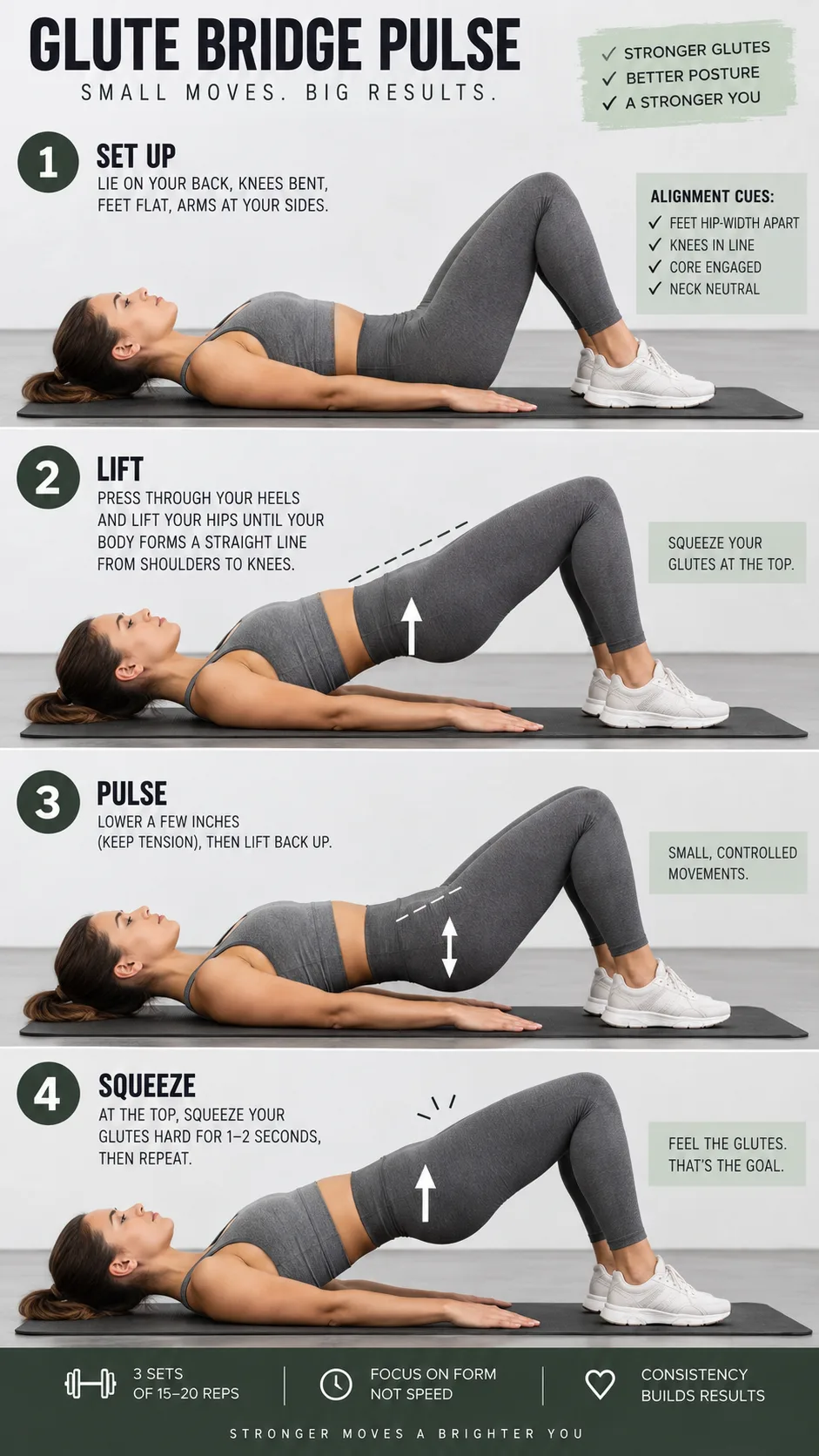
Use this simple form checklist
- Keep your chin slightly tucked and your neck relaxed.
- Keep your knees in line with your toes.
- Gently press your knees outward if they fall inward.
- Keep each pulse small and controlled.
- Exhale as you press upward.
- End the set when your lower back starts taking over.
Your glutes should drive your hip movement. If you only feel your hamstrings, move your feet slightly farther away. If your quads take over, bring your heels a little closer and press through them.
A mirror can help, but your body gives you better feedback. Do you feel your glutes working? Good. Do you feel a sharp pinch in your back or hips? Stop, reset, and shorten the range.
The biggest glute bridge pulse mistakes
People often get sloppy with small movements because they assume small means easy. That same logic burns plenty of toast, so skip it here.
Arching your lower back
Many lifters chase a higher hip position and crank through their lower back. Keep your ribs down, brace your abs, and stop when your body forms a straight line from shoulders to knees.
Your glutes should create the top position. Your lumbar spine does not need the job.
Dropping too low between pulses
Large drops turn pulses into rushed mini reps and break up the tension. Lower only a few inches, then press back into the squeeze.
Control creates the burn. Flopping around does not.
Letting your knees cave inward
Knees that drift inward often point to weak hip control or a lapse in attention. Gently press your knees outward and keep both feet planted evenly.
A light resistance band above your knees can give you useful feedback. The band cannot fix your form on its own. You still need to control the movement.
Rushing every rep
Fast pulses can raise your heart rate, but speed often takes tension away from your glutes. Use a steady rhythm and hold the top squeeze for one beat.
Try one second down, one second up, and a one second squeeze. Your glutes will notice.
How many glute bridge pulses should you do?
Your rep range depends on where pulses fit into your workout. You can use them before heavy lifts to wake up your glutes, or after your main exercises for a higher rep finisher.
- Warm up: Do 1 to 2 sets of 15 to 20 bodyweight pulses.
- Glute activation: Do 2 sets of 20 to 30 pulses with a light band.
- Muscle building finisher: Do 2 to 4 sets of 25 to 40 pulses after hip thrusts, squats, or Romanian deadlifts.
- Home workout circuit: Do 3 rounds of 30 pulses, 12 reverse lunges per side, and a 30 second wall sit.
Start with a rep target that challenges you while you maintain clean form. Add reps, use a band, slow the tempo, or hold a dumbbell across your hips when your current sets feel easy.
The American College of Sports Medicine offers practical guidance on physical activity and strength-training habits. Consistency matters here. One brutal pulse set every three weeks cannot match steady training.
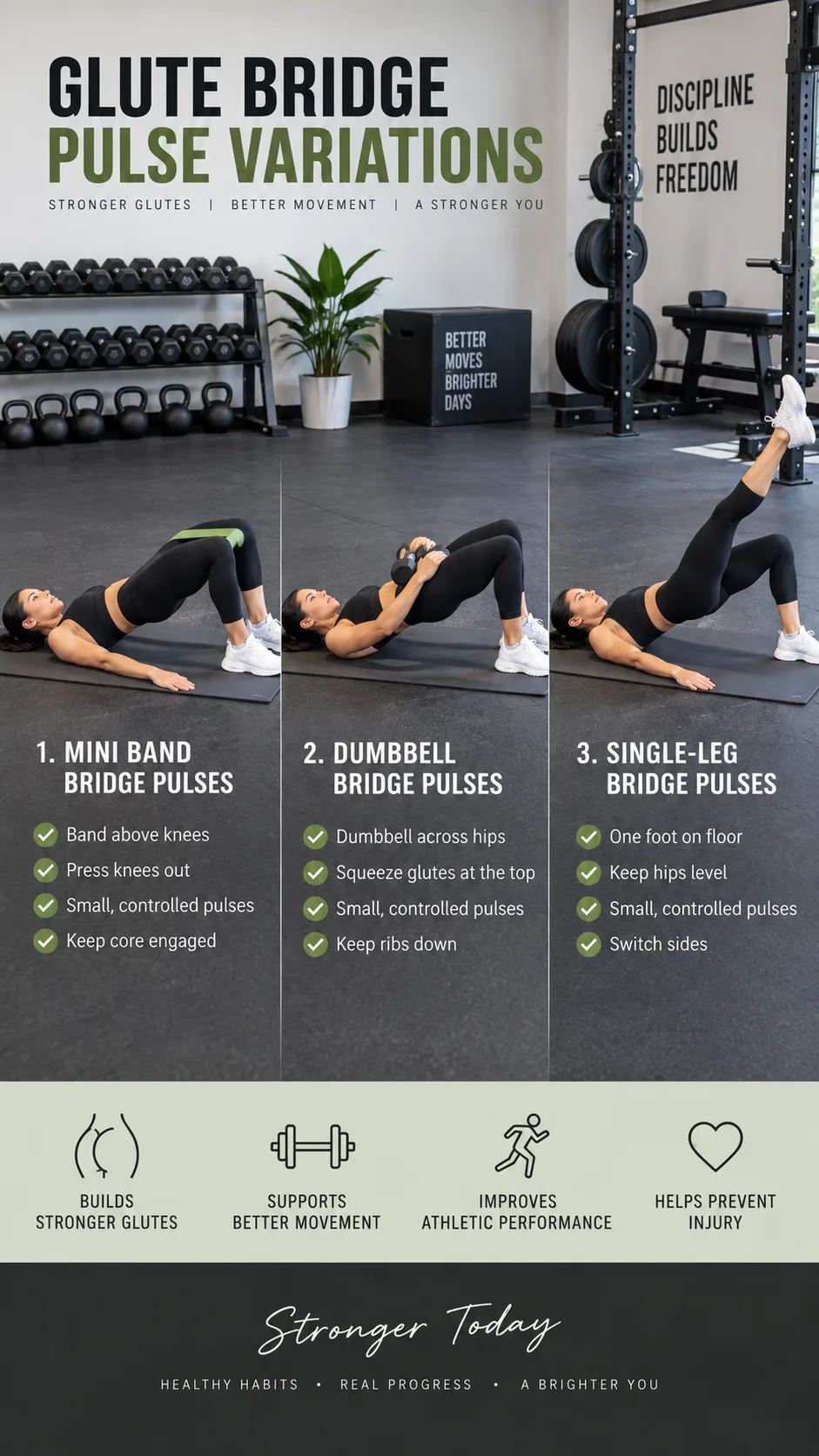
Best glute bridge pulse variations for more growth
When bodyweight pulses feel manageable, change the challenge instead of piling on endless reps. Your glutes respond to progressive overload, even in a home workout.
Banded glute bridge pulses
Place a mini band just above your knees and press your knees outward as you pulse. This variation works your outer glutes and helps you practice stable knee alignment.
Weighted glute bridge pulses
Rest a dumbbell, kettlebell, or padded barbell across your hip crease. Hold the load securely and shorten your range if the weight shifts.
Choose a load that lets you keep your ribs down and your hips level. Heavy weight does little when your lower back takes over.
Single leg glute bridge pulses
Lift one foot from the floor, keep your hips square, and pulse with the working side. This option quickly exposes strength differences from one side to the other. It can feel rude, but it helps.
Before you try it, read the single-leg glute bridge mistake that kills your gains and the fix that changed mine. Many people twist their pelvis, rush the rep, then wonder why their hamstring complains.
Where glute bridge pulses fit in a glute workout
Use compound lifts for your main strength work, then add glute bridge pulses for more focused volume. Hip thrusts, squats, deadlifts, split squats, and step ups all belong in a complete glute program.
Try this simple glute workout when you want a plan:
- Hip thrusts: 3 sets of 8 to 12 reps.
- Romanian deadlifts: 3 sets of 8 to 10 reps.
- Reverse lunges: 3 sets of 10 reps per side.
- Banded glute bridge pulses: 3 sets of 30 reps.
Rest for 60 to 90 seconds after your larger lifts. Rest for 30 to 45 seconds after pulse sets if you want a serious glute burn without making every workout feel like a survival documentary.
If you train your glutes two or three times each week, leave enough recovery time between hard sessions. Your muscles grow and recover after training, so sleep, protein, and total food intake matter too.
Do glute bridge pulses really build a rounder booty?
Glute bridge pulses can help you build stronger glutes, especially when you pair them with progressive resistance, enough weekly training volume, and solid nutrition. They work best within a broader plan, not as the entire plan.
Your genetics influence your glute shape, pelvis structure, and where your body stores fat. Training can still build more muscle and improve the shape you already have.
Get stronger, control each rep, and train regularly. Stronger glutes often lead to a rounder booty, but strength gives you a goal you can measure week after week.
Final thoughts: Make the small reps count
Glute bridge pulses give you a straightforward way to add serious glute tension without fancy gear or complicated programming. Keep your ribs down, squeeze at the top, use a small range, and make every pulse deliberate.
Add two or three sets to your next lower body workout and notice what you feel. Your glutes do not need chaos. They need consistent, well-executed work.
Start pulsing, stay patient, and let those small reps earn results. Your future jeans may send a thank you note 🙂