

Your back hurts after sit ups. Again. You finished your set, felt decent about it, then stood up to find your lower back screaming at you like you personally offended it. Sound familiar? You are not alone, and the good news is that this is almost always a form problem, not a “you” problem.
Fix that right now. No fluff, no nonsense. Just the actual stuff that makes sit ups safe, effective, and worth your time.

Why sit ups get a bad reputation (and whether it’s deserved)
Sit ups have had a rough few years in the fitness world. Trainers bash them, influencers swap them out for crunches and planks, and some gyms quietly pulled the sit up from their programs altogether. But sit ups are not inherently dangerous. Bad form is dangerous.
Research from the Spine-Health resource library confirms that improper spinal flexion under load causes injury, not the movement itself. The exercise is not broken. Your technique probably just needs some work.
So before you swear off sit ups forever, give proper form a real shot. You might be surprised at the difference.
The number one form mistake most beginners make
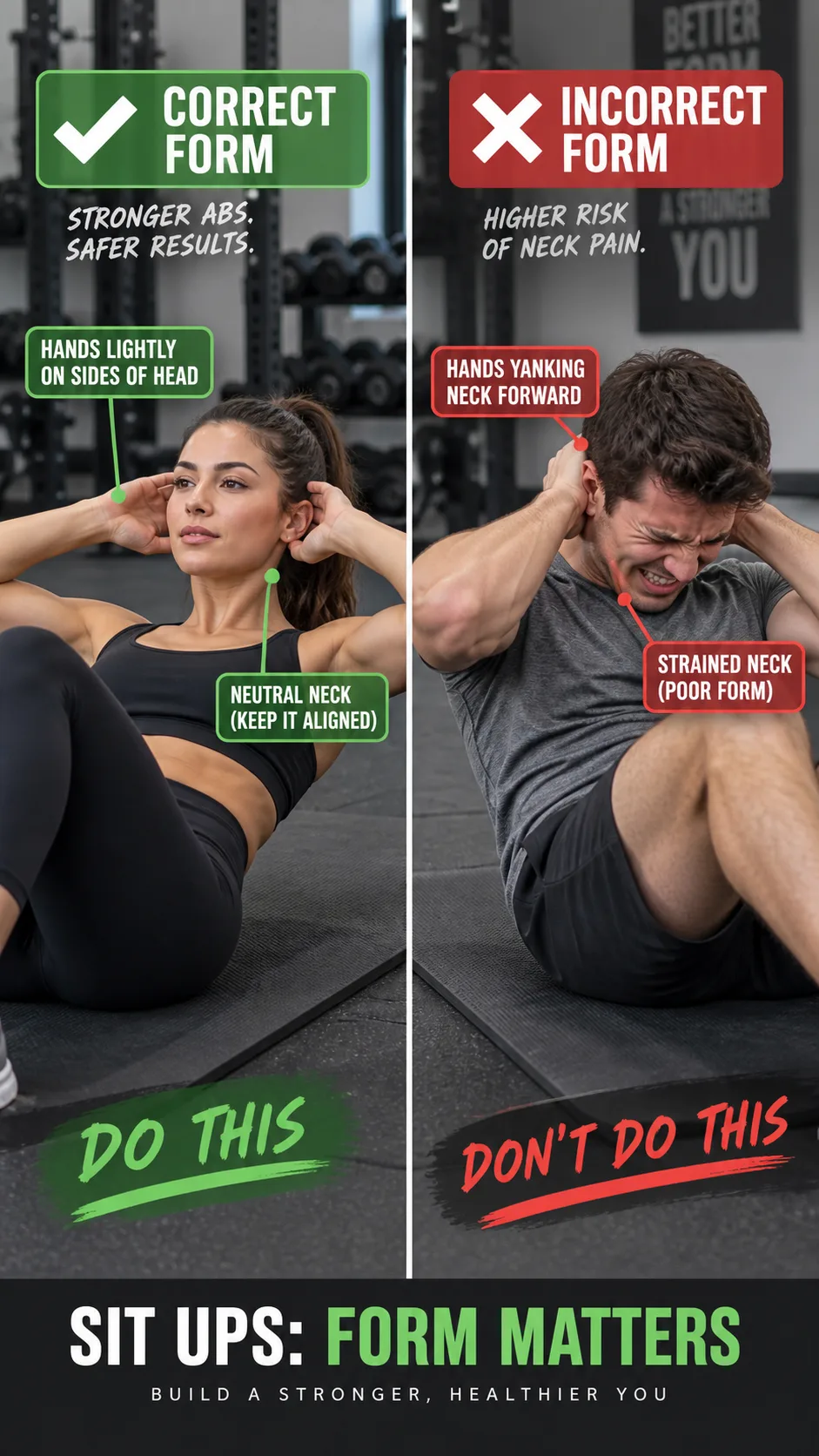
Here it is. Most beginners pull on their neck and yank themselves up using momentum instead of engaging their core. They lace their fingers behind their head, tug their chin toward their chest, and swing up like they are trying to break a world record. Their hip flexors do most of the work, and their lower back takes the hit.
Ever wondered why your neck feels stiff after a set of sit ups? That is exactly why. Your hands are acting like a crane instead of a light guide.
What you should do instead
- Place your fingertips lightly on the sides of your head, not laced behind your neck
- Keep your chin slightly tucked, like you are holding a tennis ball under it
- Drive the movement from your core, not momentum
- Move slowly and with control, because speed is your enemy here
- Exhale as you come up, inhale as you lower back down
Simple adjustments, massive difference. This one fix alone eliminates roughly 70% of the sit up injuries beginners run into.
Step-by-step: how to do a sit up with correct form
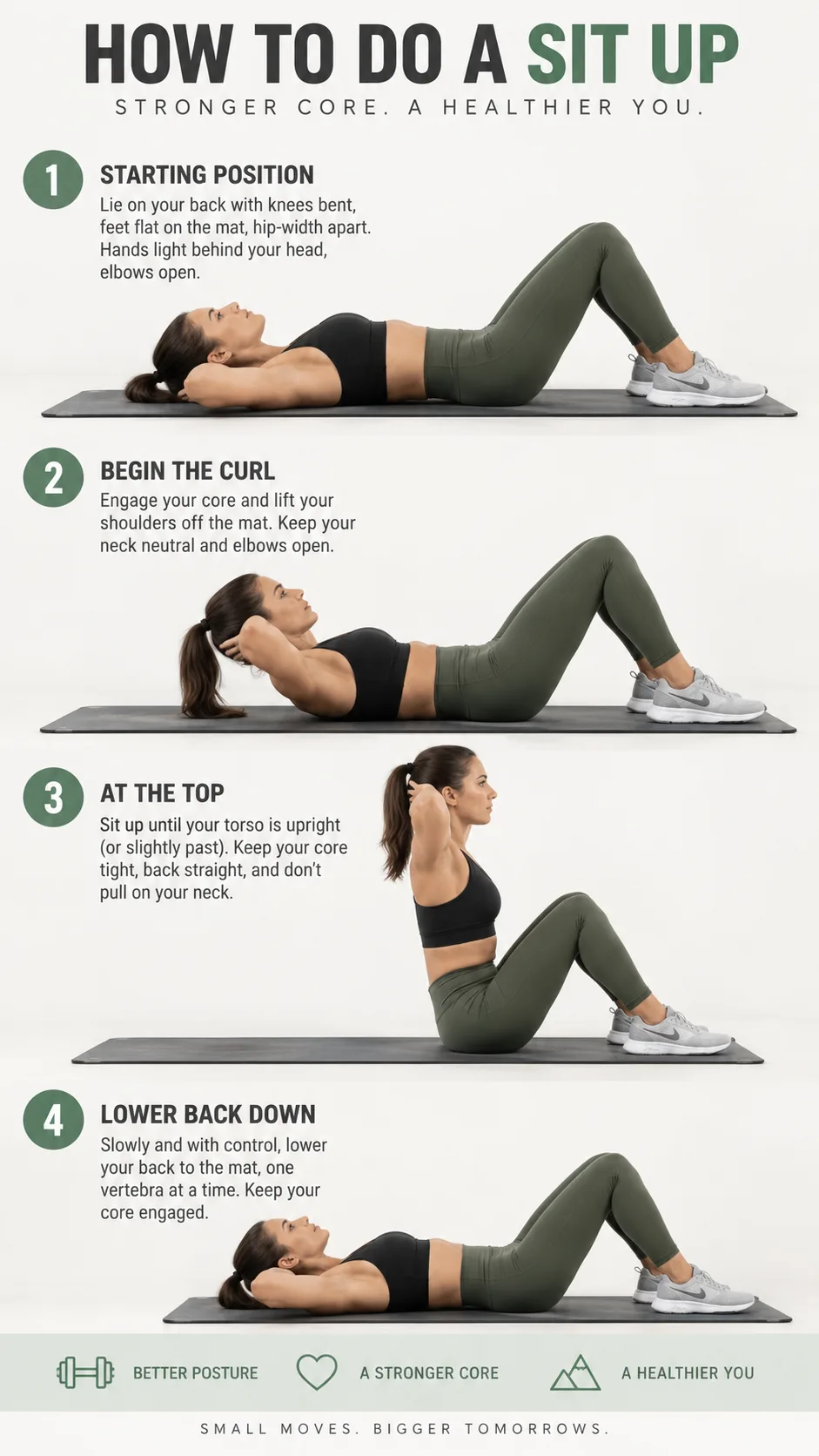
Walk through a proper sit up from the ground up, literally. Follow this sequence every single time you hit the mat.
- Lie flat on your back with your knees bent at roughly 90 degrees and feet flat on the floor
- Position your feet hip-width apart and do not cross your ankles or flare your knees out
- Place your fingertips lightly on the sides of your head with elbows pointing outward
- Engage your core before you move and brace your abs like you are about to take a punch
- Slowly curl your upper body up, leading with your chest, not your chin
- Pause briefly at the top when your torso is upright and feel the squeeze
- Lower yourself back down with control rather than flopping back to the floor
- Repeat. No rushing. No jerking. Just clean, controlled reps.
Why your lower back hurts during sit ups
Lower back pain during sit ups usually comes from one of three sources. Figure out which one is yours and fix it directly.
1. You are not engaging your core
If you go straight into the movement without bracing your abs first, your lower back compensates instantly. Always pre-activate your core before your body starts moving. Think of it as switching the engine on before you press the gas.
2. Your hip flexors are dominating the movement
When your hip flexors take over, they tug hard on your lumbar spine. This is incredibly common in people who sit at a desk all day. Stretching your hip flexors before your session and slowing down your reps can dramatically reduce this problem.
3. You are working on a hard surface
Doing sit ups on a hard floor without a proper mat causes your tailbone and lumbar spine to grind into the ground. Always use a quality exercise mat with enough cushioning to support your spine throughout the movement.
According to ACE Fitness, proper surface support and controlled tempo are two of the most overlooked factors in core exercise safety. They are not wrong.
Common sit up mistakes to avoid
Beyond the neck-yanking problem, here are the other form killers worth watching out for:
- Holding your breath, which increases intra-abdominal pressure and causes unnecessary strain
- Anchoring your feet under something heavy, which shifts the work to your hip flexors instead of your abs
- Going too fast, because momentum replaces muscle effort and you get far less core activation
- Flattening your lower back completely, since you want a slight natural curve, not a pancake-flat spine
- Doing too many reps too soon, because quality matters more than quantity
Most people get better results from 10 perfect sit ups than 50 sloppy ones. That is not an opinion. That is just how muscle activation works.
How to make sit ups easier on your back long-term
Good sit up form does not exist in isolation. Your back health depends on what you do the rest of the day too. A few smart habits go a long way.
Strengthen your posterior chain
Your glutes, hamstrings, and lower back muscles all support your spine during core work. Neglect them and your sit ups will always feel harder and riskier than they need to. Add exercises like glute bridges, deadlifts, and bird-dogs to your routine.
Stretch before and after
A quick five-minute warm-up with cat-cow stretches, knee-to-chest pulls, and hip flexor stretches makes a real difference. Cold, tight muscles strain far more easily than warm, supple ones. Do not skip the warm-up just because you are in a hurry.
Fuel your body properly
Your muscles need the right nutrition to recover and perform. If you are eating poorly, your body will struggle to support even basic exercise. Check out this guide on thermogenic Nigerian foods and metabolism-boosting options, because what you eat directly affects how your body handles exercise stress.
Watch: correct sit up form explained
Sometimes watching someone do it properly is worth more than any written description. Here is a solid tutorial that breaks down sit up form in a clear, beginner-friendly way:
Sit up variations for different fitness levels
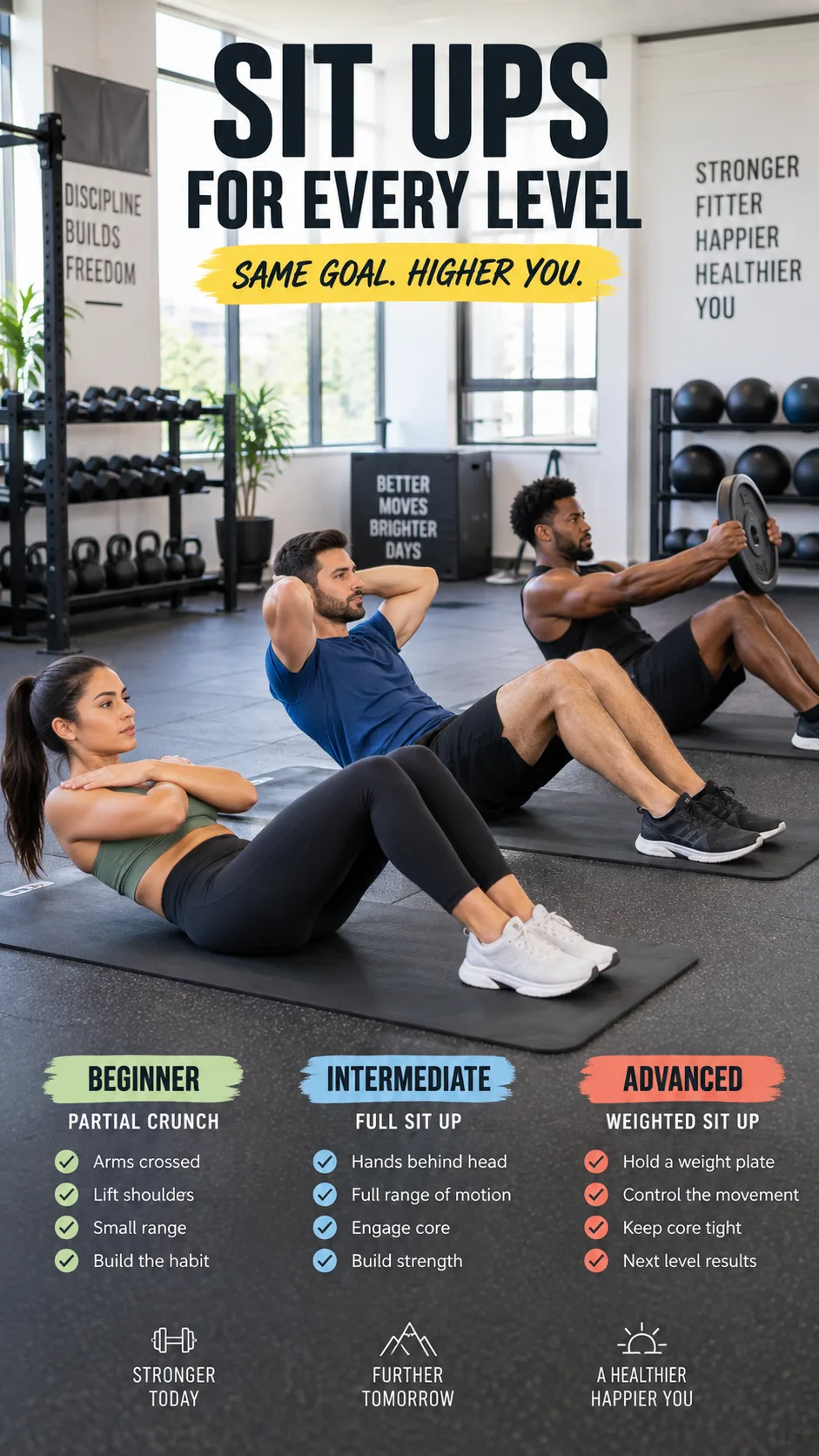
One size does not fit all with sit ups. Here are options depending on where you are starting from:
Beginner: modified sit up
Cross your arms over your chest instead of placing hands behind your head. Keep the range of motion short and just bring your shoulder blades off the floor. Build strength before moving to full sit ups.
Intermediate: standard sit up
Follow the full step-by-step guide above. Focus on slow, controlled movement with a full range of motion. Aim for 3 sets of 15 to 20 clean reps before progressing further.
Advanced: weighted sit up
Hold a weight plate against your chest as you perform the movement. This increases resistance and builds serious core strength. Only add weight when your form is genuinely solid, not before.
How sit ups fit into a bigger fitness picture
Sit ups build core strength, but they work best as part of a balanced approach to fitness. Pairing them with smart nutrition and complementary workouts produces real results instead of just sore abs.
If weight management is part of your goal, you might also want to explore a Nigerian OMAD diet approach that works alongside your exercise plan. Or if you are looking to build up rather than slim down, this guide on how to gain weight in Nigeria fast covers the nutrition side in detail.
According to Mayo Clinic, core exercises like sit ups should form part of a comprehensive fitness routine that includes cardiovascular training and full-body strength work. Your abs are not an island.
Final thoughts: fix the form, save your back
Sit ups are not the enemy. Lazy form is the enemy. The difference between a sit up that builds your core and one that wrecks your back is almost entirely technique.
Engage your core before you move. Stop yanking your neck. Slow down your reps. Use a proper mat. Warm up first. Five fixes that transform the exercise completely.
Your back deserves better than being a shock absorber for sloppy reps. Give it the proper technique it needs, and sit ups will become one of the most reliable tools in your fitness routine. Now get on that mat and do it right.