

You’ve been doing crunches for months. Your neck hurts, your floor has a permanent sweat stain, and your waist looks exactly the same. Sound familiar? The stomach vacuum exercise might be what you’ve been sleeping on.
This technique has been around since the bodybuilding golden era. Arnold Schwarzenegger used it to build that insane narrow waist you see in his competition photos. And yet, most gym-goers walk right past it in favor of another round of sit-ups. Big mistake.
Here’s what the stomach vacuum actually is, why it works better than crunches for a slimmer waist, and exactly how to do it right.

What exactly is the stomach vacuum?
The stomach vacuum is a core breathing exercise that targets your transverse abdominis, the deepest layer of your abdominal muscles. Think of it as a natural corset wrapped around your internal organs and spine.
Unlike crunches, which work the rectus abdominis (the “six-pack” muscles on top), the stomach vacuum targets what’s underneath. Training the transverse abdominis pulls your entire waist inward and gives you that flat, tight look, not just a bump of ab muscles sitting on a soft midsection.
Ever wondered why some people have huge abs but still look thick around the middle? Their deep core is untrained. The stomach vacuum fixes exactly that.
Why stomach vacuums beat crunches for waist size
Crunches build the outer ab muscles. That’s fine. But they do almost nothing for your waist circumference. The transverse abdominis compresses your midsection like a belt, and crunches basically ignore it.
A study published in the Journal of Physical Therapy Science found that drawing-in maneuvers like the stomach vacuum significantly increased transverse abdominis thickness compared to other abdominal exercises. Translation: this exercise genuinely reshapes your waist, not just your abs.
Here’s what you get with consistent stomach vacuum practice:
- A visibly smaller waist over time
- Better posture and spinal support
- Reduced lower back pain
- Improved core stability for all your other lifts
- A stronger pelvic floor (yes, really)
If you’re only doing crunches for your core, you’re leaving serious results on the table.
How to do the stomach vacuum the right way
The technique looks simple, and it is, but most people get it wrong by either sucking in too aggressively or forgetting to breathe properly. Here it is, step by step.
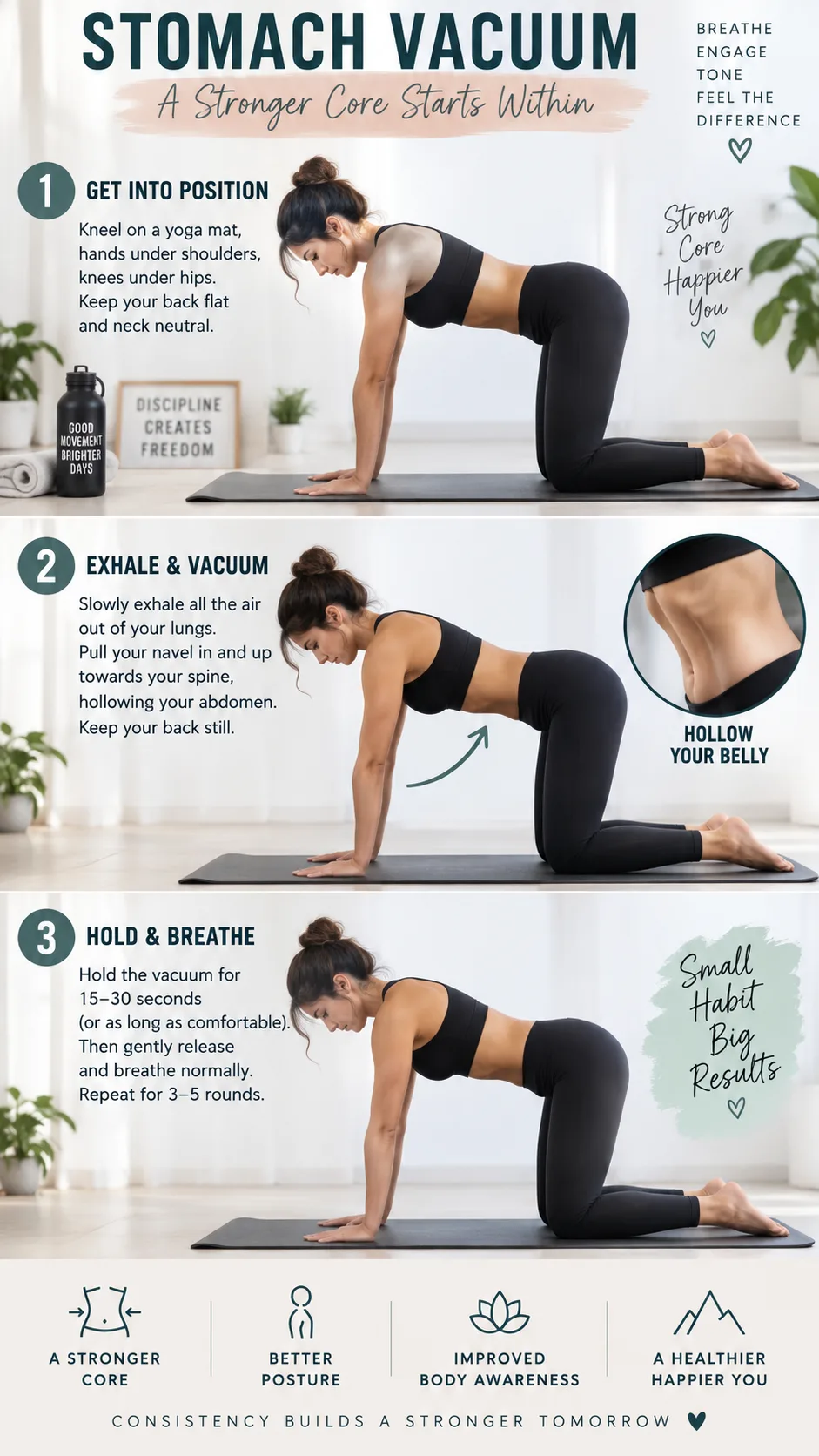
The basic stomach vacuum (standing or kneeling)
- Start in a comfortable position. Standing, on all fours, seated, or lying flat. Beginners do best on all fours or lying down.
- Exhale completely. Push all the air out of your lungs. Every last bit.
- Pull your belly button in toward your spine as hard as you can, without holding your breath aggressively or sucking in through your mouth.
- Hold that contraction for 15 to 60 seconds. Breathe shallowly through your chest if needed.
- Release slowly and take a few normal breaths before repeating.
Beginner vs. advanced variations
Start where you are. No shame in that.
- Beginner: Lying flat on your back, knees bent. This is the easiest position to feel the contraction.
- Intermediate: Seated on a chair or standing. Harder to maintain the contraction here.
- Advanced: On all fours (the classic vacuum position), or integrated into compound lifts.
Once you can hold a standing vacuum for 60 seconds, you’ve officially leveled up.
How long and how often should you do it?
You don’t need a lot of time. Consistency is what actually matters here.
- Duration per hold: 15 to 60 seconds
- Sets per session: 3 to 5 sets
- Frequency: 3 to 5 times per week
- Best time: First thing in the morning on an empty stomach. It’s easier and the contractions feel deeper.
Most people start seeing a noticeable difference in their waist within 3 to 4 weeks of consistent practice. Give it time. Your transverse abdominis needs training just like any other muscle.
Common mistakes that kill your results
The stomach vacuum is simple, but it’s easy to fumble. Here are the mistakes that hold most people back:
- Holding your breath completely — you should breathe shallowly, not stop breathing altogether
- Using your chest muscles to suck in instead of pulling from the abdomen
- Not exhaling fully before contracting — this is the foundation of the whole move
- Expecting overnight results — deep muscle changes take weeks, not days
- Doing it on a full stomach — wait at least 2 hours after eating
The most common one I see? People suck in their stomachs dramatically and tighten everything: their obliques, their chest, their face. That’s not a vacuum, that’s just tension. The contraction should feel like you’re pulling your belly button away from your waistband and inward toward your spine.
Breathing technique: the secret ingredient
The breathing is EVERYTHING here. The stomach vacuum is essentially a breathing drill that happens to reshape your core.
According to Healthline’s guide on stomach vacuums, the exhale-first approach activates the transverse abdominis more effectively than any other starting position. Empty your lungs, then draw in. That’s the sequence. Full stop.
Practice the exhale alone for a few reps before adding the contraction. It sounds silly, but it trains your body to connect breathing with core engagement, and that makes everything click much faster.

Combining stomach vacuums with other habits for faster results
The vacuum is powerful on its own, but pair it with a few smart lifestyle choices and you’ll see results even faster.
Nutrition and hydration
A smaller waist has a lot to do with reducing bloating and water retention, not just muscle size. Eating whole, unprocessed foods makes a massive difference. Check out some of these fat-burning drinks that can support your goals alongside your training.
Reducing processed sodium, eating more fiber, and staying well-hydrated all help your midsection look flatter, even before the muscle training kicks in.
Add core breathing to your workout warm-up
Do 3 sets of stomach vacuums before your workout. This wakes up the deep core and improves your stability for everything else: squats, deadlifts, overhead press, all of it. Your body will thank you.
Pair it with a smart diet
If you’re eating well but want some extra ideas for light, nutritious meals, the Nigerian Salad recipe is a genuinely solid option, fresh, filling, and low on empty calories.
Watch the stomach vacuum in action
Seeing the technique live makes everything click much faster. Here’s a solid tutorial that shows the correct form across multiple positions:
Is the stomach vacuum safe for everyone?
For most healthy adults, yes. It’s extremely safe, low-impact, joint-friendly, and puts no strain on the spine. That’s partly why it gets so little attention.
You should skip it or talk to a doctor first if you:
- Are pregnant
- Have a hernia (inguinal or umbilical)
- Recently had abdominal surgery
- Have high blood pressure that isn’t well-controlled
According to WebMD’s overview on stomach vacuums, physical therapists widely recommend this exercise for core rehabilitation, so its credibility is well established. If you’re exploring core exercises for weight management and want to understand more about overall body wellness, the hygiene tips guide for plus-size women covers a range of body-positive, health-focused insights worth reading.
Frequently asked questions about the stomach vacuum
Can the stomach vacuum help with back pain?
Yes. Strengthening the transverse abdominis directly supports your lumbar spine. Many people report significant back pain relief after a few weeks of consistent stomach vacuum practice. It’s one of the primary exercises used in lower back rehabilitation.
Can you do stomach vacuums every day?
You can, but 3 to 5 times per week gives the muscle time to adapt and recover. Daily practice is fine if you keep the intensity moderate and don’t overdo the hold duration.
How long until I see results?
Most people notice a difference in waist tightness within 2 to 4 weeks. Visible changes in waist size tend to show up around the 4 to 6 week mark with consistent effort. Diet plays a huge role here too.
The bottom line
The stomach vacuum is one of the most effective and most ignored tools for a flatter waist. While everyone else grinds through crunches, you could be training the deep core muscle that pulls everything inward.
Start with 3 sets of 20-second holds, three times a week. Build up slowly. Stay consistent. The results follow, and usually faster than you’d expect.
Your waistline is one of the first things people notice. The good part? You can do this exercise anywhere: on your bedroom floor, before your morning coffee, or during a work break. No gym required, no equipment needed.
So are you going to do another 50 crunches, or are you going to try the thing that actually works? The choice seems pretty obvious from here.