

If your lat pulldowns feel more like a bicep curl with extra steps, we need to talk. So many people grind through sets for months without building any real back width, and the reason almost always comes down to form. Let’s fix that right now.

Why lat pulldown form actually matters
The lat pulldown is one of the best exercises for building a wide, strong back. Done right, it hammers your latissimus dorsi, those big wing-shaped muscles that give your back its V-taper. Done wrong, it turns into a shoulder and arm workout with zero back activation.
Your lats are a massive muscle group. They need proper loading and a full range of motion to grow. If you’re not feeling it in your back, you’re almost certainly making one of the mistakes below. Sound familiar? Keep reading.
Mistake #1: Gripping the bar way too wide
This is one of the most common lat pulldown mistakes you’ll see in any gym. People assume a wider grip means more lat activation. It does the opposite. An excessively wide grip cuts your range of motion and dumps unnecessary stress onto your shoulder joints.
Research published by the National Institutes of Health on grip width and muscle activation found that a moderate grip width optimizes lat engagement during pulling movements. Your shoulders will also thank you over time.
The fix
- Grip the bar just slightly wider than shoulder-width
- Keep your wrists straight, no bending or curling
- Think about pulling your elbows DOWN and BACK, not just pulling the bar
Mistake #2: Leaning back way too far
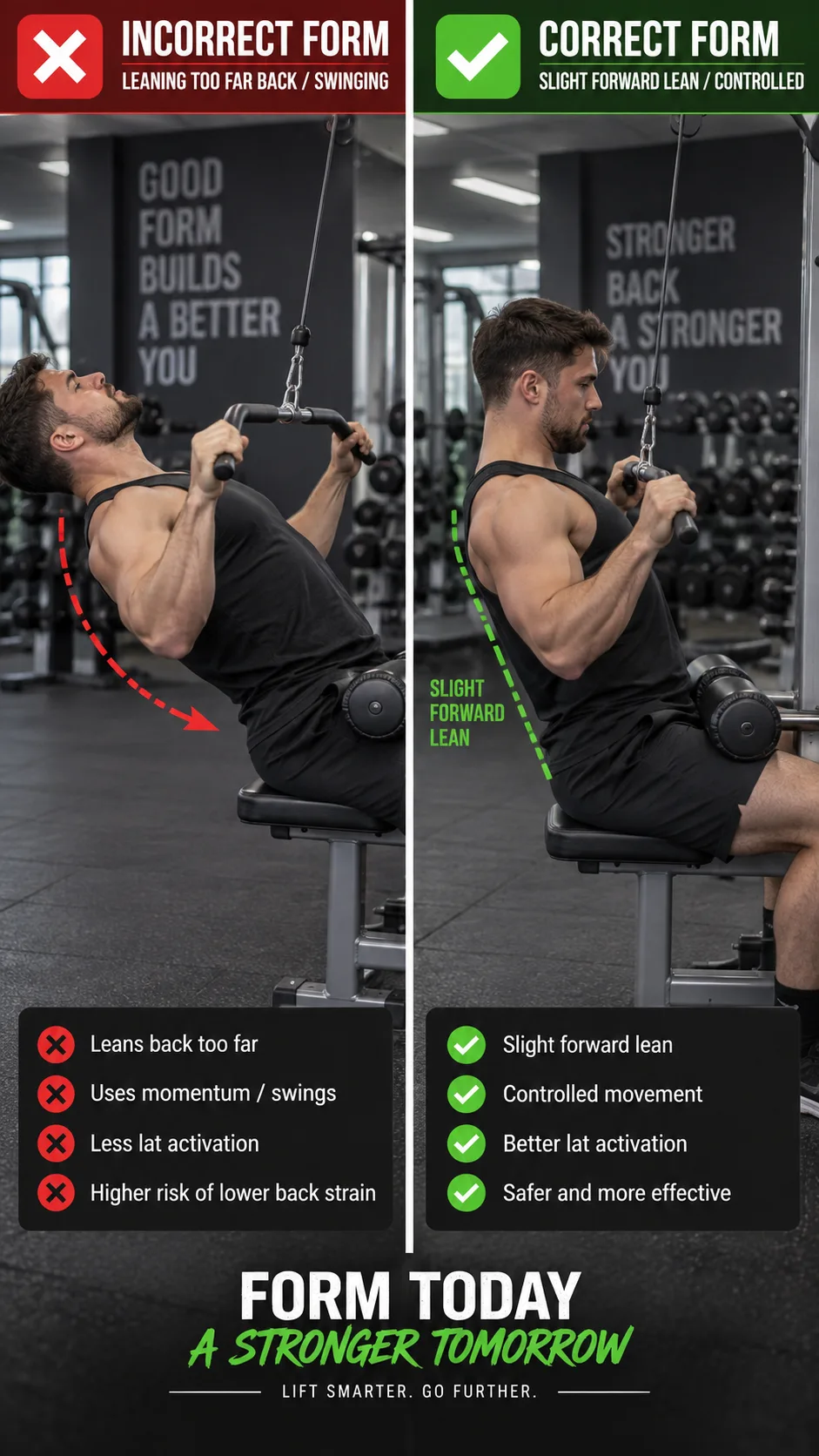
A slight lean back? Totally fine. Practically lying horizontal on the seat? That’s a rowing motion, not a lat pulldown. Leaning back excessively shifts the work from your lats to your rear deltoids and upper traps, muscles that don’t need more attention at the expense of your back width.
You’ve probably seen someone pull the bar down like they’re trying to escape a burning building, body swinging wildly. Impressive momentum management, but zero muscle building. Keep your torso angle between 70 to 80 degrees upright.
The fix
- Sit tall with a slight chest-forward lean, think proud posture
- Lock your feet under the pads and plant them firmly
- Pull the bar to your upper chest, not your lap
Mistake #3: Not depressing your shoulder blades first
This is the one that separates beginners from people who actually know what they’re doing. Before you start pulling, you need to set your shoulder blades by pulling them down and back. This pre-activates your lats and stops your arms and traps from hijacking the movement.
Think of it this way: your shoulder blades are the foundation of the whole movement. Skip this step and you’re building on sand. Every rep should START with that scapular depression before your arms contribute anything.
The fix
- Hang from the bar with arms fully extended
- Depress your shoulder blades, think “shoulders away from ears”
- Then begin pulling your elbows down and in
- Squeeze hard at the bottom before slowly returning
Mistake #4: Using way too much weight
Ego lifting is the official sport of gyms worldwide. You load up the stack, yank the bar down with everything you’ve got, arms, back, hips, probably your soul, and then call it a set. Excessive weight forces your body to compensate with momentum and secondary muscles, completely bypassing your lats.
The lat pulldown is not a max-effort, one-rep-max exercise. It thrives in the 8 to 15 rep range with controlled, deliberate movement. Drop the ego, drop the weight, and watch your back actually start growing.
How to find your right weight
- You should feel genuine lat tension throughout every rep
- Your torso should stay relatively still, no swinging
- The last two or three reps should be hard, but your form should stay clean
- If you can’t control the bar on the way back up, it’s too heavy

Mistake #5: Rushing the eccentric phase
The eccentric phase, when the bar travels back up, is where a huge chunk of muscle-building stimulus happens. Most people let the stack crash back up and immediately start their next rep. That’s leaving serious gains on the table.
According to ACE Fitness, eccentric loading creates greater muscle damage and mechanical tension, both primary drivers of hypertrophy. Slow down the return phase and you’ll feel the difference on your very next set.
The fix
- Take 2 to 3 seconds to return the bar to the starting position
- Let your lats fully stretch at the top, don’t cut the range short
- Control the weight; don’t let the weight control you
Mistake #6: Pulling the bar behind your neck
Please, just stop doing this. Behind-the-neck lat pulldowns put your cervical spine in a vulnerable position and force your shoulders into an uncomfortable internal rotation. The risk-to-reward ratio here is awful, and the front-of-neck version activates your lats just as effectively, if not more.
The Spine-Health resource centre consistently points to keeping the cervical spine neutral during resistance training. Behind-the-neck pulling directly contradicts that. Pull to your upper chest instead. Same gains, zero neck injury risk.
Mistake #7: Not engaging the mind-muscle connection
Your brain needs to talk to your lats during every rep. If you’re mindlessly going through the motion, your stronger muscles, biceps, upper traps, and forearms, will dominate the movement. Consciously focusing on your lats firing makes a measurable difference in activation.
A study covered by Men’s Health found that simply thinking about the target muscle during training can increase its activation by up to 22%. That’s a meaningful edge for something that costs you nothing.
How to build that connection
- Before each set, tap or squeeze your lats to wake them up
- Imagine driving your elbows into your back pockets as you pull
- Slow down, breathe out on the pull, and focus on the squeeze at the bottom

Putting it all together: your lat pulldown checklist
Before every set, run through this quick mental checklist. It takes about five seconds and saves you months of wasted effort.
- Grip: Slightly wider than shoulder-width, wrists straight
- Posture: Slight forward lean, chest up, proud posture
- Setup: Depress and retract shoulder blades BEFORE pulling
- Pull: Drive elbows DOWN and BACK toward your hips
- Squeeze: Hard contraction at the bottom for one second
- Eccentric: 2 to 3 seconds back up, full stretch at the top
- Weight: Use a load you can control through the full range
Nail this checklist consistently for eight weeks and you will notice the difference in your back width and thickness. That’s not hype. That’s just smart training.
How lat pulldown mistakes connect to other lifts
Form mistakes don’t live in isolation. If you’re serious about fixing your training mechanics, it’s worth auditing everything you do. Check out our guide on how to squat properly and avoid the 5 form mistakes that wreck your knees. A lot of the same principles around joint positioning and muscle activation carry straight over.
Building a strong back and strong legs through technically sound movement patterns is how you stay injury-free and keep making progress year after year. Fix the whole system, not just one piece of it.
Final thoughts: your back deserves better
The lat pulldown is a genuinely great exercise when you do it right. It builds width, improves posture, strengthens the scapular stabilizers, and makes your whole upper body look more athletic. But only if you stop making these mistakes.
Fix your grip. Control the weight. Engage your scapula. Own the eccentric. These aren’t complicated changes. They’re just the ones most people skip because nobody explained why it matters. Now you know.
Go back to the gym this week, drop the weight by 20%, and apply everything you just read. Your lats will feel it in ways they never have before. And that’s when training gets genuinely fun again.