

Your feet move two inches on the hack squat platform and suddenly your quads are screaming instead of your glutes. Sound familiar? Foot placement on the hack squat machine is one of the most underrated variables in lower body training, and most people completely ignore it.
Most gym-goers hop on, slam their feet somewhere in the middle, and just start repping. That works, kind of. But you leave serious gains on the table if you never experiment with where your feet actually sit on that platform.
Here is exactly how small foot placement changes shift the workload between your quads, glutes, hamstrings, and even your knees, and how to use that knowledge to train smarter.
Why foot placement on the hack squat machine actually matters
The hack squat machine locks your torso into a fixed path. Unlike a barbell back squat where your whole body moves freely, the machine controls the angle of movement. That means your foot position becomes the primary tool for targeting different muscles.
Think of it like adjusting a camera angle. Same subject, completely different picture. Move your feet up, down, wide, or narrow, and you change the joint angles, the range of motion, and which muscle group takes the brunt of the load.
Ever wondered why some people get massive quad development from hack squats while others swear it is a glute killer? Foot placement. Every time.
The main foot placement variables you can control
There are really three things you can play with on the platform:
- Height on the platform, meaning how high or low your feet sit
- Width of your stance, whether feet are together, hip-width, or wide
- Foot angle (toe flare), with toes pointing straight ahead, slightly out, or significantly turned out
Each variable does something different. Combining them is where things get really interesting. We will go through each one.
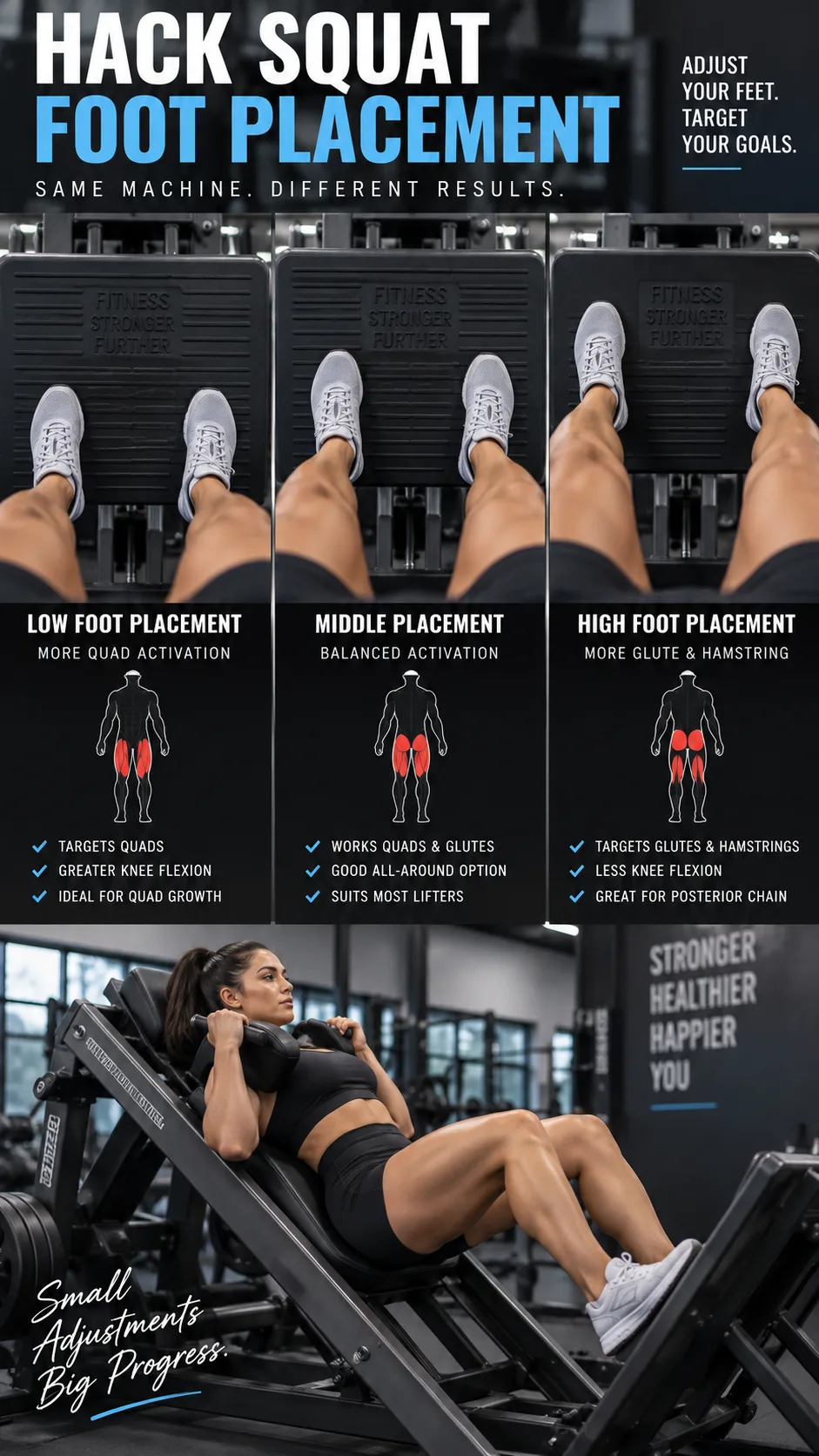
High vs. low foot placement: quads vs. glutes and hamstrings
Low foot placement = quad dominance
Place your feet low on the platform, near the bottom edge, and you force your knees to travel far forward over your toes during the squat. This dramatically increases knee flexion and places the quads under intense stretch and tension.
If you want that teardrop quad sweep, this is your placement. It is also the most popular variation for a reason: the quad pump is absolutely vicious.
- Maximum knee flexion means maximum quad recruitment
- Less hip hinge means less glute and hamstring involvement
- Great for quad hypertrophy and VMO (inner quad) development
One heads-up though: low foot placement puts more stress on the knee joint. If you have any knee issues, ease into this gradually and check out this guide on how to squat properly before loading up heavy.
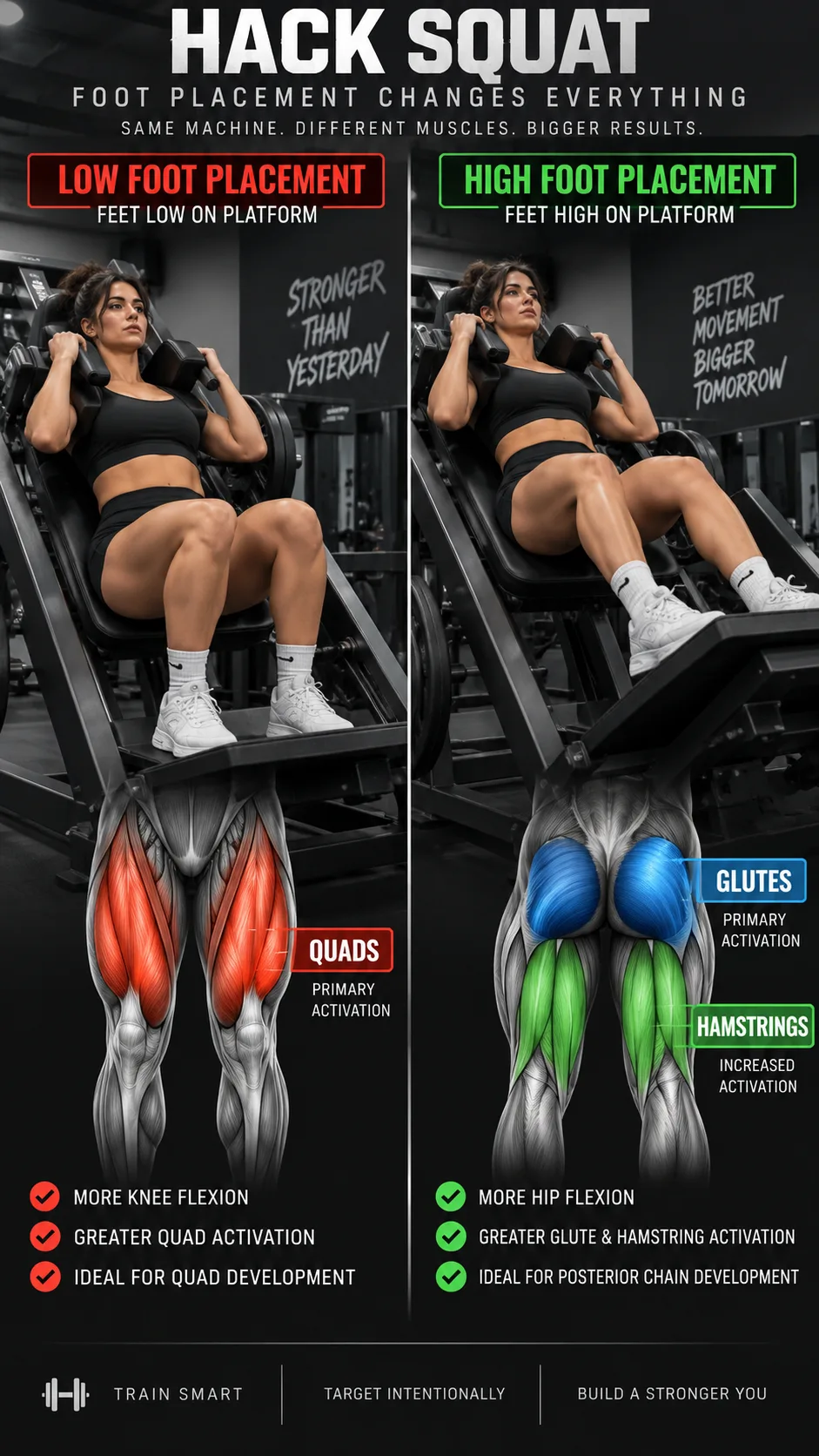
High foot placement = glutes and hamstrings take over
Slide your feet high on the platform and the mechanics flip completely. Your hips hinge more, your torso angle shifts, and your glutes and hamstrings suddenly become the prime movers. The quads still work, but they take a back seat.
This variation mimics more of a leg press feel and reduces knee stress significantly. It works well for people rehabbing knee issues or anyone who wants to bias posterior chain development.
- Greater hip flexion means more glute and hamstring activation
- Reduced knee travel means less patellar stress
- Useful for athletes who need posterior chain strength
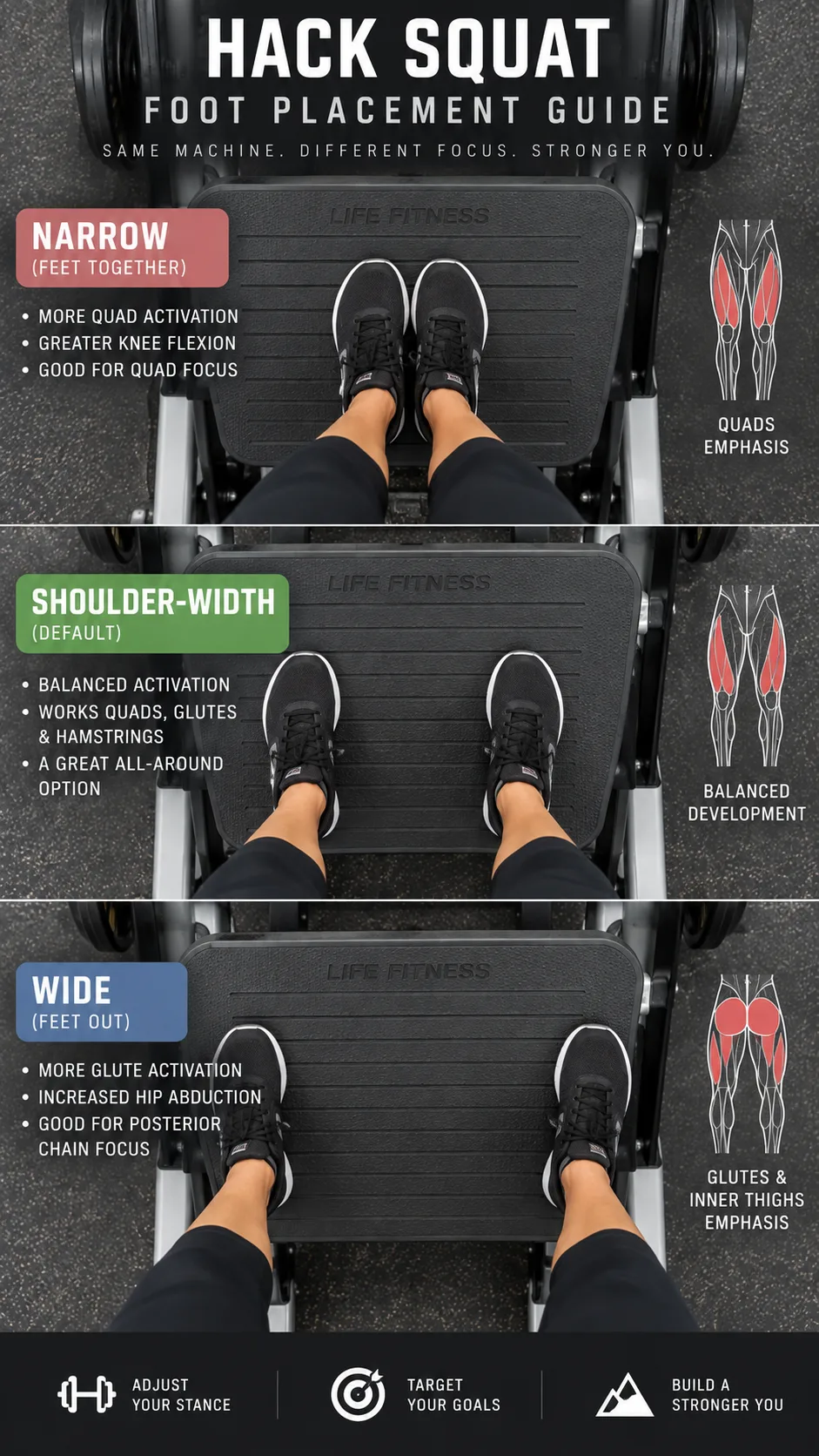
Stance width: how wide should your feet be?
Narrow stance
Feet close together, around hip-width or narrower, keeps the movement focused on the rectus femoris and outer quad. It is a clean, targeted quad builder, but it demands solid ankle mobility and knee stability. If your knees start caving inward, widen up.
Shoulder-width stance
This is your everyday, balanced option. A shoulder-width stance distributes load fairly across the quads, glutes, and inner thighs. Most people spend the majority of their hack squat time here. It is forgiving, effective, and works for almost every goal.
Wide stance
Feet significantly wider than shoulder-width? Now you are recruiting the adductors (inner thighs) and glutes far more aggressively. Combined with toes flared out, a wide stance can make the hack squat feel like a completely different exercise. Think sumo squat, but on a machine.
Toe angle: the detail nobody talks about enough
Most people either point their toes straight ahead or naturally flare them out slightly. But the angle of your toes significantly changes which muscles fire and how comfortable the movement feels for your hips and knees.
- Toes straight ahead: maximum outer quad focus, but feels awkward for wider hips
- Toes 15 to 30 degrees out: the sweet spot for most people, giving natural hip alignment and solid quad and glute balance
- Toes 45 degrees or more out (wide stance): maximum inner thigh and glute recruitment, especially when combined with a wide stance
A quick tip: let your knee track over your second toe, whatever angle that requires. Forcing your toes straight ahead when your hips naturally rotate outward is a reliable path to knee discomfort. Your anatomy matters here.
How to choose your foot placement based on your goal
Here is the practical breakdown:
- Quad size and definition: Low foot placement, shoulder-width stance, toes slightly out
- Glute development: High foot placement, shoulder to wide stance, toes 30 degrees out
- Inner thigh (adductor) work: High or mid platform, wide stance, significant toe flare
- Knee-friendly option: High placement, moderate width, natural toe angle
- Overall leg development: Rotate between placements across your weekly sessions
Mixing placements across workouts is a smart strategy for complete leg development. No single foot position hits everything perfectly, which is exactly why the machine exists with a full platform rather than one marked spot.
Common foot placement mistakes to avoid
Here are the errors that quietly stall progress:
- Heels lifting off the platform: This signals ankle mobility issues and shifts stress dangerously onto your knees. Keep those heels planted.
- Knees caving inward: Usually caused by a stance that is too narrow or too much weight. Widen up and drop the load.
- Ignoring your core: Your core works hard to stabilize even on a machine. Brace your abs through every rep rather than going limp.
- Using the exact same placement every single session: This is how you build imbalances and stall progress at the same time. Rotate your placements with intention.
For reference, the ACE Fitness Exercise Library confirms that stance variations meaningfully alter muscle recruitment patterns in compound leg movements. This is not gym lore. It is anatomy.
Programming hack squat foot placement into your training
The smartest way to use this knowledge is to assign a specific foot placement intention to each session or training phase. Here is one simple approach:
- Day 1 (quad focus): Low platform, shoulder-width, slight toe flare, 4 sets of 8 to 12 reps
- Day 2 (glute and posterior chain focus): High platform, wider stance, 30-degree toe flare, 3 sets of 10 to 15 reps
- Day 3 (full leg balance): Mid platform, shoulder-width, moderate rep range with controlled tempo
If you are working with a full body workout plan, you can still apply this. Just rotate your hack squat variation each time you hit legs rather than relying on a dedicated leg day split.
Research from the National Library of Medicine on EMG and squat variations consistently shows that stance width and foot position significantly alter EMG activity across the quadriceps, adductors, and glutes. The science backs up what experienced lifters already know from trial and error.
Also worth noting: your core stability training directly supports your hack squat performance. A strong, braced core means better force transfer and more weight moved safely.
A quick word on machine differences
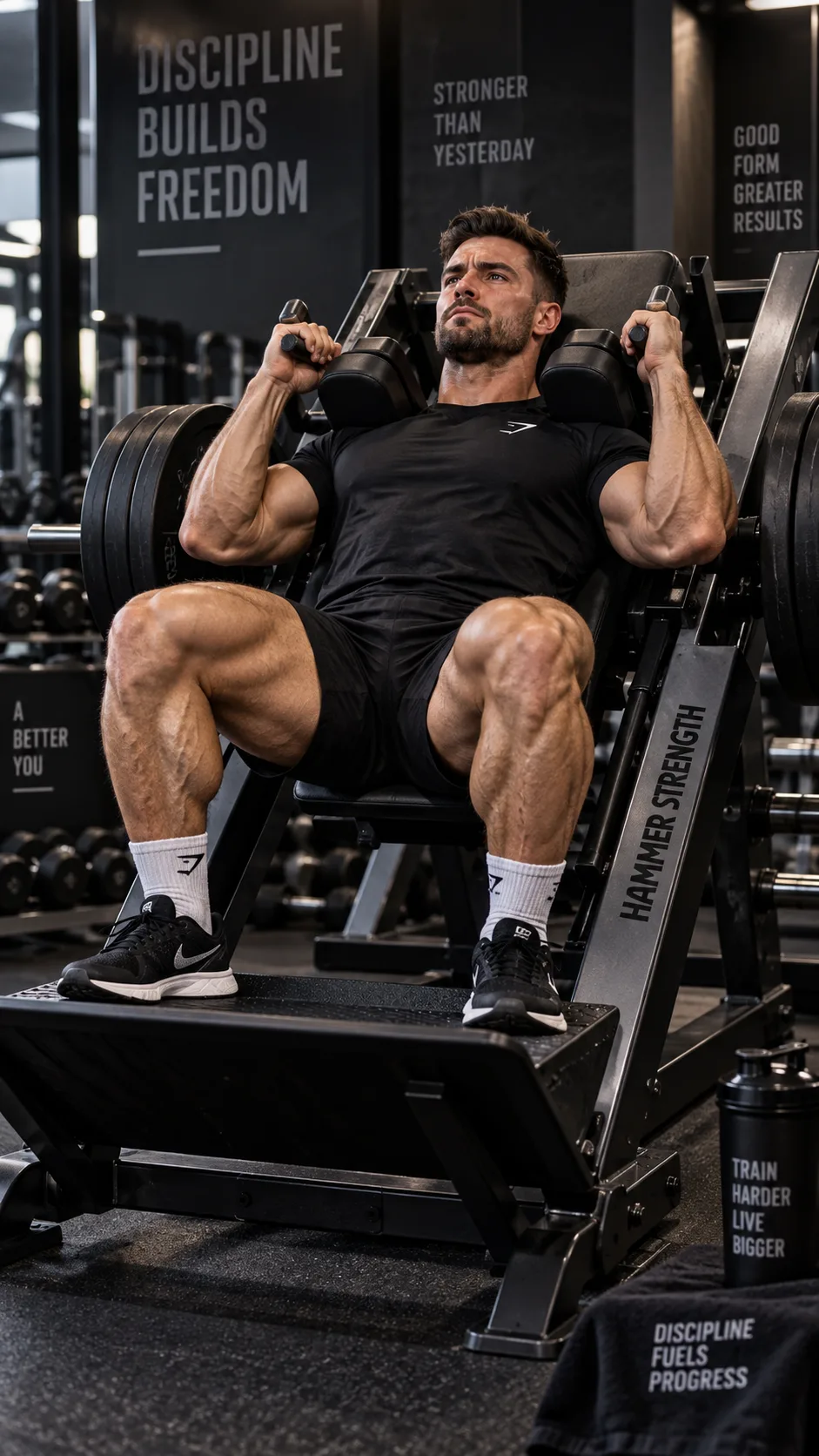
Not all hack squat machines are built the same. Some have steeper back angles, some have longer platforms, and some place your body at a more vertical position. The principles stay the same, but you may need to adjust your exact foot position based on the specific machine you are using.
Always do a few bodyweight reps first to get a feel for where things hit. According to Muscle and Strength’s exercise database, proper setup and foot position calibration before loading is consistently recommended by strength coaches for maximising both safety and muscle recruitment.
The bottom line
Two inches in any direction on the hack squat platform changes everything. Higher up targets your glutes and hamstrings. Lower down absolutely torches your quads. Wider hits your inner thighs. Toes out opens up your hips and lets your glutes contribute more.
Stop treating foot placement as an afterthought. Treat it as a training variable, because that is exactly what it is. Experiment, take notes, notice what you feel, and adjust accordingly.
The hack squat machine is not just a safer squat alternative. It is a precision instrument when you know how to use it. Now you do. Go experiment. Your legs will thank you, once the DOMS settles down.