

You skipped breakfast, drank three cups of black coffee, ate one khakhra for lunch, and the scale still hasn’t moved. Sound familiar? PCOD doesn’t reward starvation. It punishes it.
I’ve watched dozens of women white-knuckle their way through 1,000-calorie “detox” plans, only to end up with worse periods, thinning hair, and a permanent bad mood. Your hormones read hunger as an emergency. And emergencies don’t come with regular ovulation.
So let’s build something different. A real PCOD Indian diet plan that uses roti, dal, curd, ghee, and yes, even rice, to calm your insulin, lower your androgens, and get your cycle back on speaking terms with you.
First, let’s clear up what PCOD does to your body
PCOD (polycystic ovarian disease) and PCOS get used interchangeably in India, so I’ll use PCOD here since that’s what your gynaec probably wrote on your prescription. Either way, the engine of the problem is usually the same: insulin resistance.
Here’s the short version. Your cells stop listening to insulin properly. Your pancreas shouts louder by pumping out more. High insulin then tells your ovaries to make extra testosterone, and that’s where the acne, chin hair, hair fall, and missing periods come from.
Research backs this up strongly. According to the National Institute of Diabetes and Digestive and Kidney Diseases, insulin resistance affects a large majority of women with PCOS, regardless of body size. Lean women get PCOD too. FYI, “just lose weight” is lazy advice.
Why crash dieting makes PCOD worse
Ever wondered why the 800-calorie plan worked for your cousin but wrecked you? Severe restriction spikes cortisol. Cortisol raises blood sugar. Higher blood sugar means more insulin. You created the exact problem you were trying to fix.
- Chronic under-eating suppresses the hormone signals that trigger ovulation
- Low protein intake accelerates muscle loss, which worsens insulin sensitivity
- Zero fat diets starve your body of the cholesterol backbone it needs to build hormones
- Extreme restriction triggers binge cycles, and the guilt spiral wrecks consistency
My honest opinion after years of reading the research and talking to women managing this: consistency beats intensity every single time with PCOD. A boring plan you follow for eight months outperforms a brutal one you abandon in twelve days.
The 5 rules that make any Indian meal PCOD-friendly
Forget memorising food lists for a second. Learn these five rules and you can walk into any Indian kitchen, wedding buffet, or office canteen and build a decent plate.
- Protein first, always. Aim for 20 to 30g of protein per meal. Paneer, eggs, curd, chicken, fish, dal paired with rice, soya chunks, sprouts, tofu.
- Never eat naked carbs. A plain banana spikes you. A banana with peanut butter doesn’t. Always wrap your carbs in protein, fat, or fibre.
- Fibre before starch. Eat your salad or sabzi FIRST, then the roti or rice. This simple order lowers your post-meal glucose spike measurably.
- Eat fat without fear. Ghee, coconut, mustard oil, nuts, seeds. Fat slows digestion and keeps insulin calm.
- Stop eating three hours before bed. Late-night dinners destroy sleep quality, and poor sleep destroys insulin sensitivity. Brutal loop.

The carb question everyone argues about
No, you don’t have to quit rice. I’ll die on this hill. What you must quit is rice as 70% of your plate with a teaspoon of dal on the side.
Swap refined carbs for their slower cousins where you can, and control portions where you can’t:
- Instead of maida roti → bajra, jowar, ragi, or multigrain roti
- Instead of white rice mountain → 1 katori of hand-pounded, brown, or even cooled-and-reheated white rice (cooling builds resistant starch)
- Instead of poha alone → poha with peanuts, sprouts, and a side of curd
- Instead of upma alone → upma loaded with vegetables plus two boiled eggs
- Instead of sooji halwa → dates-and-nut ladoo, one piece, after a protein meal
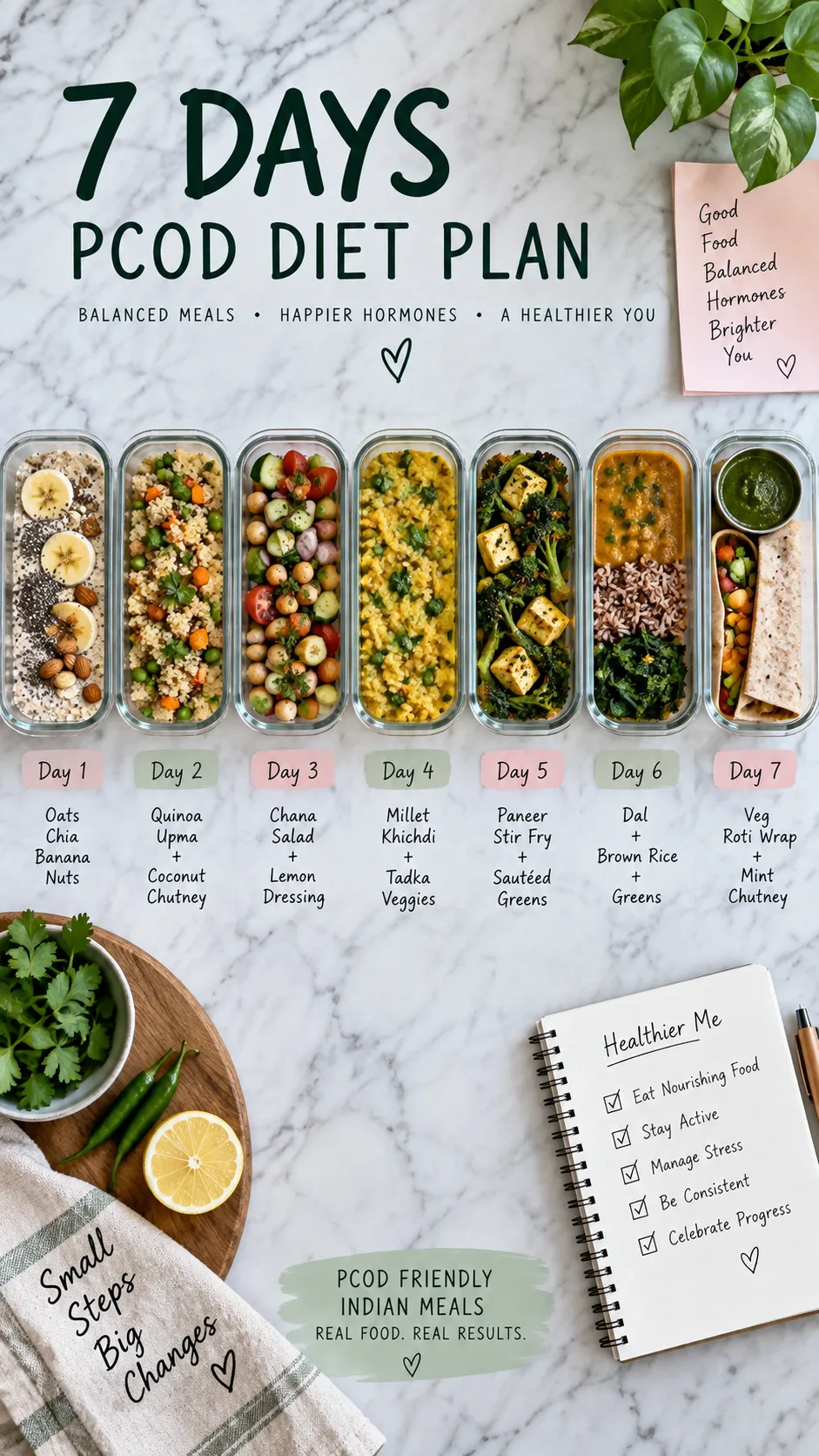
The 7-day PCOD Indian diet plan (real food, real portions)
This plan lands roughly between 1,500 and 1,700 calories for most moderately active women, with 90 to 110g of protein. Adjust portions to your body, activity, and appetite. This is a template, not scripture. If calorie targets help you, this simple 1500 calorie meal plan breaks down the mechanics of staying full on fewer calories.
Day 1
- Morning (empty stomach): Soaked methi seeds (1/2 tsp) + warm water
- Breakfast: 2 besan chillas with grated paneer stuffing + mint chutney
- Mid-morning: 10 soaked almonds + 2 walnuts
- Lunch: 2 jowar rotis + palak paneer + cucumber-tomato salad + 1 katori curd
- Evening: Green tea + roasted chana (30g)
- Dinner: Grilled fish or tofu tikka + sautéed beans and carrots + 1 small bowl dal
Day 2
- Breakfast: Vegetable oats upma + 2 boiled eggs (or 1 cup soya milk)
- Mid-morning: 1 small guava
- Lunch: 1 katori brown rice + rajma + beetroot salad + curd
- Evening: Buttermilk with roasted jeera
- Dinner: 2 bajra rotis + chicken curry (less oil) or chana masala + lauki sabzi
Day 3
- Breakfast: Moong dal cheela + 1 tbsp peanut chutney + sprouts salad
- Mid-morning: Handful of pumpkin seeds
- Lunch: 2 multigrain rotis + bhindi sabzi + dal tadka + kachumber
- Evening: Black coffee (if you tolerate it) + 2 dates
- Dinner: Paneer bhurji + mixed vegetable soup + 1 small millet roti
Day 4
- Breakfast: Greek yogurt or hung curd bowl + chia + flaxseed + berries or papaya
- Mid-morning: Roasted makhana (1 cup)
- Lunch: Khichdi (moong dal heavy) + ghee + curd + tomato-onion salad
- Evening: Green tea + 5 almonds
- Dinner: Egg curry + stir-fried cabbage + 1 jowar roti
Day 5
- Breakfast: Idli (2) + sambar loaded with vegetables + coconut chutney
- Mid-morning: 1 orange or mosambi
- Lunch: 2 rotis + soya chunk curry + cauliflower sabzi + curd
- Evening: Sprout chaat with lemon and onion
- Dinner: Grilled chicken salad or paneer salad with olive oil dressing
Day 6
- Breakfast: Peanut butter on 2 slices multigrain sourdough + 1 boiled egg
- Mid-morning: Coconut water
- Lunch: 1 katori rice + sambhar + avial + curd
- Evening: Masala chai (no sugar) + roasted peanuts
- Dinner: Methi thepla (2) + dal + salad
Day 7 (the flexible day)
- Breakfast: Masala omelette (3 eggs, 2 yolks) + 1 paratha with ghee
- Lunch: Whatever your family eats, but protein first, salad first, one serving of carbs
- Evening: One planned treat. Gulab jamun. Ice cream. Enjoy it without narrating your guilt to everyone.
- Dinner: Keep it light: vegetable soup + paneer or grilled chicken
Notice what’s missing? Suffering. Nobody sustains a plan that feels like punishment, and PCOD management runs on years, not weeks.
Foods that genuinely move the needle for PCOD
The heavy hitters
- Cinnamon (dalchini): Studies suggest it improves menstrual regularity and insulin sensitivity. Half a teaspoon daily in curd or tea.
- Flaxseed: Lignans help bind excess androgens. 1 tbsp ground, daily. Ground, because whole seeds sail right through you.
- Fenugreek (methi): Soluble fibre that slows glucose absorption. Soak overnight, drink the water.
- Curd and fermented foods: Gut health influences oestrogen clearance more than most people realise.
- Fatty fish (rohu, mackerel, sardines): Omega-3s lower inflammation and testosterone in several trials.
- Leafy greens: Magnesium-rich, and magnesium deficiency runs rampant in insulin-resistant women.
- Vitamin C-rich foods: Amla, guava, citrus. They fight the oxidative stress that comes with PCOD. This list of foods rich in vitamin C gives you plenty of cheap options.
What to limit (not ban)
I hate blanket bans. They create obsession. But these deserve genuine caution:
- Sugary drinks: cold drinks, packaged juices, sweetened lassi. Liquid sugar hits your bloodstream like a truck.
- Maida-based snacks: biscuits, samosa, bhature, pizza base. Fine occasionally, disastrous daily.
- Refined seed oils in excess: reused frying oil, in particular, drives inflammation.
- Excessive dairy for some women: if your acne flares badly, test a 3-week reduction. Not everyone reacts. Test, don’t assume.
- Alcohol: your liver clears hormones. Give it less overtime work.
Why your workouts matter more than your calorie deficit
Here’s the part most diet plans skip. Muscle is your best insulin sponge. More muscle means more places to park glucose that isn’t your fat cells or your bloodstream.
Two or three strength sessions a week will do more for your hormones than an hour of daily cardio. And you don’t need a gym membership to start. Bodyweight work on leg and glute strength at home hits the biggest muscles you own, which is exactly where you want the metabolic action.
Add a 10-minute walk after dinner. Just ten. It blunts your post-meal glucose spike noticeably, and it’s the single easiest habit I’ve ever recommended to anyone. 🙂
Don’t overtrain either
Two-hour HIIT marathons daily? That’s just cortisol with extra steps. Women with PCOD often already carry elevated stress hormones, and hammering your body harder rarely helps. Train hard, then recover properly.
The lifestyle pieces diet plans always forget
Sleep is not optional
One week of 5-hour nights can measurably reduce insulin sensitivity in healthy people. Now imagine what it does when you already have PCOD. Protect 7 to 8 hours like it’s a medical prescription, because functionally, it is.
Stress management changes your bloodwork
I know, “manage your stress” ranks right below “drink water” on the useless-advice scale. But cortisol directly antagonises insulin. Ten minutes of breathwork, a walk without your phone, journaling, prayer, whatever works for you. Pick one and do it daily.
Get the right tests done
Guessing is not a strategy. Ask your doctor about:
- Fasting insulin + fasting glucose (HOMA-IR gives you a real insulin resistance number)
- HbA1c
- Total and free testosterone, DHEAS
- TSH, T3, T4: thyroid issues love to piggyback on PCOD
- Vitamin D and B12: deficiency rates in India are eye-watering
- Lipid profile
The American College of Obstetricians and Gynecologists outlines the diagnostic criteria clearly, and the 2023 International PCOS Guideline from Monash University is genuinely the best free resource out there. Read it. Take it to your appointment.

Supplements worth discussing with your doctor
Supplements support a good diet. They never replace one. That said, a few have decent evidence behind them:
- Inositol (myo + D-chiro, 40:1 ratio): the most studied PCOD supplement, with solid data on ovulation and insulin markers
- Vitamin D3: if you’re deficient, correcting it often improves cycle regularity
- Omega-3: anti-inflammatory, helps triglycerides and androgens
- Magnesium glycinate: supports sleep and insulin sensitivity
- Berberine: promising insulin effects, but talk to your doctor first, especially if you take metformin
Please don’t buy the ₹3,000 “hormone balance detox tea” from an Instagram ad. It’s dried hibiscus and hope. :/
How long until you see results? An honest answer
Everyone wants a number, so here’s a realistic timeline based on what women consistently report:
- Weeks 1 to 3: Energy stabilises. Fewer sugar crashes. Less bloating.
- Weeks 4 to 8: Cravings drop significantly. Sleep improves. Clothes fit differently even if the scale barely moves.
- Months 3 to 4: Cycles start becoming more predictable. Acne often begins calming down.
- Months 6 to 12: Hair fall slows, hirsutism improves slowly (hair follicles are stubborn), bloodwork shifts meaningfully.
Hormones run on a slow clock. You didn’t develop PCOD in three weeks, so give your body the same courtesy going the other way. And if belly fat is your main frustration, the principles in this guide on losing stubborn belly fat pair well with everything above.
The bottom line
PCOD responds to steady, generous, protein-forward eating, not starvation. Build every plate around protein, eat fibre before starch, keep fats in, lift something heavy twice a week, sleep like it matters, and eat food your grandmother would recognise.
You don’t need to give up rice, roti, ghee, or festivals. You need to stop treating your body like an enemy that must be subdued. IMO that mindset shift does more than any meal plan ever will.
Start tomorrow with one thing: add 25g of protein to your breakfast. Just that. Then come back in a week and add the post-dinner walk. Small moves, repeated, rebuild hormones. Dramatic moves, abandoned, rebuild nothing.
This article shares general nutrition information and does not replace personalised medical advice. Work with your gynaecologist or a registered dietitian, especially if you take medication or plan to conceive.