

You finish a set of cable woodchops, feel your shoulders working hard, and call it core training. Meanwhile, your abs barely join in. One common mistake causes that problem: you pull with your arms instead of using your trunk to control the rotation.
I see it all the time in the gym. Someone grabs the handle, rips it across their body, and then wonders why their obliques never seem to work. Cable woodchops can build serious core strength, but you need to stop treating them like a hard shoulder swing.
The big cable woodchop mistake: letting your arms do everything

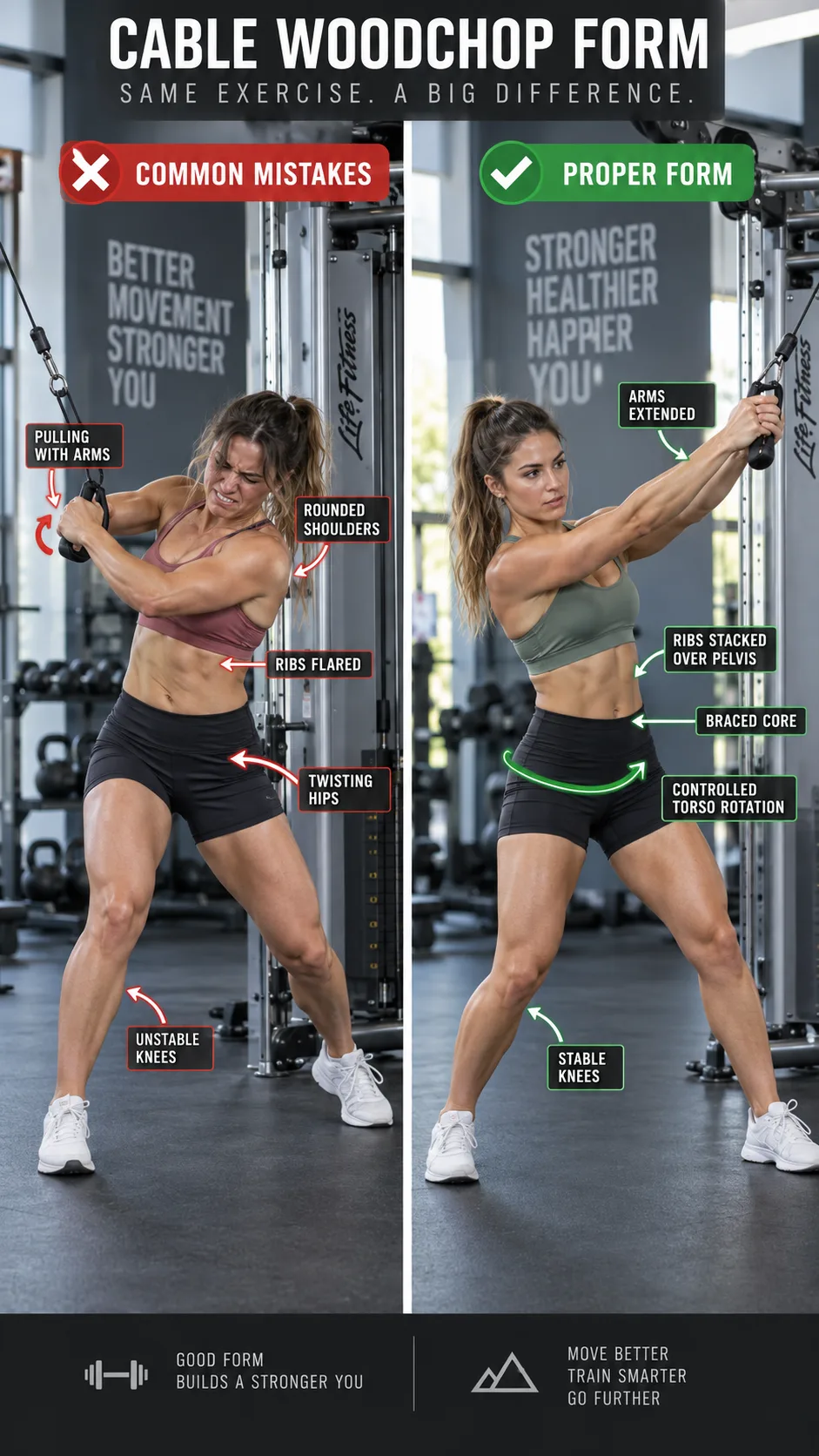
The mistake begins when you lead the pull with your hands and arms. Your shoulders race across your body, your ribs flare, and your hips spin out of control. Your core then follows the movement instead of driving it.
Your trunk should create and control the rotation. Your arms should hold the handle and keep it close to your body. Think of your arms as hooks, not the source of the movement.
Have you seen someone chop so hard that their back foot slides across the floor? They do not train their obliques. They practice a tiny tornado.
Why this form error hurts your core gains
Your obliques do more than twist your torso. They help you resist unwanted rotation, control rib position, and transfer force between your hips and upper body. When you jerk the cable with your arms, you bypass those jobs.
Your shoulders, biceps, and upper back may still work hard during a sloppy woodchop. That burn can fool you. Feeling effort does not mean the right muscles carry the load.
A solid cable woodchop creates tension through your whole midsection. You should feel your obliques tighten along the sides of your waist while your abs keep your ribs from popping up. Your lower back should not feel like it wants to file a complaint.
Your lower back pays the bill
Fast, loose twisting often pushes stress into your lumbar spine. Your lower back can rotate a little, but it does not enjoy repeated hard twisting under load. Your thoracic spine and hips should provide more movement while your core controls the space between them.
Research and practical spine training principles favor controlled trunk stability over reckless spinal motion under load. You can read more about core stability research through this PubMed-indexed research. No exercise needs to resemble an audition for a low budget action movie.
You lose tension where you need it
When your pelvis spins first, your rib cage follows, and your arms finish the pull, you lose the tension that makes the cable woodchop useful. You turn a core exercise into a momentum exercise. Momentum may look impressive, but it steals the work from your trunk.
Core training rewards control. Steady tension, solid positions, and repeatable reps beat frantic twisting.
How to do a cable woodchop with proper form
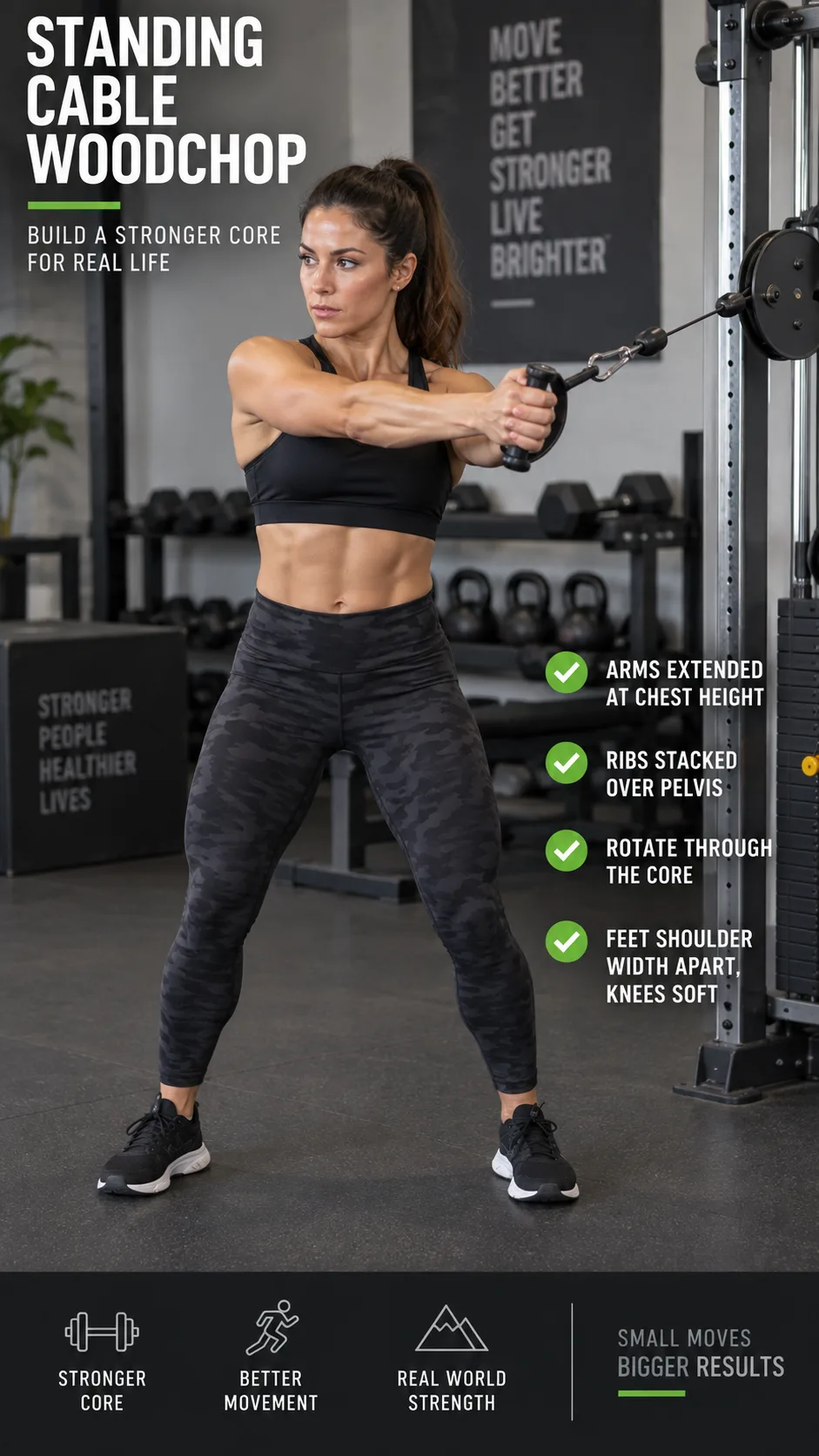
Set the cable pulley around chest height for a standard horizontal cable woodchop. You can try high to low and low to high versions later, but learn this one first. A stable setup makes it easier to feel your obliques work.
- Stand sideways to the cable machine. Set your feet about shoulder width apart and bend your knees slightly.
- Grab the handle with both hands. Keep your arms mostly straight, but do not force your elbows into a hard lockout.
- Step far enough from the machine to create tension. The stack should pull against you before you begin the rep.
- Brace your abs before you move. Imagine someone wants to poke your stomach without warning.
- Keep your ribs stacked over your pelvis. Do not puff up your chest or arch your lower back.
- Rotate your rib cage smoothly away from the machine. Let your upper back and hips move, but keep your knees steady.
- Finish with your hands across your body. Pause for one second and feel your obliques hold the position.
- Return slowly. The return builds strength too, so do not let the cable pull you back.
That pause at the end matters. It makes you control the position instead of relying on speed. If you cannot pause without wobbling, use less weight.
Five form cues that make your obliques work harder
You do not need twenty thoughts running through your head on every rep. You need a handful that make sense to you. Try these during your next cable woodchop session.
- “Ribs down.” Keep your rib cage from flaring up when you pull.
- “Arms stay long.” Do not turn the movement into a cable curl with a twist.
- “Turn smoothly, not violently.” Control creates tension. Speed often hides mistakes.
- “Keep both feet heavy.” Push into the floor instead of spinning on your toes.
- “Finish with your abs.” Pause and tighten your midsection at the end of each rep.
These cues make your core organize the movement. They also keep your shoulders from taking over the set. They sound simple, but fatigue can make them hard to follow.
Should your hips rotate during a cable woodchop?
Yes, your hips can rotate during a cable woodchop. You do not need to lock your pelvis in place like a statue. Your hips and upper back should move naturally while your abs control how your pelvis and rib cage move together.
The trouble starts when your hips spin first and pull everything else along. That pattern takes the challenge away from your trunk. Think “controlled turn” instead of “spin and hope.”
Try the anti rotation version first
If you struggle to control your ribs and hips, start with a cable Pallof press. This exercise teaches your core to resist rotation before you ask it to create rotation. That skill carries over well to woodchops.
Set the cable at chest height, stand sideways to the stack, press the handle straight out, and resist the cable as it tries to turn you. Your obliques will get the message quickly.
The Hospital for Special Surgery explains the value of core strength for controlling movement and supporting daily activity. Your gym work should help you move better outside the gym, not just make loud noises at the cable machine.
Choose the right weight for cable woodchops
Most lifters use too much weight for this exercise. They want the stack to prove something. The stack does not care, and your obliques respond better to quality tension than ego lifting.
Choose a load that lets you complete 8 to 15 smooth reps on each side. You should feel steady from the first rep to the last. If your elbows bend a lot, your torso jerks, or your feet shuffle, move the pin down.
The best cable woodchop weight lets you pause at the finish and return slowly. That standard keeps you honest. Start lighter than your ego wants, then add weight only when your form stays clean.
How to program cable woodchops for better core strength
You can do cable woodchops two or three times per week. Add them after your main strength lifts or work them into a focused core circuit. You do not need fifty sloppy reps to build a stronger midsection.
- For core strength: Do 3 sets of 8 to 10 reps per side at a slower tempo.
- For muscle growth: Do 2 to 4 sets of 10 to 15 reps per side.
- For athletic control: Use lighter weight, pause at each finish, and focus on clean rotation.
- For beginners: Start with Pallof presses and controlled half kneeling woodchops.
Pair woodchops with big lower body movements in a balanced program. Your trunk works hard during squats, hinges, carries, and split squats when you use solid technique. If your lower body training needs help, check out these squat form mistakes and easy fixes and this guide to RDL form for stronger glutes.
The CDC also recommends regular muscle strengthening activity for adults, and you can review its guidance on physical activity guidelines. Core work fits into that larger plan. It should support your training, not replace it.
Quick cable woodchop checklist before your next set
Run through this checklist before you grab the handle. It takes five seconds and can save you months of mediocre core work.
- Brace before the first pull.
- Keep your ribs over your pelvis.
- Use mostly straight arms.
- Rotate under control through your upper back and hips.
- Keep your feet grounded.
- Pause at the finish.
- Control the return.
Final takeaway: stop yanking, start training
The cable woodchop can build stronger obliques, better rotational control, and a tougher core. You only get those benefits when your trunk leads each rep. Stop pulling the cable with your arms, stop chasing momentum, and control every inch of the rotation.
Use less weight, brace harder, and slow down. Your abs will finally do the job you gave them. Save the dramatic twisting for stubborn pickle jars.