

Your stomach bloats up like a beach ball two hours after lunch, and you have no idea which food betrayed you. Sound familiar? You’ve probably blamed gluten, then dairy, then that innocent apple you ate at 3pm.
The culprit might not be any single “bad” food. It might be a group of carbohydrates with an unfortunately nerdy name: FODMAPs. The low FODMAP diet exists specifically to hunt them down.
I’ll walk you through what this diet involves, what you can eat, what you should park for a few weeks, and how to keep your meals genuinely enjoyable. Because a diet you hate is a diet you quit.
What even is a FODMAP? (the plain English version)
FODMAP stands for Fermentable Oligosaccharides, Disaccharides, Monosaccharides And Polyols. Try saying that three times fast. I’ll wait.
Translation: these are short-chain carbs that your small intestine struggles to absorb properly. They travel down to your large intestine, where your gut bacteria throw a fermentation party. The gas, bloating, and cramping? That’s the party.
Researchers at Monash University in Australia developed and tested this approach, and they still run the lab that measures FODMAP levels in foods. They invented the thing. When you want the gold standard, you go to them.
The five FODMAP groups you’ll meet
- Fructans: wheat, rye, onion, garlic. The heartbreakers.
- GOS (galacto-oligosaccharides): legumes, beans, lentils, cashews.
- Lactose: milk, soft cheese, yoghurt, ice cream.
- Excess fructose: honey, apples, mangoes, high-fructose corn syrup.
- Polyols: stone fruit, mushrooms, cauliflower, and those sugar-free mints ending in “-ol.”
Notice how many of these count as “health foods”? Cauliflower, apples, lentils, hummus. That’s exactly why so many people eat clean and still feel terrible. Frustrating, right?
Who needs this diet?
Let me be blunt: the low FODMAP diet is not a weight loss plan, a detox, or a lifestyle. It’s a diagnostic tool with a time limit.
Doctors mainly recommend it for people with Irritable Bowel Syndrome (IBS). Research puts the figure at roughly 70 to 76% of IBS patients reporting meaningful symptom relief on it, a genuinely impressive hit rate for any dietary intervention. Johns Hopkins Medicine outlines the same protocol their gastroenterologists use with patients.
Some people with SIBO or inflammatory bowel disease in remission also use it under supervision. My honest opinion: see a doctor before you start. Coeliac disease, IBD, and a handful of other conditions share symptoms with IBS, and you need to rule them out first. Cutting gluten before a coeliac test can wreck the results. Don’t do that to yourself.
Red flags that mean “see a doctor first”
- Blood in your stool
- Unexplained weight loss
- Persistent fever or night sweats
- A family history of bowel cancer or IBD
- Symptoms that started suddenly after age 50
None of those belong to “just IBS.” Get them checked.
The three phases (and why most people mess up phase 3)
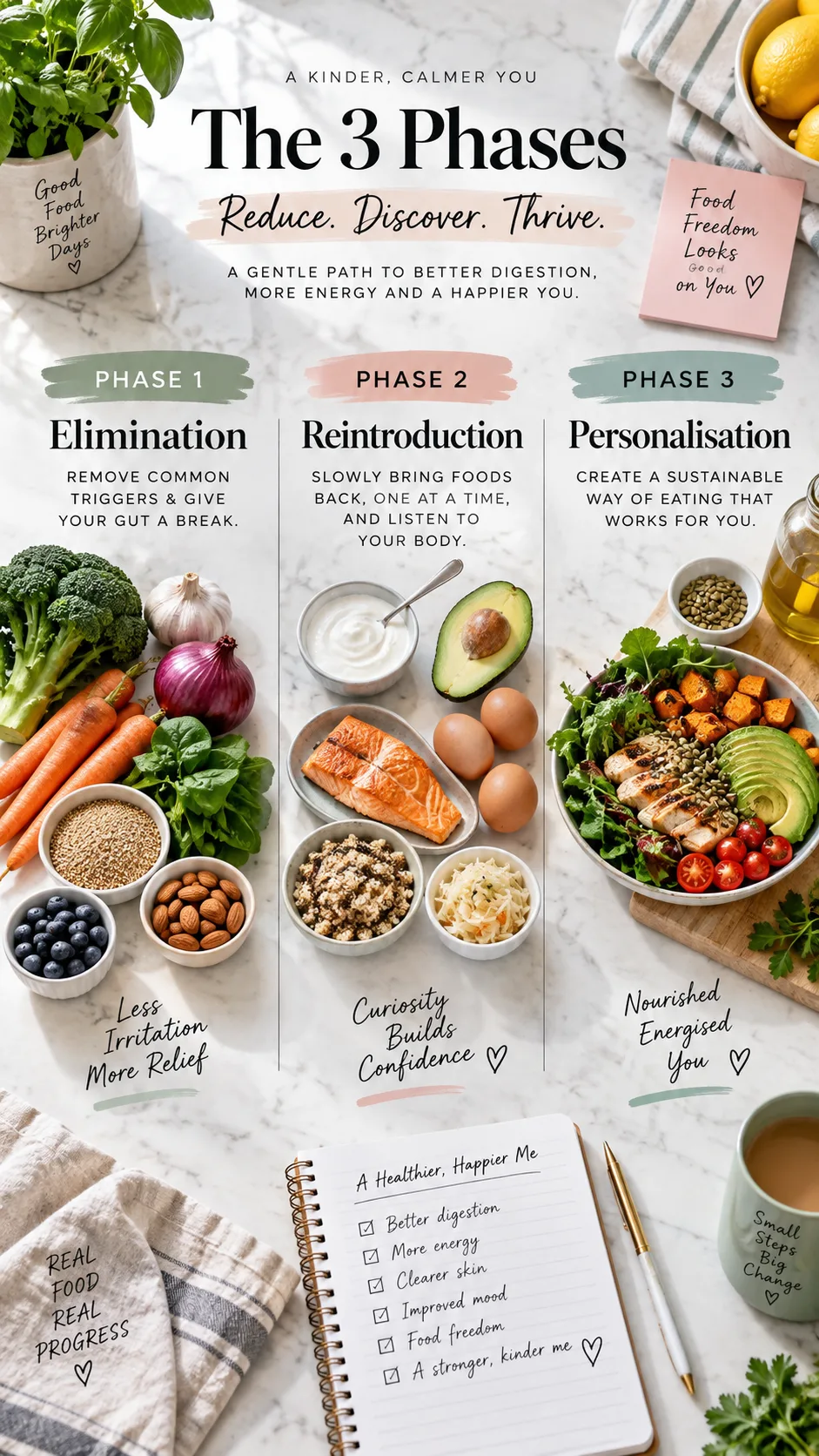
People hear “low FODMAP diet” and picture a permanent restriction list. That’s wrong, and it’s the single biggest mistake beginners make. The diet has three distinct phases, and the restriction part is the shortest one.
Phase 1: elimination (2 to 6 weeks)
You remove all high FODMAP foods. Every single one. Your symptoms should calm down noticeably within two to four weeks.
Do NOT stay here longer than six weeks. Long-term restriction starves your beneficial gut bacteria, and studies show it reduces levels of Bifidobacteria. You want a diverse microbiome, not a sterile one.
Phase 2: reintroduction (6 to 8 weeks)
This is where the diet earns its keep. You test one FODMAP group at a time, over three days, while keeping the rest of your diet low FODMAP.
- Day 1: small serve of the test food.
- Day 2: medium serve.
- Day 3: large serve.
- Days 4 and 5: wash out, back to strict low FODMAP, record what happened.
Example: testing lactose? Use plain milk, not a latte with oat milk and a pastry. One variable. Scientists would be proud.
Phase 3: personalisation (forever)
Now you build YOUR diet. Maybe you handle lactose fine but garlic destroys you. Maybe half an avocado works but a whole one doesn’t. Most people tolerate far more than they expect.
The goal? Eat the widest variety of food you can without symptoms. Not the narrowest.
What to eat: your low FODMAP green list
Good news: this list runs longer than most beginners fear. You will not survive on rice cakes and sadness.
Proteins (basically all fair game)
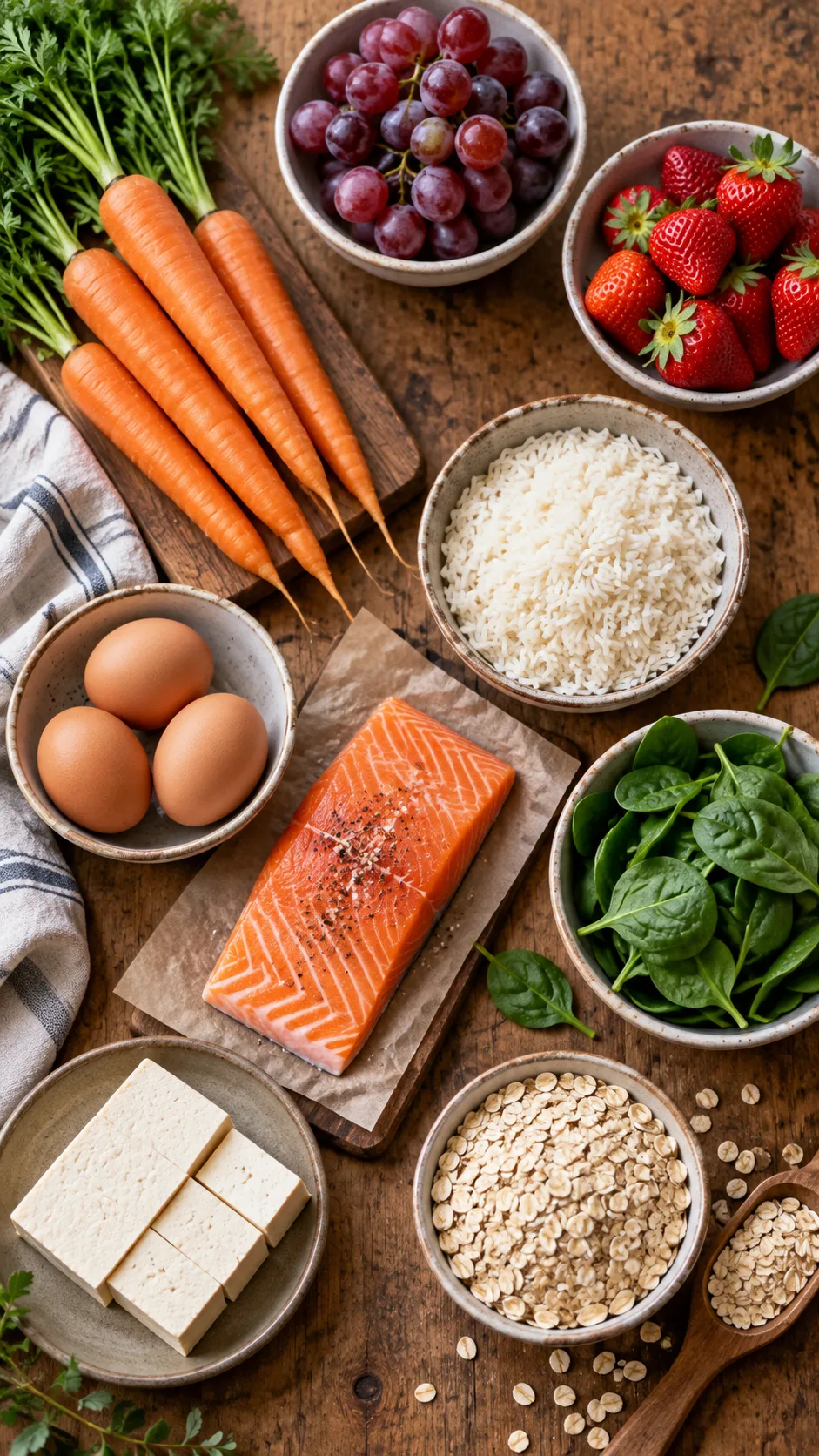
- Plain meat, poultry, fish, seafood, unseasoned or seasoned with safe herbs
- Eggs
- Firm tofu and tempeh (the pressing removes the FODMAPs, which is a neat trick)
- Canned lentils, rinsed well, up to ¼ cup
Vegetables
- Carrots, cucumber, courgette (up to 65g), bell peppers
- Spinach, kale, lettuce, rocket
- Green beans, aubergine, tomatoes, potatoes
- The green tops of spring onions and leeks, your onion flavour lifeline
Fruit (portion size matters enormously)
- Strawberries, blueberries (up to 40g), grapes, kiwi
- Oranges, pineapple, cantaloupe
- Unripe bananas (a ripe banana turns high FODMAP, because botany is rude)
Grains
- Oats, rice, quinoa, buckwheat, polenta, millet
- Sourdough spelt bread (the fermentation breaks down fructans)
- Gluten-free bread and pasta
Dairy and alternatives
- Hard cheeses: cheddar, parmesan, brie, feta
- Lactose-free milk and yoghurt
- Almond milk, macadamia milk, rice milk
- Butter (basically pure fat, with no lactose worth mentioning)
Portion size determines everything here. A small serve of avocado sits fine; a big one tips you over. FODMAPs also stack up across your day.
What to avoid: the usual suspects
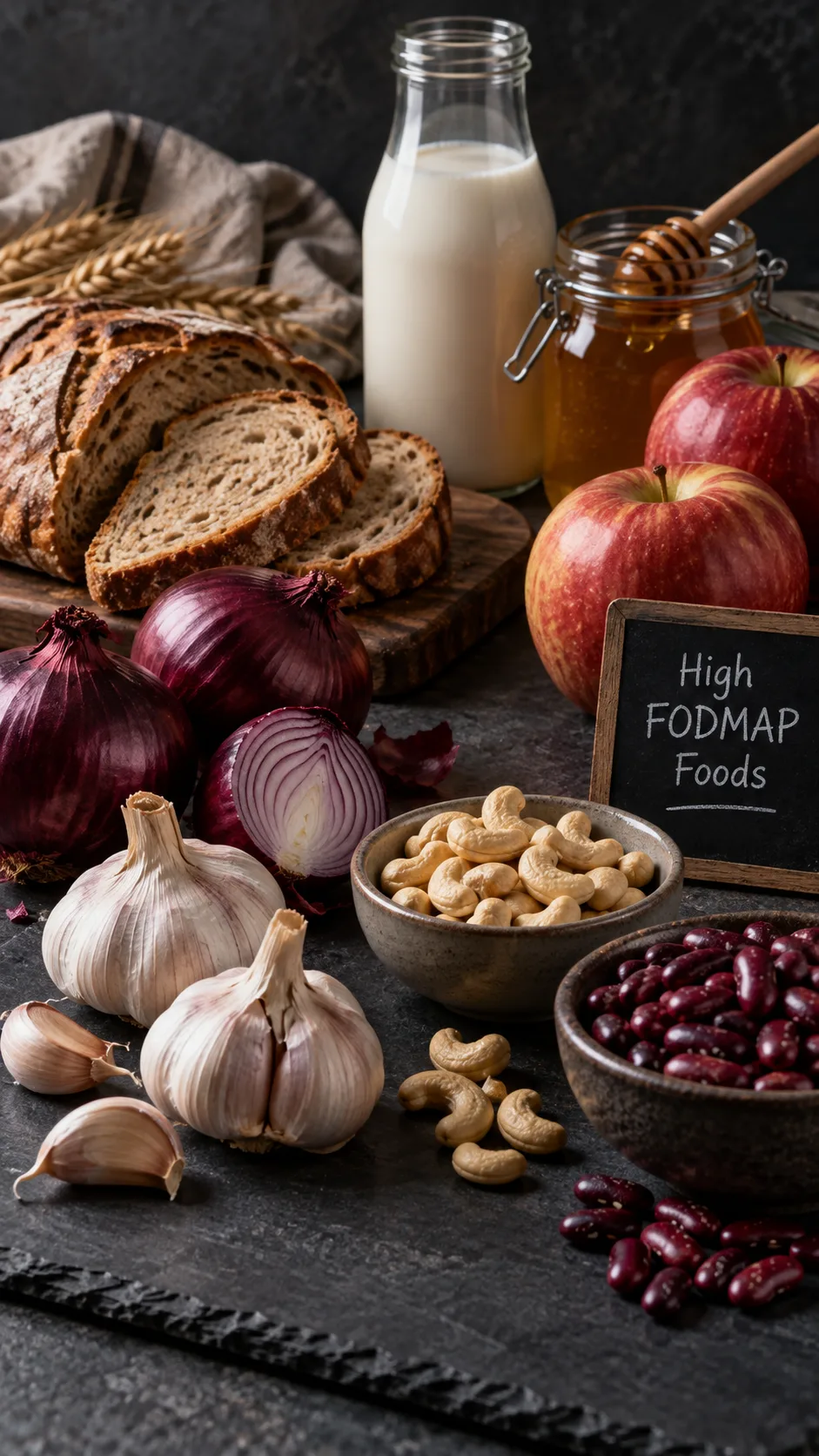
During Phase 1 only, you park these:
- Onion and garlic, including powders, stock cubes, and 90% of sauces
- Wheat, rye and barley in large amounts: bread, pasta, couscous, most cereals
- Legumes: chickpeas, kidney beans, black beans, baked beans
- Apples, pears, mangoes, watermelon, cherries, peaches, plums
- Milk, soft cheese, ice cream, regular yoghurt
- Cauliflower, mushrooms, asparagus, Brussels sprouts, snow peas
- Honey, agave, high-fructose corn syrup
- Cashews and pistachios
- Sugar alcohols: sorbitol, mannitol, xylitol, maltitol (check your gum)
The onion and garlic problem (and my favourite workaround)
Losing garlic hurts. I won’t pretend otherwise. But fructans dissolve in water, NOT in oil.
So you infuse oil: heat garlic cloves in olive oil, remove the solids, keep the oil. You get the flavour and none of the fructans. Garlic-infused oil saved my cooking during my own elimination phase, and I still use it now out of pure habit. Asafoetida powder works well too, since a pinch mimics that savoury onion depth.
A sample day that doesn’t taste like punishment
Want proof you can eat well on this? Here’s a realistic day.
- Breakfast: Oats with lactose-free milk, strawberries, a spoon of peanut butter, and maple syrup.
- Lunch: Grilled chicken, quinoa, roasted carrots and peppers, feta, olive oil and lemon.
- Snack: A handful of walnuts and 10 grapes. Or rice cakes with cheddar.
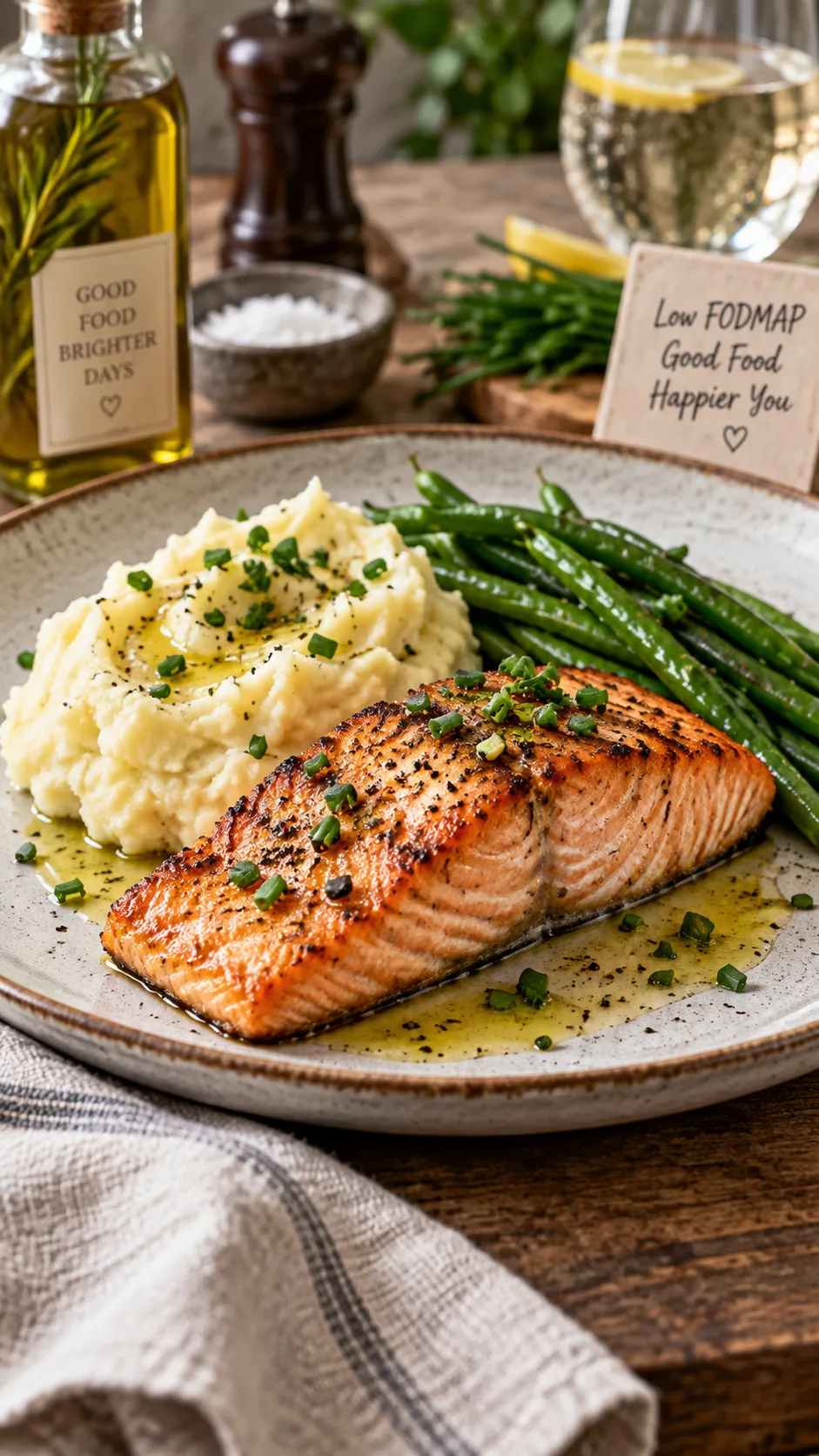
- Dinner: Salmon with mashed potato, green beans, and garlic-infused oil with chives.
- Dessert: Dark chocolate (30g) and a few raspberries.
That’s not deprivation. That’s just dinner. If you’ve tried other structured eating plans like the Mediterranean diet, you’ll notice the low FODMAP version borrows a lot of the same building blocks: olive oil, fish, vegetables, herbs.
7 beginner mistakes that sabotage results
- Treating it as permanent. Restriction is a phase, not a personality. Reintroduce.
- Ignoring portion sizes. You can eat 40g of blueberries. 200g? Different story.
- Forgetting FODMAP stacking. Three “safe” portions in one meal can add up to a high FODMAP meal.
- Not reading labels. Onion powder hides in crisps, stock, sausages, marinades, and “natural flavouring.”
- Blaming FODMAPs for everything. Caffeine, alcohol, huge meals, and stress all trigger IBS on their own.
- Skipping the food diary. Your memory lies. Your notes don’t.
- Going it completely alone. A registered dietitian who specialises in gut health speeds this up massively.
The stress factor nobody mentions
Your gut and brain talk constantly through the gut-brain axis. Stress genuinely changes gut motility and pain sensitivity. You can eat a perfect low FODMAP meal before a big presentation and still feel awful.
Gentle movement helps here. Walking, yoga, easy jogging, nothing punishing. A lot of people find that starting a simple routine like a beginner walk-to-run plan calms their symptoms alongside the diet. Research on IBS consistently supports physical activity as a symptom reducer. Two tools beat one.
Shopping, label reading and eating out
Your label-reading cheat sheet
Scan ingredient lists for these landmines:
- Onion powder, garlic powder, dehydrated onion
- Inulin, chicory root, FOS (added “fibre” that wrecks FODMAP-sensitive guts)
- High-fructose corn syrup, honey, agave
- Sorbitol, mannitol, xylitol, isomalt
- Wheat flour listed high on the list
- Milk solids, milk powder, whey protein concentrate
Restaurants without the panic
Eating out feels terrifying at first. Then you learn the patterns.
- Order simple: grilled protein, plain potato or rice, steamed vegetables, olive oil.
- Ask for sauces on the side. Sauce is where garlic hides.
- Japanese, steakhouse and Greek grill places tend to work well.
- Skip the “creamy,” “caramelised onion,” or “roasted garlic” anything.
- Eat a small safe snack beforehand so hunger doesn’t make your decisions.
The official Monash FODMAP app costs a few quid and pays for itself in week one. It uses a traffic-light system with tested portion sizes. I consider it non-negotiable for beginners.
How this compares to other popular diets
People ask me constantly whether keto or carnivore “fixes” IBS. My take: both remove a lot of FODMAPs by accident, which is why some people feel better on them. But neither one teaches you which FODMAPs you personally react to.
That’s the difference that counts. If you’re curious about those approaches for other reasons, the guides on the keto diet for beginners lay out how they work. Just don’t mistake them for a diagnostic tool. The low FODMAP diet’s entire purpose is giving foods BACK to you.
Quick comparison
- Low FODMAP: temporary, targeted, evidence-backed for IBS, ends in personalisation.
- Keto: metabolic focus, removes some FODMAPs incidentally, not designed for gut testing.
- Gluten-free: helps coeliacs; for IBS, fructans usually matter more than gluten itself.
- Elimination by guesswork: the one most people try first. Also the least effective.
How long until you feel better?
Most people notice changes within one to two weeks, with clearer results by week four. Bloating usually improves first. Pain and bowel habit changes take a bit longer.
And if nothing improves after six weeks? Stop. The diet isn’t your answer, and staying on it does more harm than good. Go back to your GP and investigate further. Roughly a quarter of people simply don’t respond, and that information matters too.
The NHS guidance on IBS diet and lifestyle offers solid first-line advice worth trying alongside: regular meals, limited caffeine, managed fibre intake, and less alcohol.
The bottom line
The low FODMAP diet works brilliantly when you use it correctly: restrict briefly, reintroduce systematically, then personalise for life. It’s a detective mission, not a life sentence.
Remember the essentials:
- Get a proper diagnosis first and rule out coeliac disease and other conditions.
- Cap elimination at 2 to 6 weeks. Your microbiome will thank you.
- Reintroduction is the most important phase, and most people skip it. Don’t.
- Portion sizes and stacking change everything.
- Use the Monash app and, ideally, a gut-health dietitian.
You deserve to eat a meal without calculating your escape route to the nearest bathroom. Start this week, keep a simple food diary, and treat the whole thing as an experiment rather than a punishment.
Your gut has been sending you messages for years. Time to finally read them properly.