

The good morning exercise looks almost too simple to mess up. You lean forward, you come back up. Easy, right? Wrong. Most people at the gym do it in a way that quietly destroys their lower back, and they have absolutely no idea.
I’ve watched this happen countless times. Someone loads up a barbell, bends over with a rounded spine, and then wonders why they can’t sit down properly the next morning. Sound familiar? Here’s how to fix it.
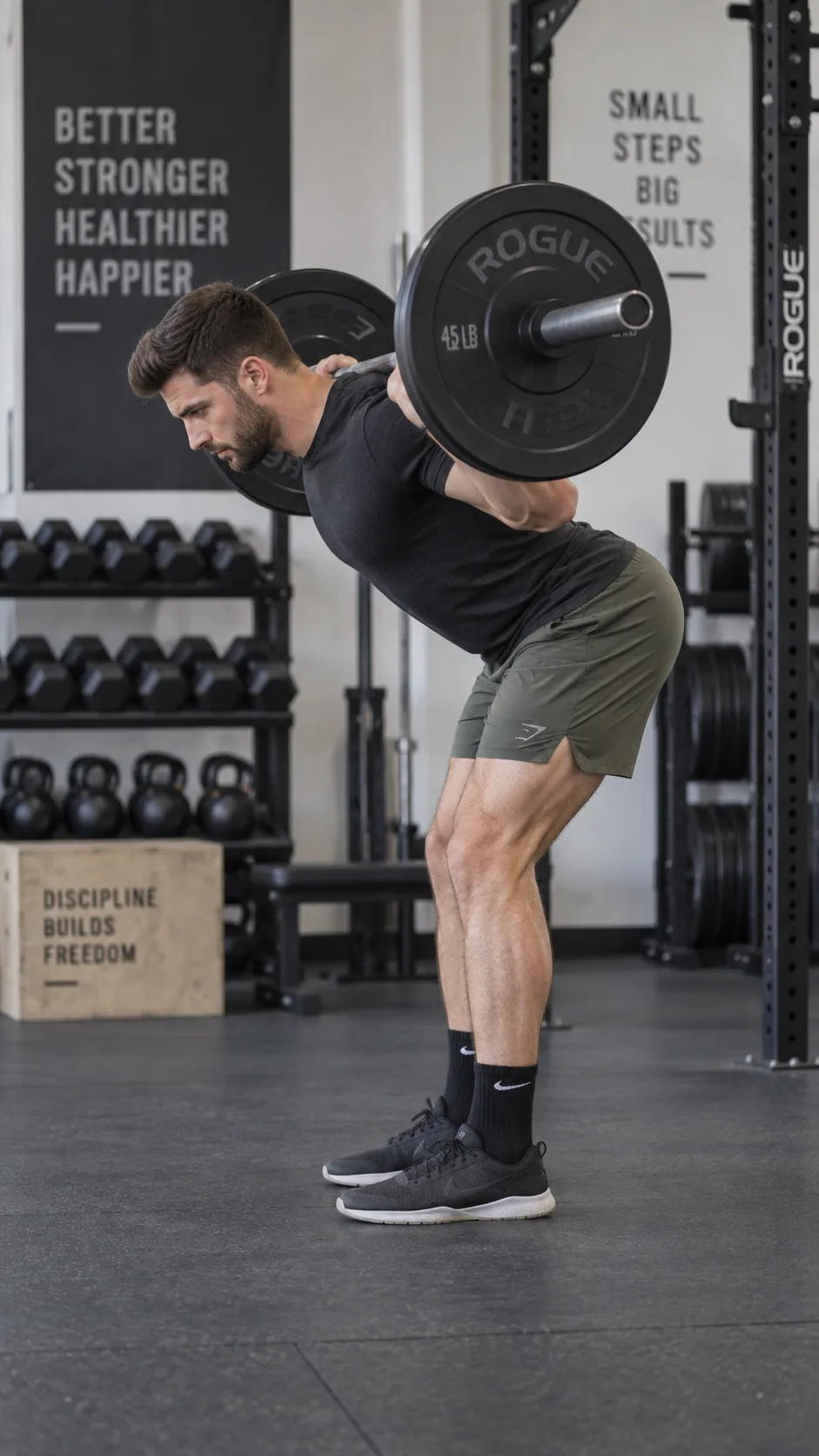
What is the good morning exercise?
The good morning is a hip hinge movement that targets your hamstrings, glutes, and the entire posterior chain. You place a barbell across your upper back (just like a squat), hinge forward at the hips until your torso is roughly parallel to the floor, then return upright.
Done correctly, it’s one of the best exercises you can do for building serious posterior chain strength. Done incorrectly, it’s basically a machine designed to herniate a disc. Not exactly what you signed up for.
Elite powerlifters, sprinters, and strength coaches have used good mornings for decades to build explosive hip power. The National Strength and Conditioning Association recognizes the hip hinge as a foundational movement pattern for athletic performance. This exercise absolutely deserves a spot in your program, when you do it right.
The number one mistake everyone makes
Here it is: rounding the lower back during the hinge. That’s the killer mistake. It sounds simple, but the consequences are anything but.
When you round your lumbar spine under load, you shift massive compressive force onto your spinal discs and the surrounding ligaments. Your lower back muscles, which are supposed to stabilize the movement, suddenly become the primary movers. They were not built for that job under load.
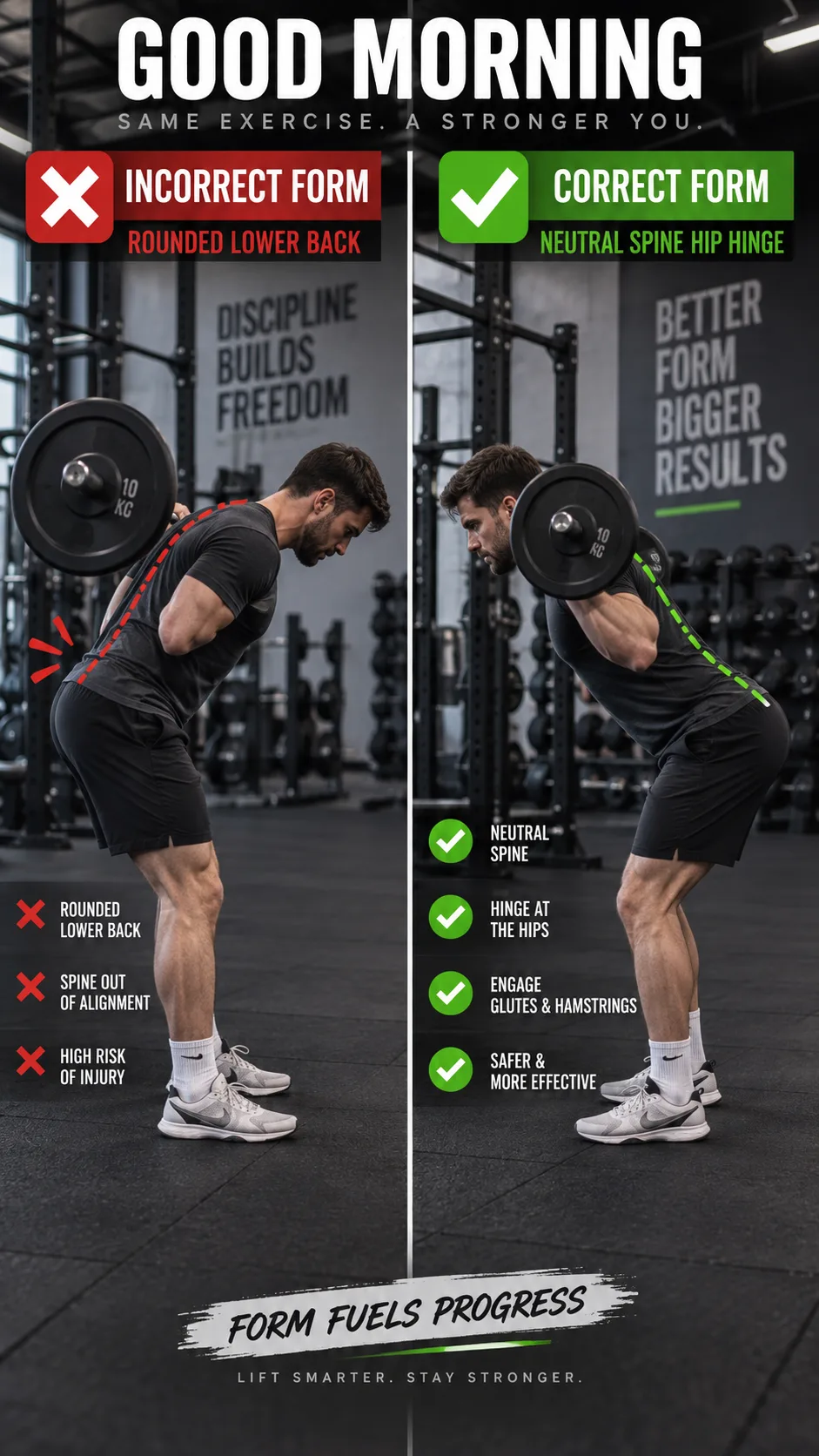
Why does this keep happening?
Usually it comes down to one (or all) of these reasons:
- Tight hamstrings — when your hamstrings hit their end range, your pelvis stops rotating and your lumbar spine compensates by rounding
- Weak glutes — if your glutes aren’t firing properly, your lower back picks up the slack
- Too much weight, too soon — ego loading is the fastest route to a physio’s waiting room
- No body awareness of “neutral spine” — most people genuinely cannot feel when their lower back rounds
- Anterior pelvic tilt — a postural issue that makes the hip hinge pattern much harder to execute correctly
That last point matters more than people realize. If you’re dealing with anterior pelvic tilt, your pelvis already tilts forward at rest, which means your hamstrings are chronically tight and your glutes are inhibited. You’re fighting an uphill battle from the very first rep. I wrote a full breakdown of this exact issue — check out my article on anterior pelvic tilt correction and the exercises that fixed my lower back pain if this sounds like you.
The simple fix: nail the hip hinge first
Before you touch a barbell for good mornings, you need to own the hip hinge. Think of it as the foundation. You wouldn’t build a house on sand, so don’t load a movement pattern you haven’t mastered yet.
Step 1: The wall drill
Stand about a foot away from a wall, feet hip-width apart. Push your hips back until they touch the wall. Your weight should shift to your heels, your spine stays neutral, and you feel a deep stretch in your hamstrings. That’s a hip hinge. Practice this until it feels automatic.
Step 2: The dowel rod check
Hold a dowel rod (or a broomstick) along your spine. It should maintain three points of contact: the back of your head, between your shoulder blades, and your tailbone. Now hinge forward. If any of those points break contact, your spine has deviated from neutral. This drill builds body awareness faster than almost anything else you can do.
Step 3: Load gradually (start lighter than you think)
Once your hip hinge is solid, start with bodyweight good mornings. Then move to a light resistance band across your upper back. Only then touch a barbell, and start embarrassingly light. Even experienced lifters regularly return to bodyweight drills when resetting their movement patterns.
How to perform the good morning with proper form
Once you’re ready to load the movement, here’s exactly how to execute a good morning correctly:
- Bar position: Place the barbell in a low-bar position, just below your traps. High bar tends to pull you into forward lean too aggressively.
- Stance: Feet hip-to-shoulder width, toes slightly turned out. This lets your hips move freely without restriction.
- Brace your core: Take a big breath into your belly, brace like you’re about to take a punch, and create intra-abdominal pressure before you move.
- Soft knee bend: Unlock your knees slightly, around 15 to 20 degrees. This takes the strain off your knee joints and lets your hamstrings work through their full range.
- Hinge at the hips, not the waist: Push your hips back, not your chest down. There’s a real difference. The hips lead the movement.
- Stop at parallel (or before): Hinge until your torso is roughly parallel to the floor. Your hamstring flexibility determines your actual safe range — don’t force it.
- Drive through the floor and squeeze: Push your feet into the floor, drive your hips forward, and squeeze your glutes at the top.

How much weight should you actually use?
This is where most lifters go wrong immediately. Good mornings are not a max-effort lift for the vast majority of people. If you’re going above 50% of your body weight before you’ve logged dozens of sessions with clean form, you’re moving too fast.
Research published by Spine-Health confirms that spinal flexion under heavy compressive load is one of the leading causes of disc herniation. The good morning puts you in a vulnerable position, which is fine when your spine is neutral and the load is appropriate. Respect the movement.
A solid rule of thumb: if your form breaks down, the weight is too heavy. Every single time. No exceptions.
Supporting muscles you need to train alongside this
The good morning doesn’t exist in a vacuum. To do it safely and effectively long-term, you need to actively strengthen these supporting players:
- Glutes — hip thrusts, Romanian deadlifts, and Bulgarian split squats
- Core stabilizers — planks, dead bugs, and Pallof presses
- Hamstrings — Nordic curls and stiff-leg deadlifts
- Thoracic extensors — face pulls and prone cobras
If you’ve been struggling with lower back pain specifically, correcting your anterior pelvic tilt might be the single most impactful thing you do for your overall movement quality. It directly improves your ability to hinge safely and load your posterior chain the way it’s designed to work.
The American Council on Exercise recommends addressing postural imbalances before progressing to loaded hinge patterns, and that’s exactly the right call.
Red flags: when to stop immediately
Some pain is just muscle fatigue. Other pain is your body telling you to stop. Know the difference:
- Sharp or shooting pain in your lower back during the movement — stop now
- Pain radiating down your leg (sciatica symptoms) — see a professional
- A “pop” or sudden onset pain — rack the bar immediately
- Dull aching that gets worse rep by rep — your form has broken down, lighten the load
Muscle soreness the day after is normal and expected. Spinal pain that lingers is not. Always train with a coach or experienced training partner when you’re learning this movement.
One exercise, done right, changes everything
The good morning is genuinely fantastic for building a resilient posterior chain. But it demands respect, patience, and proper technique before you start loading it up. Rounding your lower back isn’t just a form error — it’s a fast track to real injury.
Master the hip hinge first. Train the supporting muscles. Load gradually. And for the love of your lumbar spine, check your ego at the door.
Your back will thank you for years to come. Now go hinge like you mean it.