

Most people spend way too long in the gym and walk out with almost nothing to show for it. If you’ve ever clocked 90 minutes “working out” and wondered why you’re not growing, this guide has your answer.
Building real muscle doesn’t require living at the gym. It requires smart programming, consistent effort, and a clear understanding of how your body responds to training. Everything else is noise.

Why most gym workouts waste your time
The hard truth: most gym sessions are stuffed with junk volume — exercises that feel productive but don’t actually stimulate muscle growth. Scrolling between sets, running through 12 isolation exercises, copying whatever the biggest guy in the gym does… none of that is a strategy.
Some people get results faster than others, and it’s rarely genetics. It’s almost always training efficiency. They do less, but they do it harder and smarter.
Research from the National Library of Medicine consistently shows that progressive overload — gradually increasing the weight or reps over time — is the single biggest driver of muscle hypertrophy. Not the number of exercises. Not the fancy machines.
The core principles of effective muscle building
Progressive overload: the one thing you can’t skip
Progressive overload means you need to do more over time. Add weight, add reps, or tighten up your form on a consistent basis. If you’ve been lifting the same 20kg barbell for six months, your muscles have zero reason to grow.
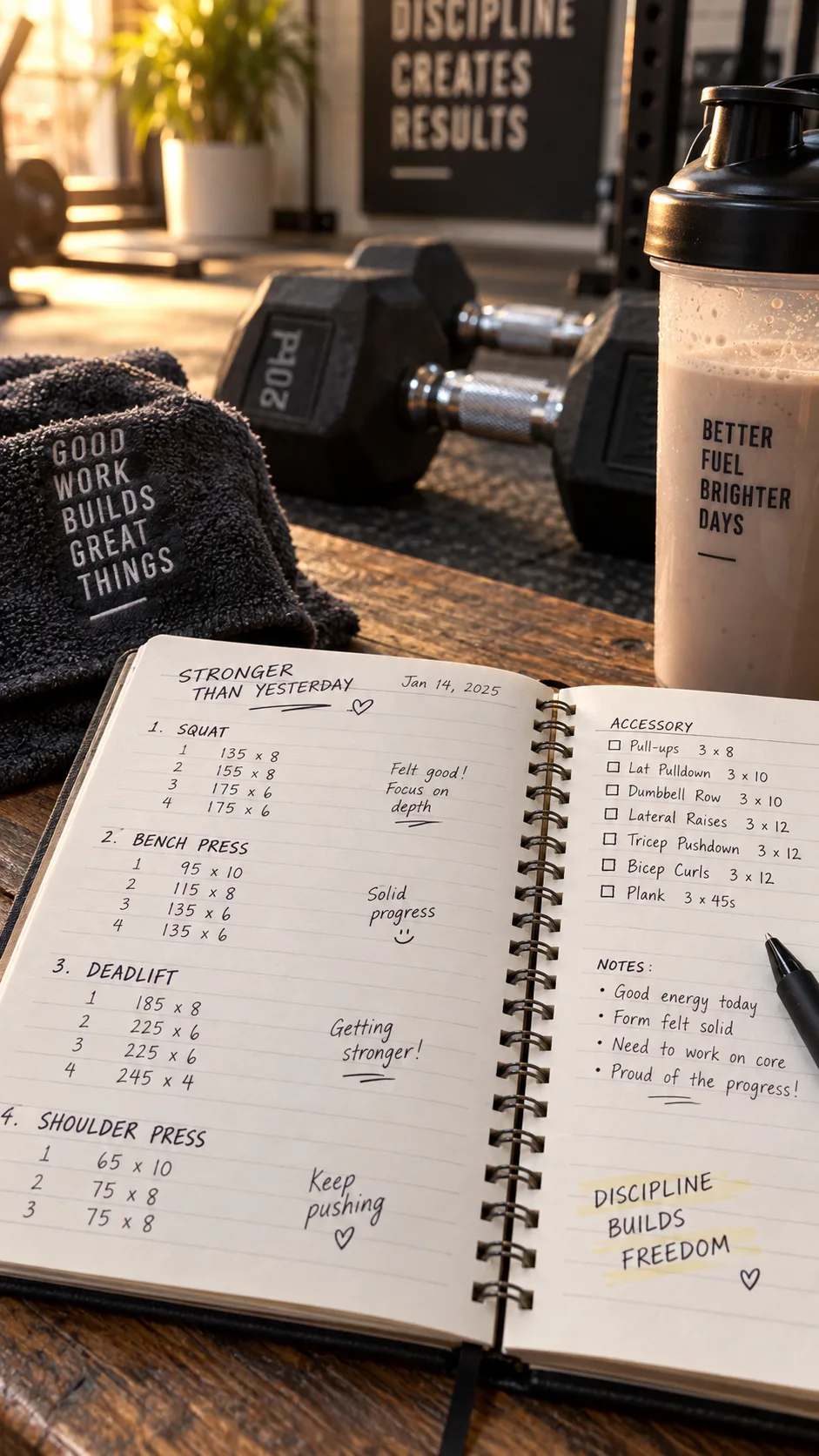
Track your lifts. Use your phone notes, a gym journal, an app — whatever works for you. What gets tracked gets improved.
Training volume vs. training intensity
Volume is the total amount of work you do (sets x reps x weight). Intensity is how hard those sets are relative to your maximum effort. You need both, but most beginners pile on too much volume and never push hard enough in individual sets.
Aim for 10 to 20 working sets per muscle group per week, spread across your sessions. Sports science consistently supports that range. Go above it without adequate recovery and you accumulate fatigue instead of gains.
Rest and recovery are part of the programme
Your muscles grow when you rest, not when you train. Training creates the stimulus; sleep and nutrition produce the actual adaptation. This is the most underrated part of any workout programme.
Aim for 7 to 9 hours of sleep per night. Staying up until 1am to squeeze in one more YouTube fitness video does not count as recovery.
The workout structure that actually builds muscle
You don’t need a 6-day programme to build muscle. For most people, 3 to 4 days per week of structured resistance training produces real, measurable progress. Here’s a framework that works:
Option 1: Upper/lower split (4 days)
- Day 1 – Upper body (push focus): Bench press, overhead press, tricep dips, lateral raises
- Day 2 – Lower body (quad focus): Squats, leg press, Romanian deadlift, calf raises
- Day 3 – Rest or light cardio
- Day 4 – Upper body (pull focus): Pull-ups, barbell rows, face pulls, bicep curls
- Day 5 – Lower body (hamstring focus): Deadlifts, Bulgarian split squats, leg curls
- Days 6 and 7 – Rest and recover
Option 2: Full body training (3 days)
If you’re newer to the gym, full body sessions three days a week hit every muscle group more frequently and drive faster early gains. If you’re just starting out, check out this beginner gym workout guide with a simple weekly plan before moving to a split.
- Squat pattern (e.g. goblet squat or barbell squat)
- Hip hinge (e.g. deadlift or Romanian deadlift)
- Horizontal push (e.g. bench press or push-ups)
- Horizontal pull (e.g. dumbbell row)
- Vertical pull (e.g. lat pulldown or pull-up)
- Core work (e.g. plank, ab wheel)
Keep each session to 45 to 60 minutes. If you regularly go over 75 minutes, you’re either resting too long or doing too much unnecessary volume.
The exercises that deliver the most bang for your buck
Not all exercises are equal. Compound movements — exercises that recruit multiple muscle groups at once — should form the foundation of your programme. They build more muscle, burn more calories, and save you time.
The six lifts to build your programme around
- Squat — The foundation of lower body training. Builds quads, glutes, hamstrings, and core.
- Deadlift — A full-body strength builder. Nothing touches it for posterior chain development.
- Bench press — The standard chest builder. Also trains shoulders and triceps hard.
- Overhead press — Builds shoulder strength and size. Most people ignore it, which is a mistake.
- Pull-ups / lat pulldown — The best back-width builder available. Do them every week.
- Barbell or dumbbell row — Builds back thickness, rear delts, and biceps at the same time.
Cable crossovers, 15 variations of bicep curls, and bosu ball supersets don’t make this list. None of that replaces the basics.

Nutrition: you can’t out-train a bad diet
Your gym programme is only half the equation. Muscle growth requires a caloric surplus and adequate protein. Eating too little is like trying to build a house with no materials.
Sports nutrition guidelines consistently point to 1.6 to 2.2 grams of protein per kilogram of body weight per day. According to Healthline’s nutrition breakdown, research supports this range across most training goals.
- Eat a protein-rich meal or shake within 2 hours after your workout
- Prioritise whole foods: chicken, eggs, beef, fish, legumes, Greek yogurt
- Don’t fear carbs — they fuel your sessions and support recovery
- Stay hydrated. Even mild dehydration tanks your performance
Common mistakes that kill your progress
The same avoidable mistakes show up week after week in gyms everywhere. Here are the biggest ones:
- No progressive overload — lifting the same weight forever and expecting something to change
- Skipping compound lifts in favour of isolation exercises
- Inconsistency — training hard for two weeks, then disappearing for three
- Poor sleep — treating rest as optional when your body treats it as non-negotiable
- Ego lifting — loading too much weight, losing all control over form, and wondering why nothing grows
- Programme hopping — switching workout plans every two weeks before anything has time to work
Pick a programme. Stick to it for at least 8 to 12 weeks before deciding it’s not working. Real adaptations take time, not days.
How to track progress without obsessing over it
Tracking keeps you accountable and motivated, but it doesn’t mean daily weigh-ins and calorie counting to the gram. Simple, consistent tracking beats obsessive monitoring every time.
Here’s what to track each week:
- Body weight (same time of day, same conditions)
- Your working weight and reps on the main compound movements
- How you feel — energy levels, sleep quality, general mood
- Optional: progress photos every 4 weeks
The principles of progressive tracking are straightforward: if your numbers climb and your body composition improves over months, you’re moving in the right direction. Stop comparing your week 2 to someone else’s year 3.
If you want a structured starting point before jumping into a full split programme, the first gym workout guide for beginners breaks everything down into a simple, no-fluff weekly plan that genuinely works.
Wrapping it up
Building real muscle without wasting hours comes down to a handful of things you can’t ignore:
- Train 3 to 4 days per week with intention and focus
- Build your sessions around compound movements
- Apply progressive overload consistently
- Eat enough protein and calories to support growth
- Sleep, recover, and repeat
The gym doesn’t need to take over your life. An hour of focused, smart training beats three hours of aimless wandering between machines every single time.
Stop overthinking it. Show up consistently, lift progressively heavier, eat enough, and sleep well. That’s the whole playbook, and it works.