

Your leg press foot placement can turn the same machine into a quad builder, a glute exercise, or a hamstring helper. One small shuffle changes what your legs do.
Most lifters load plates, sit down, and hope their lower body gets the memo. I made that mistake for years. My quads did nearly all the work while my glutes watched from the sidelines. Sound familiar?
Foot position changes joint angles, range of motion, and which muscles take the largest share of the load. It will not isolate a muscle like magic, but it can shift the emphasis in your leg press workout.
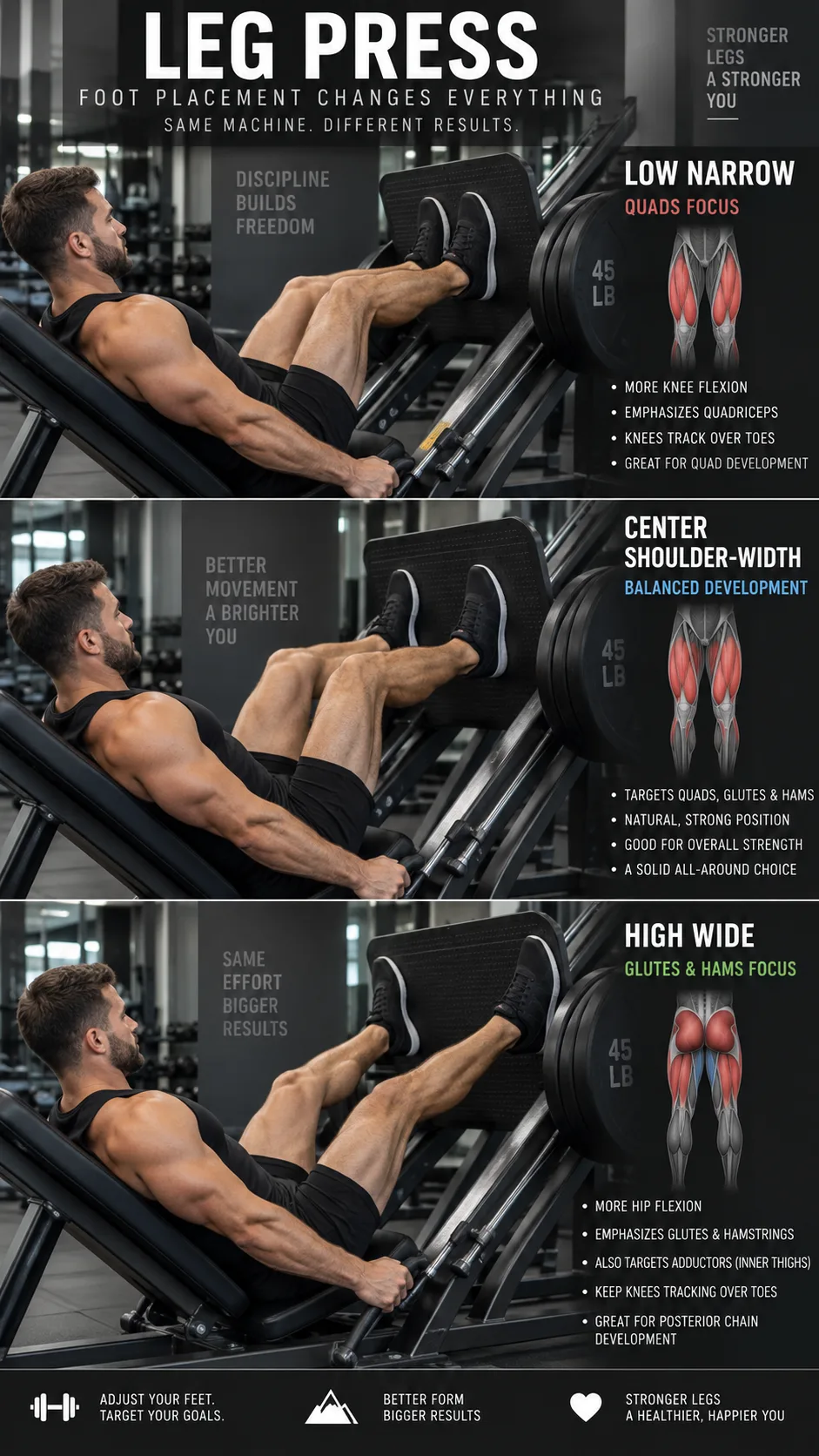
Why leg press foot placement matters so much
The leg press looks simple because you push a platform away from you. Your hips, knees, ankles, and feet still coordinate a full lower-body movement. Move your feet, and each joint bends a little differently.
More knee bend usually demands more from your quadriceps. More hip bend gives your glutes and hamstrings more room to contribute. Your body does not read gym-bro diagrams, but biomechanics still matter.
Researchers use EMG to measure muscle activity, and those studies show that stance changes can alter activation. Still, muscle growth comes from hard sets, enough range of motion, progressive overload, and recovery, not from chasing a tiny activation difference like it holds the secret to Atlantis.
For useful background on resistance-training programming, read the American College of Sports Medicine position stand on resistance training. It makes the familiar basics clear: train consistently, add challenge over time, and use solid technique.
Low foot placement: Put more emphasis on your quads
A low leg press foot placement puts your feet closer to the bottom edge of the platform. This position lets your knees travel farther forward as you lower the sled. Your quads must create plenty of force to straighten your knees on the way up.
Choose a lower foot placement when you want more quad emphasis. You will usually feel your rectus femoris, vastus lateralis, and vastus medialis working hard, especially at the bottom of a controlled rep.
How to set up a low foot position
- Place your feet in the lower third of the platform.
- Start with roughly shoulder-width spacing.
- Point your toes slightly outward if your hips prefer that angle.
- Let your knees track in the same direction as your toes.
- Lower the sled until your pelvis stays firmly against the pad.
Do not put your feet so low that your heels pop up or your lower back curls. Your ego may want another inch of depth, but your hips may strongly disagree :/
Start with a moderate load. Low placement can feel surprisingly demanding because your knees travel farther forward and your quads cannot hide.
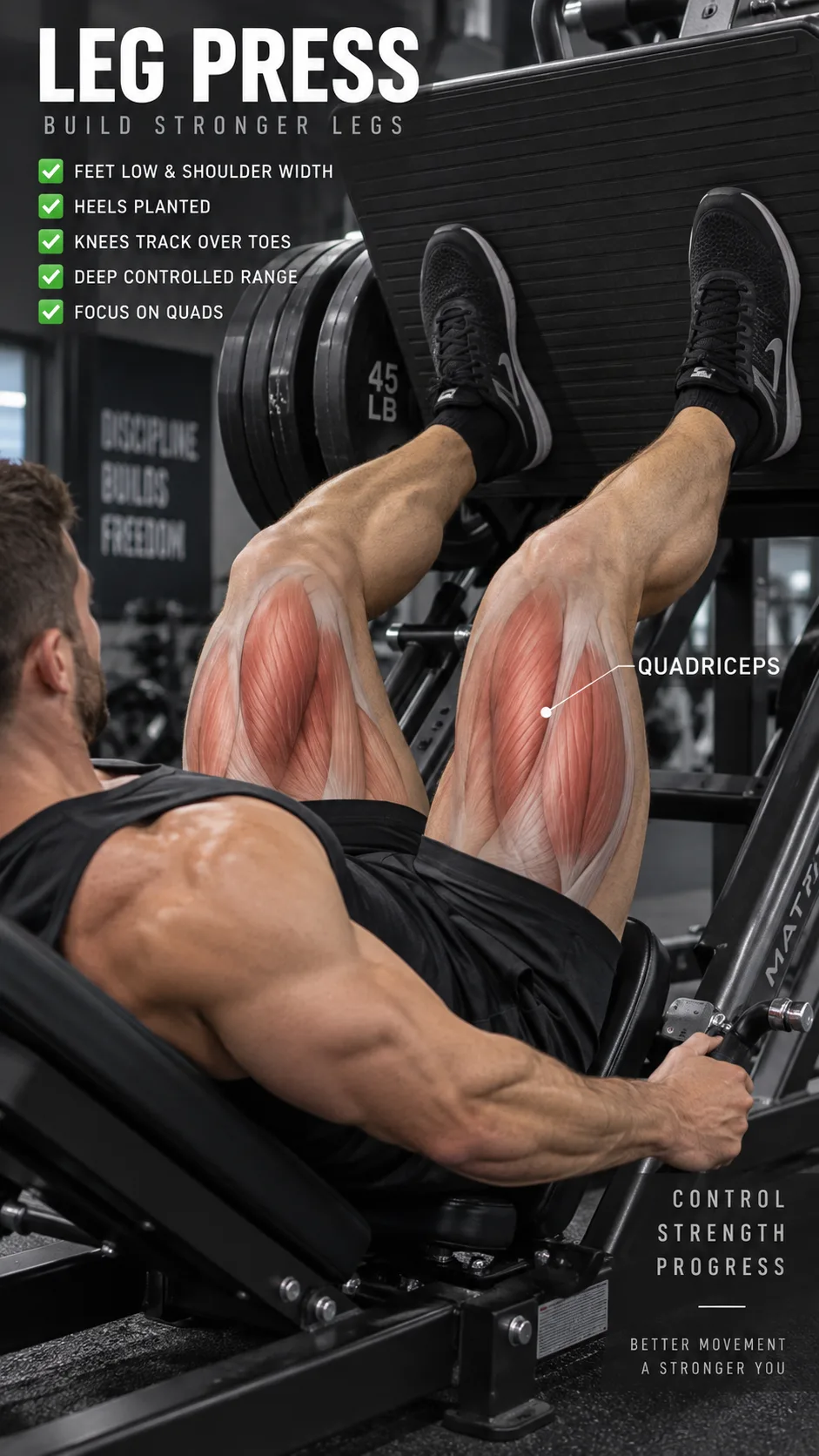
High foot placement: Shift more work toward glutes and hamstrings
A high leg press foot placement moves your feet closer to the top of the platform. This setup often limits forward knee travel and increases hip flexion as you descend. Your glutes and hamstrings can then contribute more force during the press.
Higher feet can put more emphasis on your glutes and hamstrings, especially when you use a deep, controlled range. Your quads still work because every leg press includes knee extension. No foot placement removes a muscle from the exercise.
How to make high foot placement work
Set your feet in the upper third of the platform without crowding the top edge. Keep your whole foot connected to the plate, especially your heels. Drive through your midfoot and heel as you press the sled away.
Control the descent. Let your hips fold, then press the platform up without letting your tailbone roll off the pad. A pelvic tuck tells you that you have run out of useful hip range, so stop just before it happens.
If you want extra lower-body work away from the gym, try these leg press at-home alternatives that build leg and glute strength. A machine helps, but your living room can still give your legs a rude wake-up call.
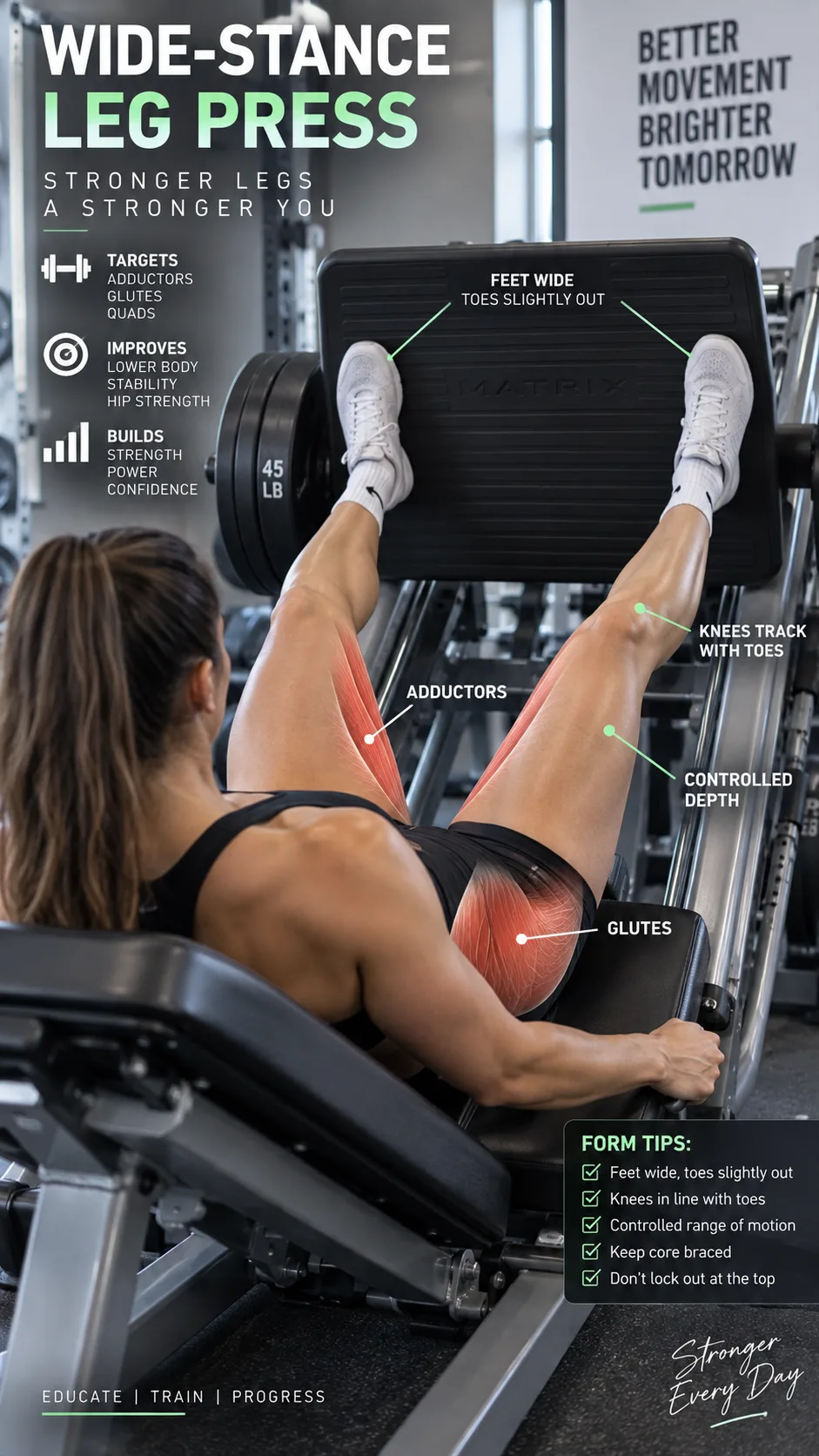
Wide stance: Give your adductors more attention
A wide leg press stance places your feet wider than shoulder width, often with your toes turned out slightly. This position can make your inner thighs, or adductors, work harder alongside your glutes and quads. Many lifters feel a noticeably different stretch at the bottom.
Your adductors do more than pull your knees together. They stabilize your hips and help extend your hips, particularly from deeper positions. Strong adductors can support squats, deadlifts, cutting, and everyday movement.
Wide stance cues that keep it comfortable
- Start only a little wider than shoulder width.
- Turn your toes out only as far as your knees naturally follow.
- Keep both knees aligned with the second or third toe.
- Use a depth that feels stable through your hips and lower back.
- Stop if you feel pinching in your hips or sharp knee discomfort.
Do not assume wider always means better. Your hip structure determines your comfortable stance width, not the person two machines over who does circus-level splits.
The NHS exercise guidance offers sensible advice: build activity gradually and choose movements that fit your current ability. Your body gives useful feedback when you listen.
Narrow stance: A small change with a big quad feel
A narrow stance places your feet closer together, usually around hip width or slightly narrower. Many lifters feel a stronger quad pump with this setup because their knees can travel forward more easily. The position can also challenge knee tracking, so treat it with respect.
Narrow does not mean feet touching. Leave enough room to keep your knees in line with your toes and your arches stable. If your knees collapse inward, widen your stance before you blame the machine.
You may prefer a narrow stance for higher-rep quad work after heavier compound lifts. Try 10 to 15 controlled reps and keep your tempo honest. Your quads should burn. Your joints should not need to negotiate a peace treaty.
Toes straight, toes out, or toes in?
Your toe angle should mostly match the direction your knees naturally travel. A slight toe-out angle works well for many people because it gives the hips room to move. Some lifters feel better with nearly straight feet, and that works too.
Avoid turning your toes aggressively inward. That position can make knee tracking awkward and rarely gives you a useful muscle-building benefit. Save weird angles for experimental dance moves, not loaded leg presses.
Use this simple rule: your knees should follow your toes throughout every rep. If they drift inward or your feet roll, adjust your stance width, toe angle, or load.
How deep should you go on the leg press?
Use the deepest range that lets you keep your feet planted, your knees aligned, and your lower back against the pad. For many lifters, that means lowering until the thighs approach the torso without letting the pelvis roll under. Chase muscular tension, not a lower-back rounding contest.
Deep reps can support muscle growth because they load muscles at longer lengths. You still need control. If you rush the bottom position, you turn a productive rep into a sled-assisted bounce.
Keep your knees unlocked at the top. Full lockout under control will not automatically wreck your knees, but snapping hard into lockout adds little and can irritate some lifters. Control every part of the rep.
Common leg press foot placement mistakes
- Do not copy someone else’s stance exactly. Your femur length, hip shape, ankle mobility, and injury history determine your best setup.
- Do not go lower than your mobility allows. Stop the descent before your pelvis curls away from the pad.
- Do not let your heels lift. Lower the load, adjust foot height, or improve your ankle mobility.
- Do not use tiny half reps with giant plates. Your plate count does not build muscle. Challenging full-range reps do.
- Do not change foot position every set. Pick one goal, keep the setup consistent, and track progress.
- Do not ignore pain. Muscle effort feels hard; sharp joint pain calls for a stop and a reassessment.
If knee, hip, or back pain continues, speak with a qualified physiotherapist or sports medicine professional. The American Academy of Orthopaedic Surgeons also provides reliable exercise and joint-health resources.
A simple leg press foot placement plan for muscle growth
You do not need twelve random variations in one session. Choose a placement that matches your main goal, train it hard for several weeks, and watch your performance. Consistency beats novelty almost every time.
For quad growth
Use a low-to-mid foot placement with a shoulder-width or modestly narrow stance. Perform 3 to 4 sets of 8 to 15 reps. Control the lowering phase, reach a stable depth, and keep one to three reps in reserve on most sets.
For glute and hamstring emphasis
Use a high foot placement around shoulder width or slightly wider. Perform 3 to 4 sets of 8 to 12 reps with a deep range that keeps your pelvis stable. Add load or reps when you can complete every rep with the same clean form.
For balanced leg development
Start with a centered, shoulder-width placement. Use it for six to eight weeks, then shift your emphasis if you want more quad, glute, or adductor work. You can also pair leg press work with squats, hinges, lunges, and leg curls for complete lower-body training.
Want another machine-based perspective? Read our guide to hack squat machine foot placement and muscle emphasis. The same principle applies: small setup changes can make a familiar exercise feel very different.
The bottom line
Low feet generally favor your quads, high feet often bring more glute and hamstring contribution, wide stances can challenge your adductors, and narrow stances can intensify quad work. Your anatomy and technique still determine whether a position works well for you.
Pick a stance, use a controlled range, track your sets, and earn progress over time. The best leg press foot placement does not need to look impressive from across the gym. It makes your target muscles work hard, lets your joints feel good, and helps you return stronger next week.