

You ate the same lunch three days in a row. Day one, fine. Day two, fine. Day three, your stomach staged a full rebellion and you spent the afternoon negotiating with a bathroom door.
Sound familiar? If you have IBS, you have probably built an entire mental spreadsheet of “safe” foods, only to watch it betray you at the worst possible moment. This guide gives you a structured IBS diet plan that swaps random guessing for an actual method, the kind gut specialists and dietitians have tested on thousands of people.
Why random food elimination keeps failing you
Nobody warns you about this part: cutting out foods one by one almost never works for IBS. The symptoms lag. You might eat something at noon and feel it at 9pm, or the next morning.
So when you blame the bread, you probably owe the bread an apology and should be giving a stern look to last night’s onions instead. Your brain connects the wrong dots, and you end up with a shrinking food list and zero answers.
Stress plays its part too. Your gut and brain talk constantly through the gut-brain axis, so a brutal workweek can trigger the exact same bloating you pinned on garlic.

The three mistakes almost everyone makes
- Cutting too many foods at once. You lose any chance of spotting the real culprit and wreck your nutrition while you are at it.
- Testing during a flare. Your gut is already inflamed and irritable, so every food looks guilty.
- Ignoring portion size. Plenty of IBS triggers depend on the dose. Half an avocado may be fine. A whole one is a different story.
The low FODMAP approach: your structured starting point
Researchers at Monash University in Australia built the low FODMAP diet, and it remains the most evidence-backed dietary tool for IBS. Studies show that roughly 70 to 75% of people with IBS report meaningful symptom relief when they follow it properly. You can read the research directly at Monash FODMAP.
FODMAP stands for Fermentable Oligosaccharides, Disaccharides, Monosaccharides and Polyols. Translation: short-chain carbs that your small intestine struggles to absorb. They pull water into your gut, then your colon bacteria ferment them into gas.
Gas plus water plus a hypersensitive gut equals the bloating, cramping and unpredictable bathroom schedule you know too well.
The main FODMAP groups and where they hide
- Fructans: wheat, rye, onions, garlic, leeks
- GOS (galacto-oligosaccharides): beans, lentils, chickpeas, soybeans
- Lactose: milk, soft cheese, ice cream, yoghurt
- Excess fructose: honey, mango, apples, high-fructose corn syrup
- Polyols: sorbitol, mannitol, xylitol, avocado, mushrooms, stone fruits
Notice how “healthy” most of that list looks? That is exactly why so many people with IBS feel gaslit by their own salad. You do everything right and still feel awful.
The 3-phase IBS diet plan (follow this exact order)
Here is where most people go wrong. They stay in phase one forever and skip the rest. Do not do that. The elimination phase is a diagnostic tool, NOT a lifestyle.
Phase 1: Elimination (2 to 6 weeks)
You remove high-FODMAP foods across all groups. The goal is simple: calm your symptoms down so you have a clean baseline.
The rule that matters most: stop at 6 weeks maximum. Longer restriction starves your beneficial gut bacteria and can shrink microbiome diversity, which ironically leaves your gut more sensitive over time.
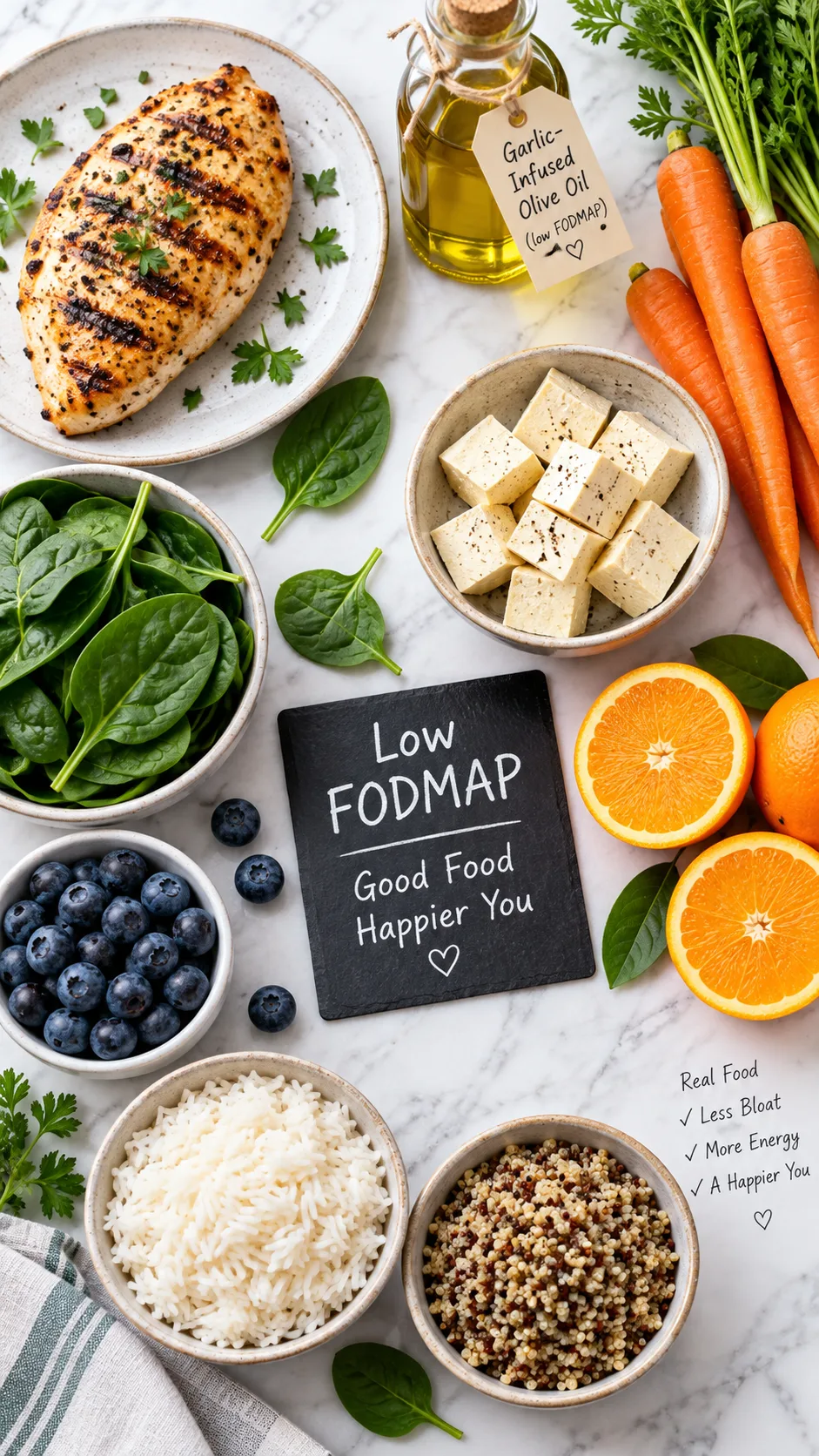
- Swap wheat bread for sourdough spelt or gluten-free bread
- Swap onion and garlic for garlic-infused oil (FODMAPs do not dissolve in oil, which is a lovely loophole)
- Swap cow’s milk for lactose-free milk or almond milk
- Swap apples and pears for oranges, unripe bananas, blueberries or kiwi
- Swap beans for firm tofu, eggs, chicken, fish or small portions of canned lentils
Phase 2: Reintroduction (6 to 8 weeks)
This phase ends the guessing game. You test ONE FODMAP group at a time while you stay low FODMAP in the background.
The protocol that works looks like this.
- Pick one group (say, lactose). Choose a food that contains ONLY that FODMAP. Milk works for lactose; yoghurt with added fruit does not.
- Day 1: small portion (¼ cup milk). Track symptoms for 24 hours.
- Day 2: medium portion (½ cup). Track again.
- Day 3: large portion (1 cup). Track again.
- Days 4 to 6: return to strict low FODMAP. Let your gut reset completely.
- Repeat with the next group.
If symptoms hit hard on day one, stop that test immediately. You already have your answer, and nobody hands out medals for suffering through day three.
Phase 3: Personalisation (forever)
Now you build YOUR diet. Not a generic list from the internet, but your own tolerance map.
Most people find they react to two or three FODMAP groups, not all six. IMO this is the most liberating moment of the whole process. You get foods back. Lots of them.
You want the widest possible diet with the fewest possible symptoms. Write that on a sticky note.
A food diary that tells you something useful
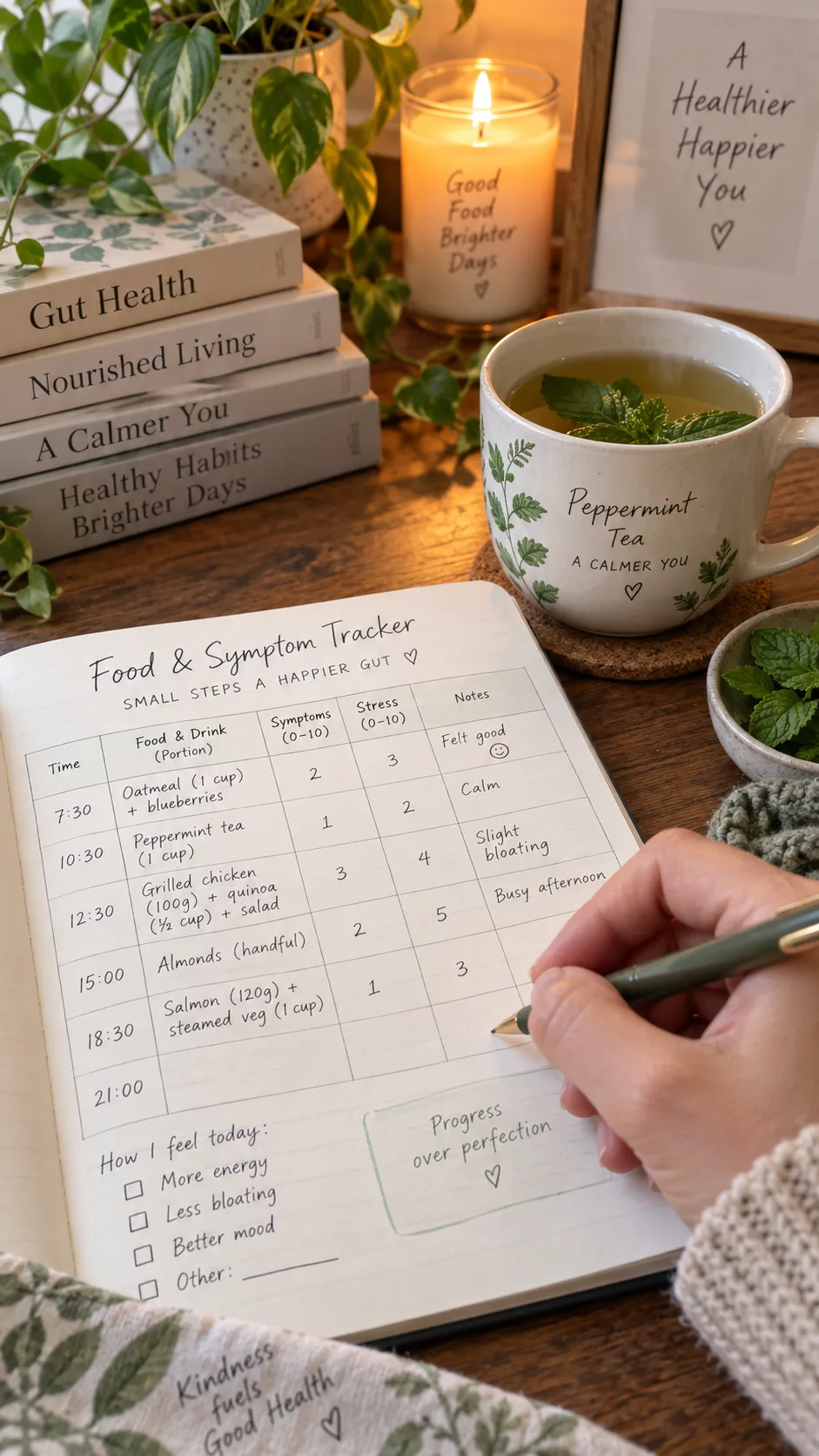
Most IBS food diaries go nowhere. People write “chicken and rice, felt bad” and then wonder why no pattern emerges.
Track these five things instead, every single time:
- Time of the meal and the time symptoms appeared (that gap matters enormously)
- Portion size, not just the name of the food
- Symptom type: bloating, cramping, urgency, constipation. They come from different mechanisms.
- Stress level that day, scored 1 to 10
- Sleep the night before, in hours
Ever wondered why your “trigger food” behaves itself on holiday? Because you slept eight hours and nobody emailed you at 11pm. Stress and sleep genuinely change gut motility and pain sensitivity.
What to eat on an IBS diet plan: a real week
Let me show you what this looks like on an actual plate, because “low FODMAP” sounds terrifying until you see the food.
Breakfast ideas
- Oats with lactose-free milk, blueberries and a handful of walnuts
- Scrambled eggs with spinach on sourdough spelt toast
- Rice porridge with cinnamon and a drizzle of maple syrup
If you want more morning inspiration built on gentle, whole ingredients, these Nigerian breakfast ideas include several options that sit easy on a sensitive stomach.
Lunch ideas
- Grilled chicken, quinoa, roasted carrots and courgette, garlic-infused olive oil
- Tuna and rice bowl with cucumber, red bell pepper and sesame seeds
- Rice noodle soup with chicken, ginger, spring onion GREENS only
Dinner ideas
- Baked salmon, mashed potato, green beans
- Beef stir-fry with rice, bok choy and carrot in garlic-infused oil
- Firm tofu curry with coconut milk (limit to ½ cup), rice and spinach
Snacks that will not sabotage you
- Rice cakes with peanut butter (2 tablespoons max)
- A small handful of macadamias or pecans
- Unripe banana, orange, or 10 strawberries
- Lactose-free yoghurt with a few blueberries
Planning ahead makes or breaks this. The difference between a good IBS week and a miserable one usually comes down to one Sunday afternoon with a chopping board. These meal prep ideas translate well to low FODMAP cooking with minor swaps.
Beyond FODMAPs: the other levers nobody mentions
FODMAPs get all the attention, but they are not the whole story. If you have run the full protocol and still struggle, check these.
1. Fibre type (this one is big)
Soluble fibre helps IBS. Insoluble fibre often makes it worse. Oats, psyllium husk, chia and linseed sit in the soluble camp. Wheat bran, raw kale and corn kernels are insoluble.
Psyllium has the strongest evidence of any fibre supplement for IBS, particularly for constipation-predominant IBS. Start with one teaspoon daily and build slowly, with plenty of water. If your gut needs gentler support, these easily digestible foods are a good reference point.
2. Caffeine, alcohol and fizzy drinks
Caffeine speeds up colonic contractions. If you have IBS-D, that morning triple espresso is not your friend, it is an accomplice. Alcohol irritates the gut lining and worsens permeability, and carbonation literally adds gas to a system that already produces too much.
3. Fat load
Large fatty meals trigger the gastrocolic reflex hard. A greasy takeaway can send you running even when every single ingredient is technically low FODMAP. Spread fat across the day instead of one heavy hit.
4. Eating speed and meal size
- Eat 4 to 6 smaller meals rather than 2 huge ones
- Chew properly. Mechanical digestion genuinely reduces fermentation further down the line.
- Do not eat while stressed, standing, or scrolling through bad news
- Leave 3 to 4 hours between meals so your migrating motor complex can sweep the small intestine clean

The gut-brain piece you cannot skip
I will be blunt: if you fix your diet and ignore stress, you have done half the job. The National Institute of Diabetes and Digestive and Kidney Diseases lists stress as a core driver of IBS symptoms, not a soft add-on.
Gut-directed hypnotherapy has clinical trial results that rival the low FODMAP diet for symptom improvement. Cognitive behavioural therapy performs similarly. Both work on the hypersensitivity rather than the food.
Practical things that move the needle:
- Diaphragmatic breathing. Five minutes before each meal, hand on belly, slow exhale.
- Daily movement. Twenty to thirty minutes of walking reduces bloating and improves transit time.
- Consistent sleep. Poor sleep measurably raises next-day pain sensitivity.
- Gentle stretching. Twists and hip openers help trapped gas move, and if you are starting from scratch, this beginner flexibility plan is a friendly entry point.
Common questions I get asked constantly
Should I take probiotics?
Maybe. The evidence stays mixed because “probiotics” is not one thing, and different strains do different jobs. Bifidobacterium infantis 35624 has the best IBS data. Give any strain 4 weeks minimum before you judge it, and take only one at a time. Otherwise you are back to guessing.
Is gluten the problem?
Usually not the gluten itself. Wheat contains fructans, and fructans are a FODMAP. In studies where people got gluten without fructans, most IBS patients did fine. FYI, that is why some people tolerate sourdough: the long fermentation breaks down the fructans.
That said, get tested for coeliac disease BEFORE you cut gluten. The test needs gluten in your system to be accurate. The Coeliac UK guidance explains this clearly.
Do I need a dietitian?
Ideally, yes. A FODMAP-trained dietitian improves success rates dramatically and keeps your nutrition intact. If cost is a barrier, the Monash app is the next best thing, since it is the only database the team updates with their own lab testing.
What about peppermint oil?
Enteric-coated peppermint oil capsules have solid trial evidence for cramping and pain. They relax intestinal smooth muscle. Skip them if you get reflux, though, because peppermint relaxes the oesophageal sphincter too.
My main symptom is constipation. Does this still apply?
Yes, with tweaks. IBS-C needs soluble fibre, adequate fluid, magnesium citrate in some cases, and kiwi fruit (two a day has real trial data behind it). These foods for constipation cover more options worth trying.
The 7 rules that summarise this entire plan
- Stop eliminating randomly. Use a structured 3-phase protocol or you will never learn anything.
- Cap elimination at 6 weeks. Your microbiome needs those fibres back.
- Reintroduce systematically, one FODMAP group at a time, with a washout gap between tests.
- Track portion size and timing, not just food names.
- Manage stress and sleep as seriously as you manage food.
- Put soluble fibre first and add it slowly.
- Aim for the widest diet possible. Restriction is the tool, never the destination.

Final thoughts
IBS makes you feel like your body is playing a game with rules it refuses to share. A structured plan lets you stop playing that game and start running the experiment properly.
You will not get it perfect. Some weeks will still surprise you. But there is a massive difference between “I have no idea why I feel awful” and “I know fructans are my limit and I had three servings yesterday.” One is chaos. The other is information you can use.
Start this week. Pick your elimination start date, download a tracking app, book a dietitian if you can, and give yourself the full 12 to 14 weeks to run the whole protocol. Your future self, the one eating out without a risk assessment first, will thank you.
This article shares general nutritional information and does not replace medical advice. Talk to your doctor before starting any elimination diet, especially if you have unexplained weight loss, blood in your stool, or a family history of bowel disease.