

When most guys hear “Kegel exercises,” they immediately assume it’s a women’s thing. It’s not. Kegels are one of the most underrated tools in a man’s fitness routine, and the fact that almost no one talks about them for men is a genuine oversight.
Whether you’re dealing with leaks after a bathroom trip, bedroom performance issues, or just want a stronger pelvic floor for athletic performance, this 5-minute Kegel routine is going to change things for you. No equipment. No gym. Nobody even needs to know you’re doing it.

What are Kegel exercises for men, exactly?
Kegel exercises target your pelvic floor muscles, the group of muscles at the base of your pelvis that support your bladder, bowel, and sexual function. Think of them as the invisible foundation holding everything together down there.
Dr. Arnold Kegel developed these exercises in the 1940s, originally for women postpartum. Research quickly confirmed that men benefit just as much, and sometimes more. According to the Urology Care Foundation, pelvic floor training in men significantly improves urinary control and sexual function.
These muscles engage every time you stop urination midstream or hold in gas. Most men have never consciously trained them, which is exactly why they tend to weaken over time.
Why should men do Kegel exercises?
Here’s the short answer: squats, deadlifts, and leg presses don’t touch your pelvic floor. You can have legs like tree trunks and still have a weak pelvic floor. That’s not a flex. It’s a gap in your training.
Real benefits of Kegel exercises for men
- Improved bladder control — stops that post-pee dribble that nobody talks about but everyone experiences
- Better erectile function — stronger pelvic muscles support better blood flow and firmness
- Delayed ejaculation — improved control over the muscles involved in ejaculation
- Faster recovery after prostate surgery — urologists actively prescribe Kegels post-op
- Stronger core stability — your pelvic floor is part of your deep core system
- Reduced symptoms of pelvic pain — when done correctly under guidance
A 2019 study published by the National Institutes of Health (NIH) found that pelvic floor muscle training significantly improved erectile dysfunction in men. That alone should get every man’s attention.
How to find your pelvic floor muscles (start here)
Before you can train these muscles, you need to locate them. It sounds odd, but it matters. Most men accidentally clench the wrong muscles (glutes, abs, inner thighs) and wonder why nothing’s working.
The simplest way to locate them
- Sit or lie down comfortably
- Imagine you’re trying to stop urinating midstream and squeeze those muscles
- Hold for 2-3 seconds, then fully release
- Keep your stomach, buttocks, and thighs relaxed throughout
- Breathe normally throughout and do not hold your breath
If you feel a lifting, squeezing sensation inside your lower pelvis, you’ve found it. That’s your pubococcygeus (PC) muscle. That’s the muscle you’re going to train.
You can also locate these muscles by briefly stopping urination midstream once to confirm the sensation. Don’t make a habit of stopping urination regularly, though. Doing that consistently can interfere with normal bladder function over time.
Kegel exercise how to do for men: the 5-minute daily routine
Here’s the actual routine. Five minutes. No excuses. You can do this sitting at your desk, lying in bed, or stuck in traffic. Nobody will know.
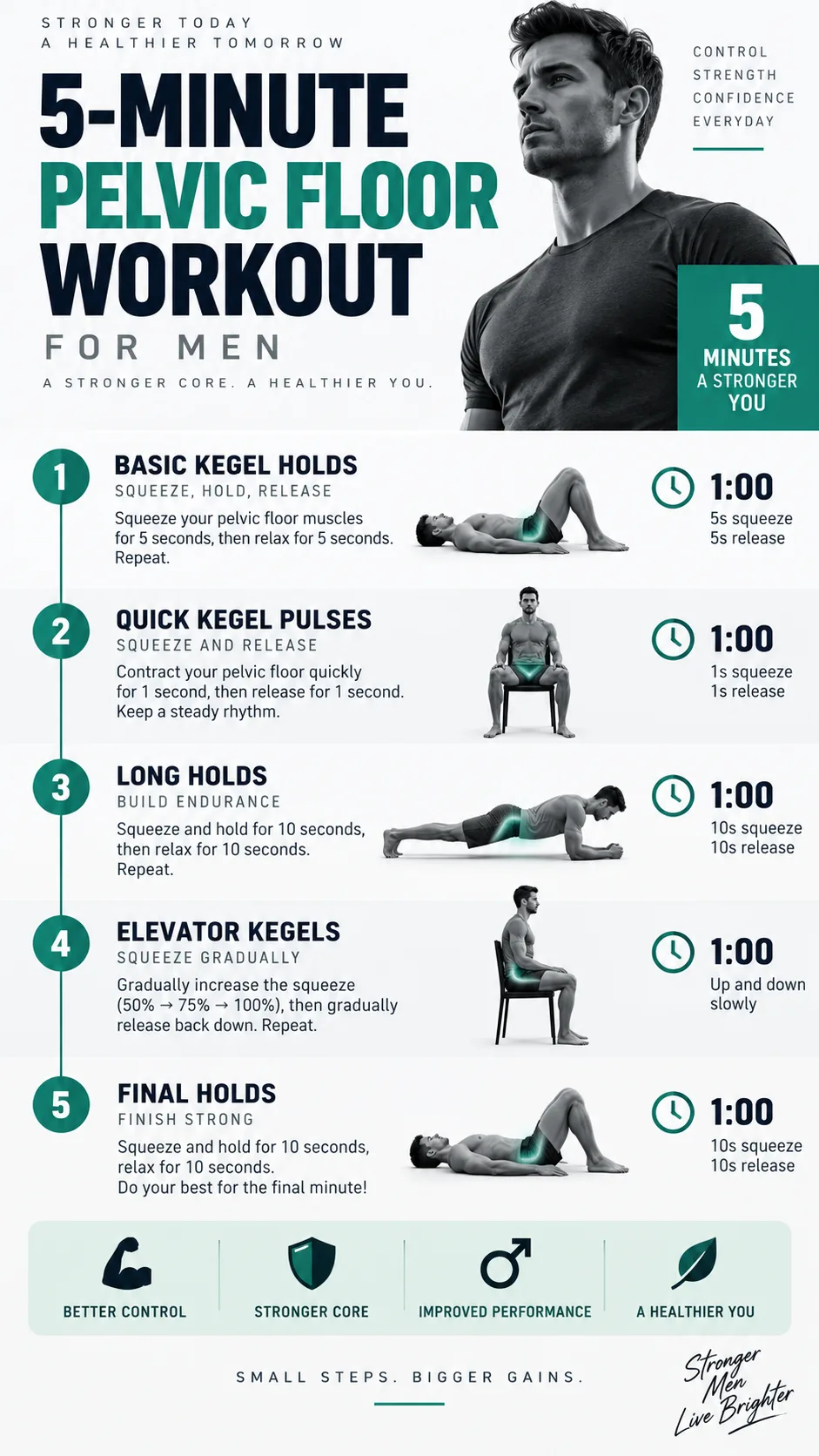
Phase 1: Quick flicks (1 minute)
Fast contractions wake up the muscle fibers quickly.
- Quickly squeeze and release your pelvic floor muscles
- Aim for 1 contraction per second
- Do 20-30 rapid squeezes
- Rest for 10 seconds, then repeat once more
Phase 2: Long holds (2 minutes)
This builds endurance in the muscle, which is the real functional strength you need day to day.
- Squeeze your pelvic floor and hold for 5-10 seconds
- Release fully and rest for 5 seconds
- Repeat for 8-10 reps
- Focus on a full release between each rep. Partial releases don’t count
Phase 3: The elevator (2 minutes)
This one changes how you think about pelvic floor training. Instead of squeezing all at once, you build the contraction gradually in layers.
- Gently contract to 25% of your maximum squeeze and hold for 2 seconds
- Increase to 50% and hold for 2 seconds
- Increase to 75% and hold for 2 seconds
- Go to 100% and hold for 2 seconds
- Slowly release in the same four stages on the way back down
- Repeat 4-5 times
The elevator technique trains both strength and fine muscle control, which translates directly to better sexual performance and bladder control. Don’t skip this phase.
Common mistakes men make with Kegel exercises
Plenty of guys try Kegels and quit because they don’t see results. Nine times out of ten, they’re doing them wrong. Watch out for these:
- Holding your breath — breathe normally throughout every contraction
- Squeezing the wrong muscles — glutes and abs should stay completely relaxed
- Not fully releasing — an incomplete release prevents proper muscle recovery
- Overdoing it — more is not better. Twice daily is plenty. Overtraining causes muscle fatigue and can make symptoms worse
- Expecting overnight results — give it 4-6 weeks of consistent practice before you judge anything
- Skipping days constantly — consistency beats intensity here, every time
How often should men do Kegel exercises?
The NHS recommends doing pelvic floor exercises at least 3 times a day to see meaningful improvement. Realistically, twice a day (morning and evening) works well for most men.
Build the habit by pairing it with something you already do. Morning Kegels while brushing your teeth. Evening Kegels before bed. Stack the habit and it becomes automatic within two weeks.
Results typically appear between 4 and 12 weeks depending on your starting point and how consistent you are. Men recovering from prostate surgery may need 3-6 months, and that’s completely normal.
Who should be extra careful with Kegel exercises
Kegels are generally safe, but a hypertonic (overly tight) pelvic floor gets worse with more squeezing, not better. If you experience pelvic pain, discomfort during sex, or a feeling of pressure in the perineum, talk to a pelvic floor physiotherapist before you start this routine.
Men with chronic pelvic pain syndrome or interstitial cystitis should get professional guidance first. More squeezing isn’t always the answer. Sometimes you need to learn how to release, not contract.

Kegel exercises and your overall fitness routine
Kegels work best as part of a broader healthy lifestyle, not as a standalone fix. If you’re building a consistent fitness habit, check out The Only Workout Guide You Need to Build a Routine That Actually Sticks for a complete framework that complements your pelvic floor training.
Nutrition plays a role too. Certain foods directly affect your hormonal health and energy levels. These 13 proven banana benefits for men might surprise you, especially the ones tied to muscle recovery and male vitality.
The smartest approach is pairing Kegels with compound lifts, good sleep, and a clean diet. Pelvic floor health doesn’t exist in isolation from everything else you do.
Quick-reference routine summary
- Quick flicks — 30 rapid contractions, 1 per second (1 minute)
- Long holds — 8-10 reps holding 5-10 seconds each (2 minutes)
- The elevator — 4-5 reps of gradual four-stage squeeze and release (2 minutes)
- Frequency — twice daily, 7 days a week
- Timeline for results — 4-12 weeks with consistent effort
If you want to build functional strength more broadly, our beginner-friendly strength training blueprint covers programming principles that transfer directly to male athletes too.
Final thoughts
Kegel exercises for men deliver one of the highest returns per minute of any exercise you’ll ever do and they cost you five minutes a day and nothing else. Better bladder control. Better sexual performance. Better core stability. That’s a lot of benefit for a small daily commitment.
The guys ignoring their pelvic floor while grinding out squats and bench press are leaving real gains on the table. Don’t be that guy. Start today, stay consistent, and give it 6 weeks before you judge the results.
Your pelvic floor has been holding things together quietly your whole life. Time to return the favor.