
Your Bulgarian split squats should work your glutes and legs, not leave your front knee feeling beaten up.
The exercise looks simple: one foot forward, one foot elevated, then squat. Small setup mistakes, though, can move stress out of your glutes and into your knees, lower back, or the muscles trying to keep you balanced.
Dial in the details and the Bulgarian split squat can build stronger quads, fuller glutes, better balance, and steadier knees.
Why Bulgarian split squat form matters so much
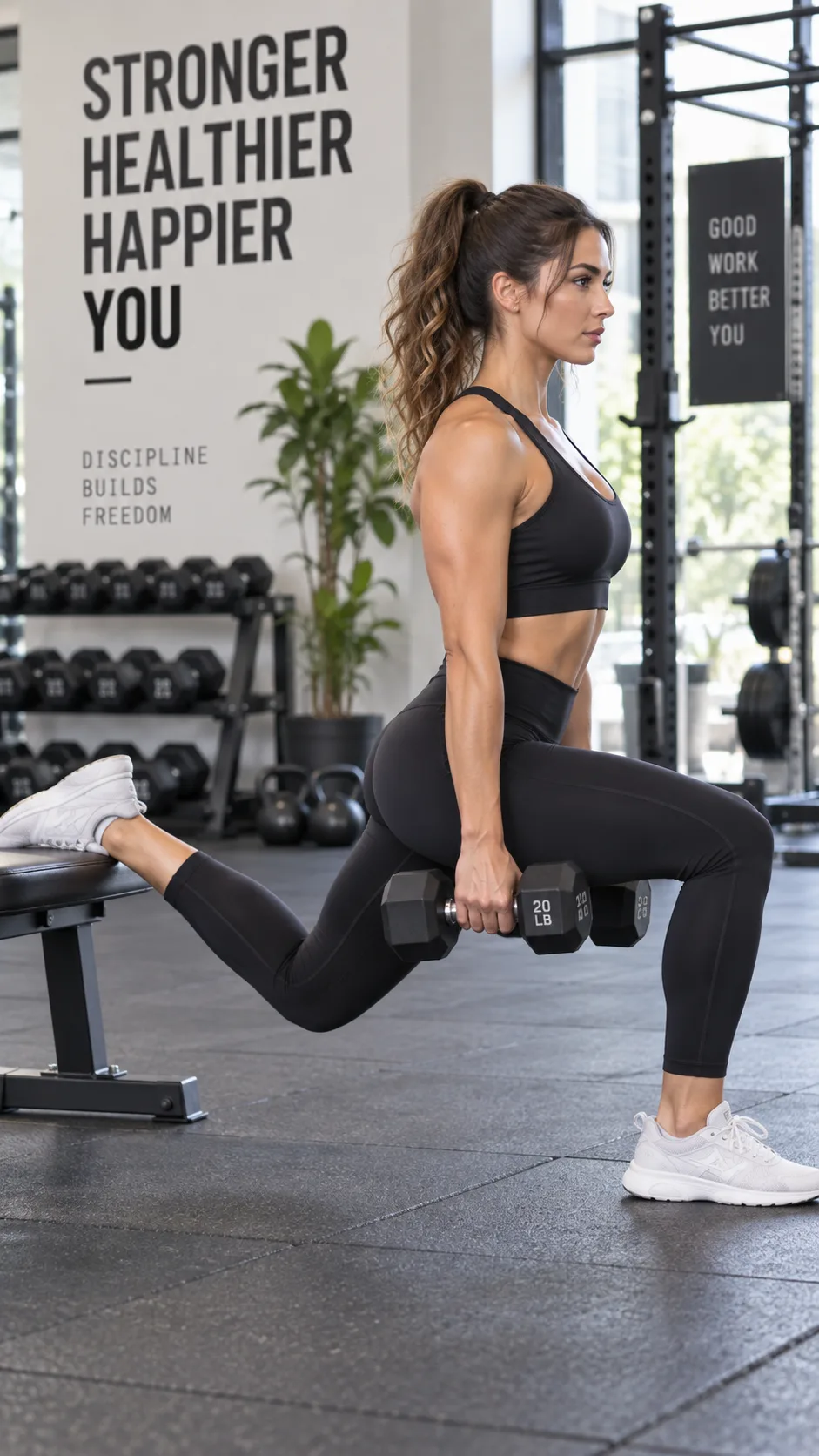
The Bulgarian split squat loads one leg at a time, so it exposes strength differences that standard squats often hide. Your front leg does most of the work while your core resists rotation and your hips manage side-to-side movement.
That mix makes the exercise useful, but it also reveals sloppy reps fast. One side may feel smooth while the other feels like a shopping cart with a bad wheel.
Your stance and torso angle decide where you feel the movement. A longer stance with a slight forward lean usually puts more work on your glutes. A shorter stance with a more upright torso often puts more work on your quads.
Neither setup automatically makes the exercise right or wrong. Let your knee comfort, balance, and training goal guide your setup. Build this movement on solid squat form fundamentals instead of treating each leg exercise as its own separate skill.
The 5 Bulgarian split squat mistakes that hurt your knees and steal your glute gains
-
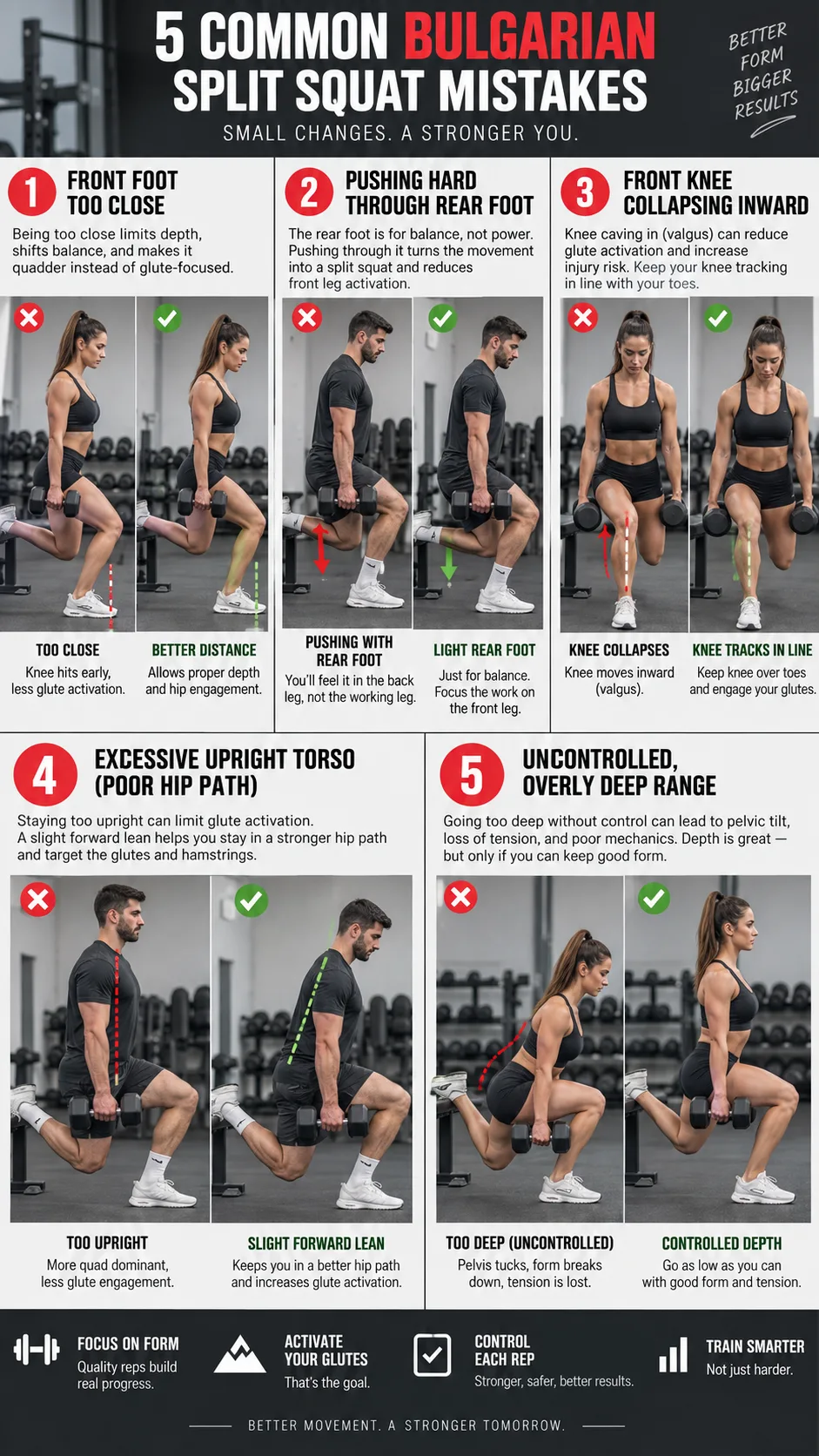
1. You set your front foot too close to the bench
A short stance often sends your front knee far forward as you lower. Your knee can move forward safely, but a very short setup can ask more of your knee than your current mobility or strength can handle.
You may also lose glute tension when your front heel starts to rise or your pelvis runs out of room. Your knee then does more work while your glutes quit early.
The fix: Put your front foot far enough forward that you can lower with control and keep your entire front foot on the floor. At the bottom, use a comfortable knee bend and keep your heel heavy.
Take a longer stance when you want more glute work. Let your front shin angle forward a little, but keep your heel down and your knee steady.
-
2. Your rear foot carries too much weight
Your back foot helps you balance. It should not do the job of your front leg. When you drive hard through the top of your rear foot, you take work away from the front leg and often put extra pressure on your back hip or lower back.
Many lifters also push off the bench to get out of the bottom position. That habit turns a strong unilateral leg exercise into an assisted lunge involving furniture.
The fix: Keep roughly 80 to 90 percent of your weight over the front leg. Rest your rear foot lightly on the bench, then stand by driving through your front midfoot and heel.
If the top of your back foot feels uncomfortable, put your toes on the bench instead. You can also use a lower platform. A bench around knee height works for many people, but your hip mobility decides what works for you.
-
3. Your front knee collapses inward
Your knee should move in roughly the same direction as your toes when you lower and stand. When the knee caves inward, your hip loses control and your knee twists under load.
A small wobble does not mean disaster. Everyone has an untidy rep from time to time. Repeated inward collapse usually means the weight, range of motion, fatigue, or setup has gone beyond your current control.
The fix: Turn your front toes slightly outward if that feels natural, then guide your knee over your second or third toe. Press through your big toe, little toe, and heel.
Think, “spread the floor with my front foot.” That cue helps your glutes and hip muscles create a steadier base without forcing your knee into a rigid position.
-
4. You drop straight down instead of controlling your hip path
Many people turn the Bulgarian split squat into a vertical knee bend. They drop quickly, bounce at the bottom, and hope their joints tolerate it. Your glutes need some hip flexion and a controlled forward torso angle to work hard.
You do not need to fold over as if you dropped your keys. A small forward lean from your hips can keep your ribs stacked over your pelvis and put more tension on your glutes.
The fix: Lower your back knee toward the floor and let your torso lean forward slightly as one unit. Keep your chest up, brace your abs, and do not round your lower back.
Want more glute strength from this exercise? Push the floor away through your front heel. Then pair your single-leg work with a solid hip hinge, such as the technique in this guide to RDL form for glutes.
-
5. You chase depth that your hips cannot control
Deep Bulgarian split squats can build strength through a large range of motion. They can also irritate your knee, hip, or back when you force depth before you can control it.
Your body does not hand out medals for slamming your rear knee into the floor. More range helps only when you can control that range.
The fix: Stop lowering when your front heel stays down, your pelvis stays level, and your front knee tracks cleanly. Add depth over time as your mobility and strength improve.
Put a pad under your rear knee as a depth target if you struggle to judge your range. The pad gives you a clear stopping point, slows the rep, and keeps you from free-falling into the bottom.
How to set up a Bulgarian split squat that feels good on your knees
A good rep starts before you lower. Take a few seconds to find your distance, settle your foot pressure, and brace your torso. Those seconds can save you from twenty wobbly reps that teach your body nothing useful.
- Stand about two to three foot-lengths in front of a bench or stable platform.
- Put the top of your rear foot on the bench, or use your rear toes if that position feels better.
- Set your front foot about hip-width from an imaginary center line instead of placing it tightrope-style.
- Brace your abs as if someone plans to poke your stomach.
- Lower slowly and keep most of your pressure through the front foot.
- Guide your front knee in line with your toes.
- Drive through your front heel and midfoot until you stand tall.
Start with bodyweight. Add dumbbells after you can control the full movement. Strength coaches and exercise professionals often use single-leg movements to spot imbalances, and the American Council on Exercise exercise library offers useful movement references when you need a refresher.
How much knee travel should you allow?
Your knees can move past your toes. They do it whenever you walk downstairs, sit down, or climb stairs.
The real question involves control. Can you let your knee move forward without pain, heel lift, or inward collapse? A forward knee position can make your quads work harder, while a longer stride can shift more demand toward your glutes and hamstrings.
Treat symptoms as feedback, not as a toughness test. Stop and adjust when you feel sharp pain, catching, swelling, or pain that gets worse after training. The Hospital for Special Surgery provides reliable knee health information, but a qualified clinician should assess knee pain that continues.
Best Bulgarian split squat variations for your goal
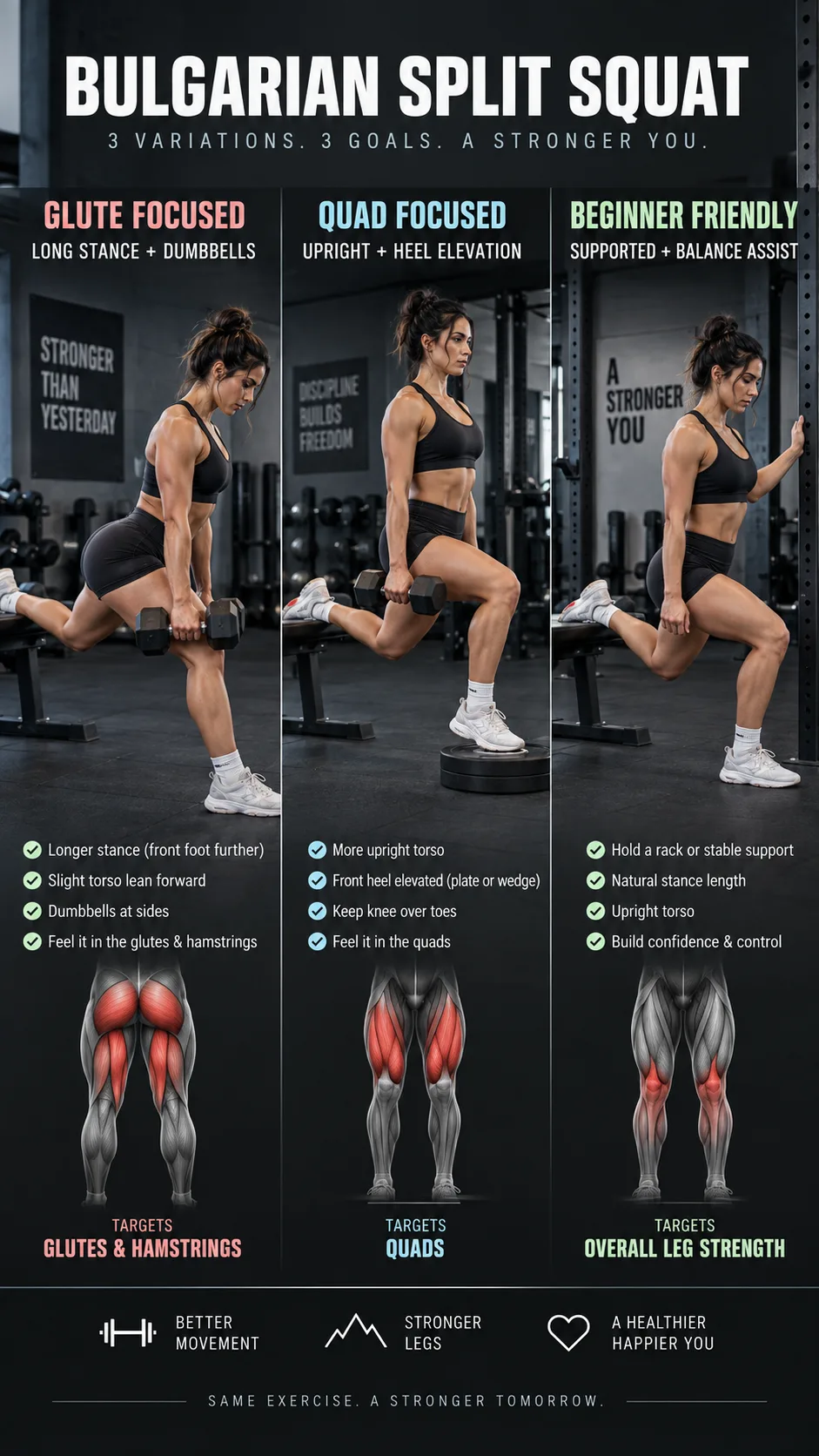
For more glute growth
Use a slightly longer stance, lean your torso forward a little, and hold dumbbells at your sides. Lower under control and pause briefly near the bottom without losing your pelvic position.
Work within a range that gives your glutes a strong stretch without pinching your hip. This version humbles almost everyone at first, including lifters who insist they have strong legs.
For more quad strength
Use a moderately shorter stance and keep your torso more upright. Let your front knee move forward naturally while your heel stays down and your knee follows your toes.
Try a small front-heel elevation if your ankles limit your depth. Keep the elevation stable, and do not stack random plates into a tiny gym Jenga tower.
For better balance and control
Hold a rack or sturdy support with one hand. The support lets you train your legs harder instead of spending half the set trying to control frantic arm windmills.
Research on single-leg strength and lower-limb mechanics keeps growing, and you can explore relevant studies through PubMed’s Bulgarian split squat research listings. Let research inform your choices, then let your own pain-free performance guide the exercise variations you use.
Programming Bulgarian split squats without wrecking yourself
You do not need to turn every set into a near-death experience. Bulgarian split squats create plenty of fatigue because each leg works on its own, so moderate loads often give you enough stimulus.
- For muscle growth: Perform 3 to 4 sets of 8 to 12 reps per leg.
- For strength: Perform 3 to 5 sets of 5 to 8 controlled reps per leg.
- For beginners: Perform 2 to 3 sets of 6 to 10 bodyweight or lightly supported reps per leg.
- For control: Lower for 2 to 3 seconds, pause briefly, then stand with intent.
Put Bulgarian split squats early in your lower-body workout when strength or glute growth ranks first on your list. Put them later when you already squat or deadlift hard and want more unilateral volume.
Leave one to three reps in reserve on most sets. Your form usually breaks down before your motivation does, and motivation loves to write checks your knees will not cash.
The bottom line: Build glutes, not knee drama
Strong Bulgarian split squat form comes down to five things: a sensible stance, light rear-foot pressure, steady knee tracking, a controlled hip path, and a depth you can control.
Keep most of your weight on the front leg, drive through a planted foot, and earn each extra inch of range. Start lighter than your ego wants, film a set from the side, and change one thing at a time.
Your glutes will notice. Your knees may send a thank-you note 🙂