

You’ve been doing push ups for months. Maybe years. And yet your chest isn’t growing, your shoulders feel sketchy, and your wrists protest every single rep. Sound familiar? Bad push up form is far more common than people realise, and it quietly sabotages your results every time you hit the floor.
Push ups look simple. Drop down, push up. Done, right? Not quite. The push up is a full-body movement that demands solid technique from head to toe. Get it wrong and you’re just grinding through reps that build bad habits and breed injuries.
Here are the five most common push up form mistakes and exactly how to correct them today.
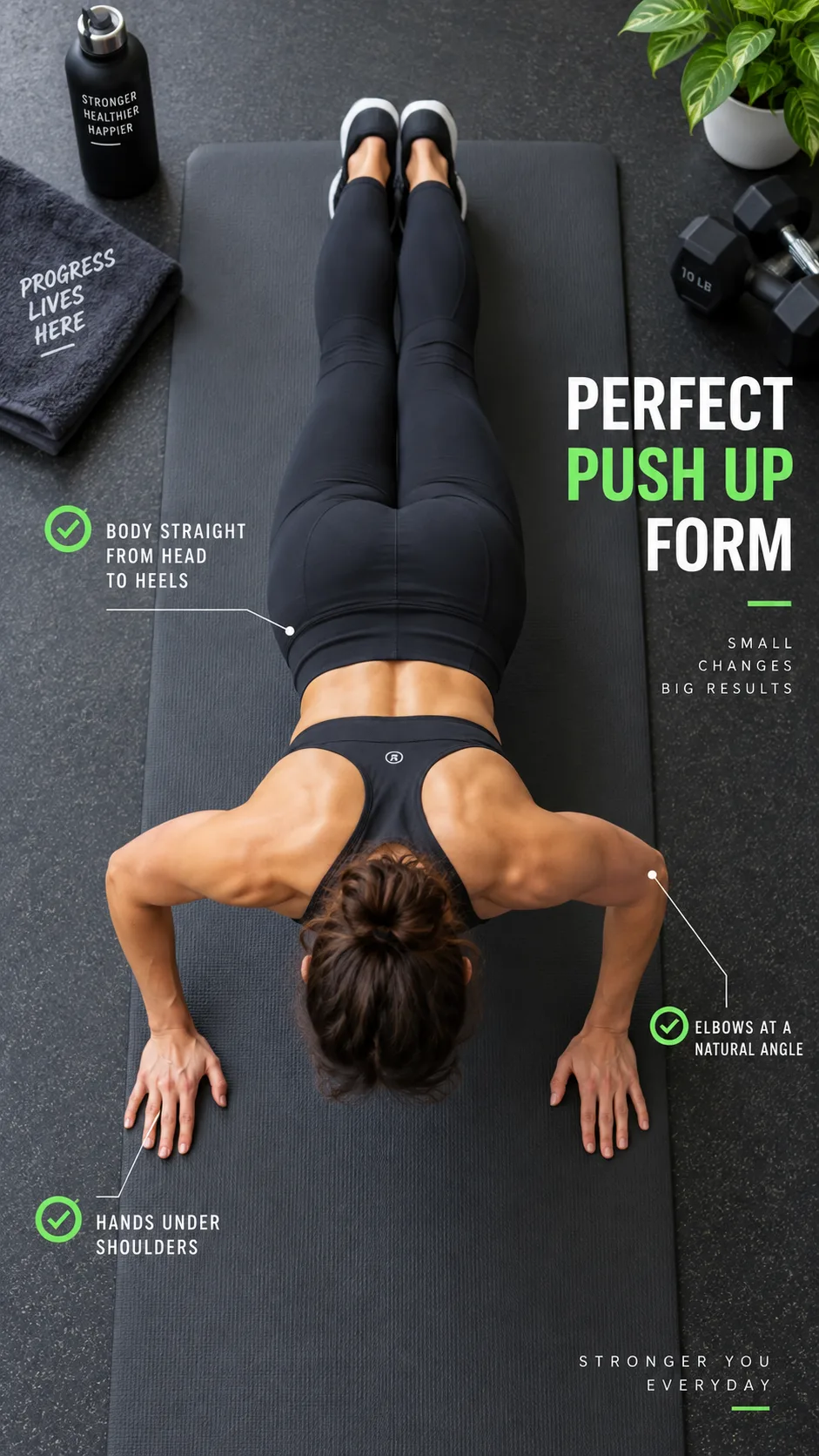
Why proper push up form matters
Before we get into the mistakes, let’s be real about something. A push up done correctly recruits your chest, shoulders, triceps, core, and even your glutes. It’s not just an upper body exercise. It’s a moving plank, and that makes it genuinely effective.
But when your form breaks down, you shift load onto the wrong muscles and joints. Your chest stops working. Your rotator cuff picks up the slack. Your lower back screams. None of that is progress. It’s just damage accumulation with extra steps.
Even elite athletes revisit push up fundamentals regularly. If it’s good enough for them, it’s good enough for us.
Mistake #1: Your hips are either sagging or sky-high
This is probably the most visually obvious push up mistake out there. Walk into any gym or fitness class and you’ll spot it immediately. Either someone’s hips are drooping toward the floor like a hammock, or they’re pointing toward the ceiling like a very sad downward dog.
Both positions completely kill the effectiveness of the exercise. Sagging hips dump compression into your lumbar spine. Raised hips take the load off your chest and triceps entirely.
The fix
- Before every set, actively squeeze your glutes and brace your core like you’re about to take a punch to the stomach.
- Your body should form a single rigid line from the crown of your head to your heels.
- Think of a push up as a moving plank. The plank position never changes. You just lower and press.
- Film yourself from the side. You’ll see the truth fast.

Mistake #2: Flaring your elbows out like chicken wings
Here’s one that wrecks shoulders silently over time. Most people assume elbows should point straight out to the sides at 90 degrees. They’ve seen it in old-school gym photos. They copy it. And then they wonder why their shoulders feel broken after a few months.
Wide elbow flare places enormous stress on the shoulder joint, specifically the AC joint and rotator cuff. It also reduces how much your chest muscles contribute to each rep.
The fix
- Keep your elbows at roughly a 45-degree angle from your torso. Not straight out, not fully tucked.
- Think of your hands and elbows forming an arrow shape pointing forward, not a “T” shape.
- This position is more shoulder-friendly and activates the chest more effectively, according to research published by the National Institutes of Health on upper limb biomechanics.
- It also mimics a proper bench press angle, so you’re building transferable strength.
Mistake #3: Looking up and wrecking your neck
Where your head goes, your spine follows. Ever noticed people craning their neck upward mid-push up, eyes fixed on the wall in front of them? That hyperextension pulls your cervical spine out of neutral alignment and cascades down your entire back.
Your head position is part of your form. It’s not a cosmetic detail. Get it wrong and you’re fighting your own posture on every single rep.
The fix
- Keep your gaze about 6 to 12 inches in front of your hands on the floor. Not forward, not tucked into your chest.
- Your ears should stay in line with your shoulders and hips throughout the movement.
- Think of a “proud chest” position: chest open, head neutral, no chin jutting forward.

Mistake #4: Not going through a full range of motion
Half reps are the great gym lie. They feel like a lot of work. They look like a lot of reps. But they’re basically half the exercise. Cutting your push up short at the bottom cheats your chest out of the stretch where growth happens.
Most people stop when their elbows hit 90 degrees. That’s a choice. It’s just not a good one if building strength and muscle is your goal.
The fix
- Lower your chest until it touches or nearly touches the floor on every rep.
- At the top, fully extend your arms and protract your shoulder blades (push them apart) to finish the movement properly.
- If full range feels impossible, work on progressions first. Check out how to do a push up for beginners to build up safely from wall push ups to floor variations.
- Slow your tempo down. Try a 3-second descent to build control through the full range.
According to ACE Fitness, full range of motion push ups significantly outperform partial reps in muscle activation across both the pectoralis major and triceps brachii. Go all the way down.
Mistake #5: Your hand placement is all wrong
Hand position sounds like a small thing. It’s not. Too wide and you lose tricep involvement and increase shoulder strain. Too narrow and you shift everything onto your triceps while your chest barely works. And if your hands sit too far forward, your wrists end up bearing load they’re not designed to handle.
Most people set their hands too wide and too far forward, usually because it feels more stable at first. Feeling stable isn’t the same as being correct.
The fix
- Place your hands slightly wider than shoulder-width apart, roughly in line with your nipple line.
- Your wrists should sit directly under your shoulders, not in front of them.
- Point your fingers slightly outward (around 10 to 15 degrees) to reduce wrist strain.
- Grip the floor actively. Press your fingertips and knuckles into the ground to engage your forearms and stabilise the wrist joint.
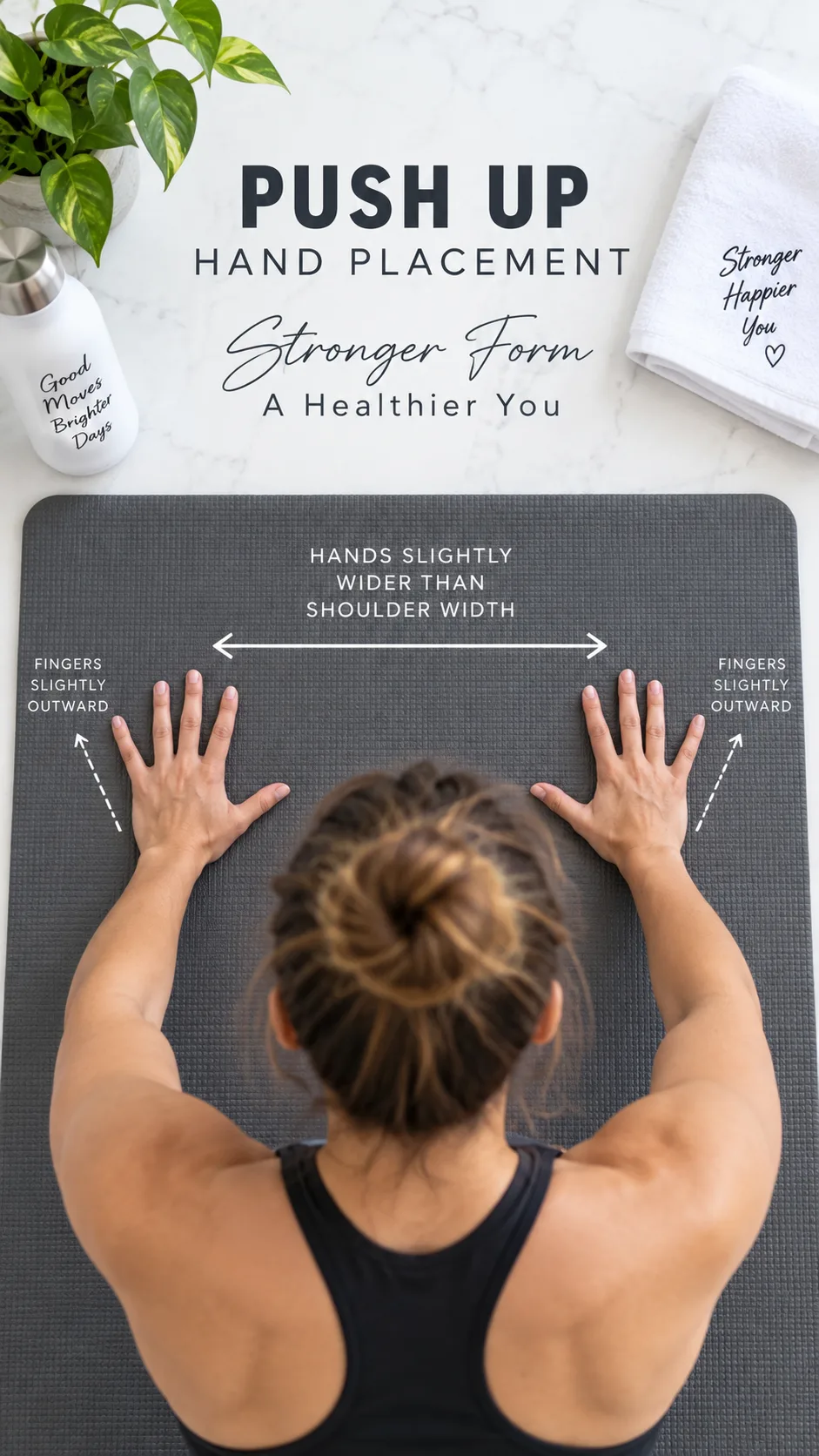
Quick reference: the perfect push up checklist
Before every push up session, run through this mentally. It takes about five seconds and saves you from grinding through bad reps:
- Hands slightly wider than shoulders, wrists under shoulders, fingers angled outward slightly.
- Core braced, glutes squeezed, body in a rigid plank position.
- Elbows at 45 degrees to your torso, not flared wide.
- Head neutral, gaze forward, ears in line with hips and shoulders.
- Full range of motion, chest to floor, full arm extension at the top.
If you want to push further after locking in your form, this push up progression guide will take you from basic to advanced variations step by step. It’s one of the most effective bodyweight progressions out there.
What about wrist pain during push ups?
Wrist pain during push ups is usually a form issue, not a structural problem. Most wrist pain comes from incorrect hand placement and weak forearm stabilisers. Once you correct your hand position and actively grip the floor, it often clears up quickly.
If wrist pain persists, try performing push ups on your fists or on push up handles. Both options keep your wrist in a neutral position and dramatically reduce joint stress. You can also check guidance from Healthline’s expert-reviewed piece on wrist pain during push ups for further reading.
And if you’re dealing with other movement issues, sorting out your squat form can help with overall lower-body mechanics that feed into core stability, which directly affects your push up quality.
Fix the form, fix the results
Push ups are one of the best exercises on the planet when you do them right. Five simple mistakes are costing thousands of people their progress every single day: sagging hips, flared elbows, a craned neck, partial reps, and poor hand placement.
The good news? Every single one of those mistakes is fixable today. Not next week. Today. Slow down, run through the checklist, film yourself, and commit to quality over quantity.
Ten perfect push ups beat fifty sloppy ones every time. Your chest, shoulders, and future self will thank you for it.
Now drop and give me twenty. The right way this time.