
Regular squats work. But when your glutes ignore them like a group chat notification, Bulgarian split squats at home can give them a reason to pay attention.
This single leg exercise makes each glute carry its own share of the work instead of letting your stronger side take over. You need little equipment, steady focus, and a willingness to make a slightly dramatic face by rep eight.
Want stronger, rounder glutes without giving up your living room to a squat rack? Grab a sturdy chair, bench, or sofa edge and get to work.
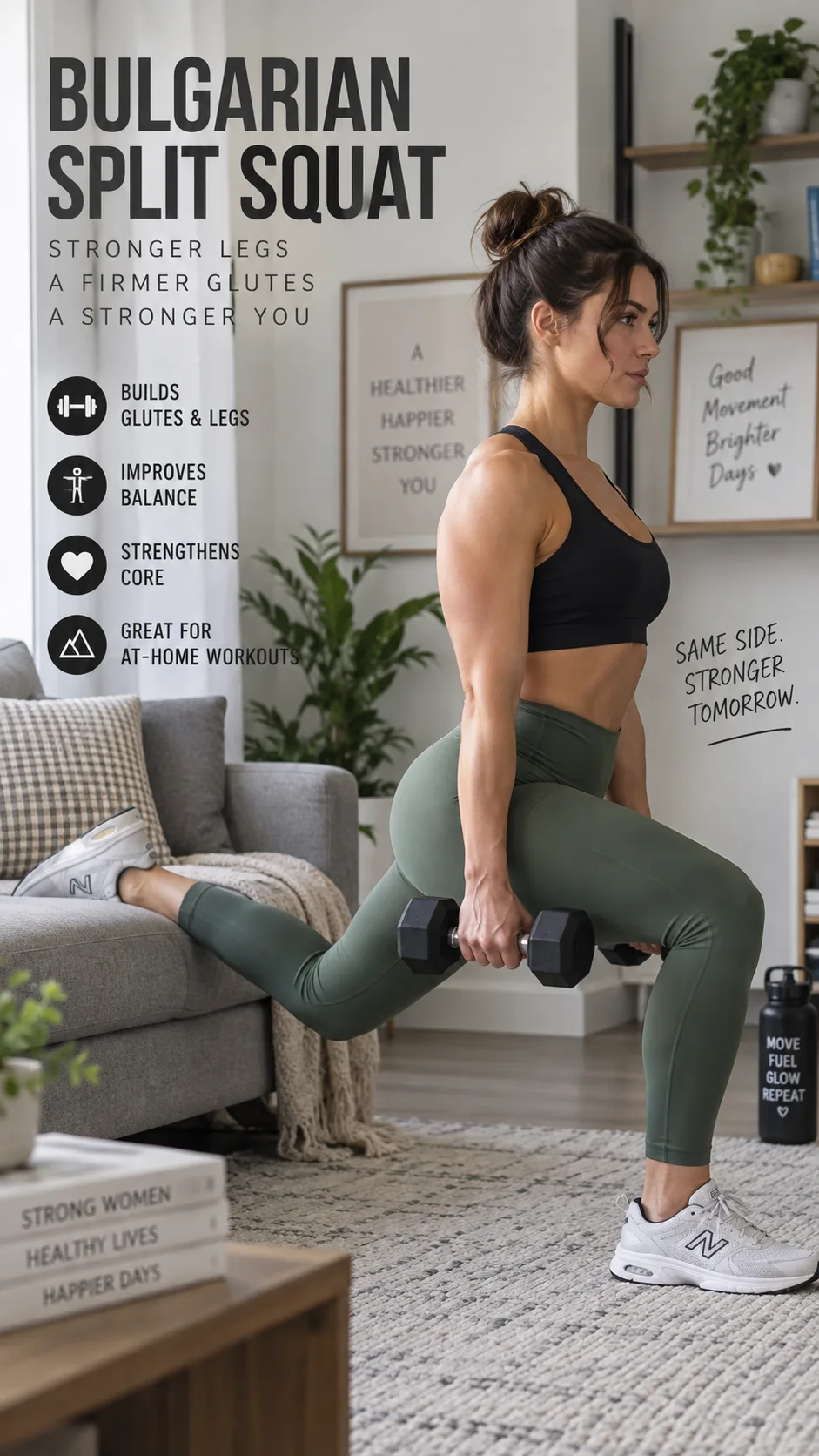
Why Bulgarian split squats work your glutes so hard
Bulgarian split squats place most of the load on one leg, so your working glute must produce more force on every rep. Your front leg controls the descent, pushes you back up, and keeps your pelvis steady at the same time.
Regular squats divide the work between both legs. That lets you use heavier loads, but your dominant leg can quietly take more than its share. Sneaky little overachiever.
The Bulgarian split squat takes your hip through a long range of motion, especially when you use a longer stance and lean your torso slightly forward. Your glute max has plenty of work to do in that position.
Research on unilateral lower body training shows that single leg exercises can build strength, improve balance, and reveal differences between your sides. The American College of Sports Medicine also recommends regular resistance training as part of a balanced fitness routine.
Do Bulgarian split squats build glutes faster than regular squats?
They can, but no exercise offers a magic shortcut. Bulgarian split squats often help people build their glutes faster because they expose weak glutes, create a tough challenge with lighter weights, and make it easy to add difficulty at home.
Regular squats still belong in many training plans. But if you mostly feel squats in your quads or lower back, Bulgarian split squats can put your glutes to work more directly.
Your results depend on effort, solid form, enough weekly training volume, protein, sleep, and consistency. Your glutes do not care about your motivational playlist when you quit after two weeks. Harsh, but fair.
What you need for Bulgarian split squats at home
You can do Bulgarian split squats with bodyweight alone. As you get stronger, add dumbbells, a backpack full of books, kettlebells, resistance bands, or a weighted vest.
- A stable rear foot support: Use a bench, sturdy chair, couch edge, or low step.
- Clear floor space: Give your front foot enough room to step forward.
- A wall or chair nearby: Use it for balance during your first sessions.
- Optional load: Hold dumbbells at your sides or hug a backpack to your chest.
Choose a support around knee height or a little lower. A very high surface can pull your hip into an awkward position and turn a glute exercise into a flexibility audition.
Check your chair before every set. If it slides, wobbles, or looks like it survived a questionable flat pack project, choose something safer.
How to do Bulgarian split squats at home with proper form
Good Bulgarian split squat form keeps the work in your glutes and legs. You do not need perfect flexibility, but you do need control.
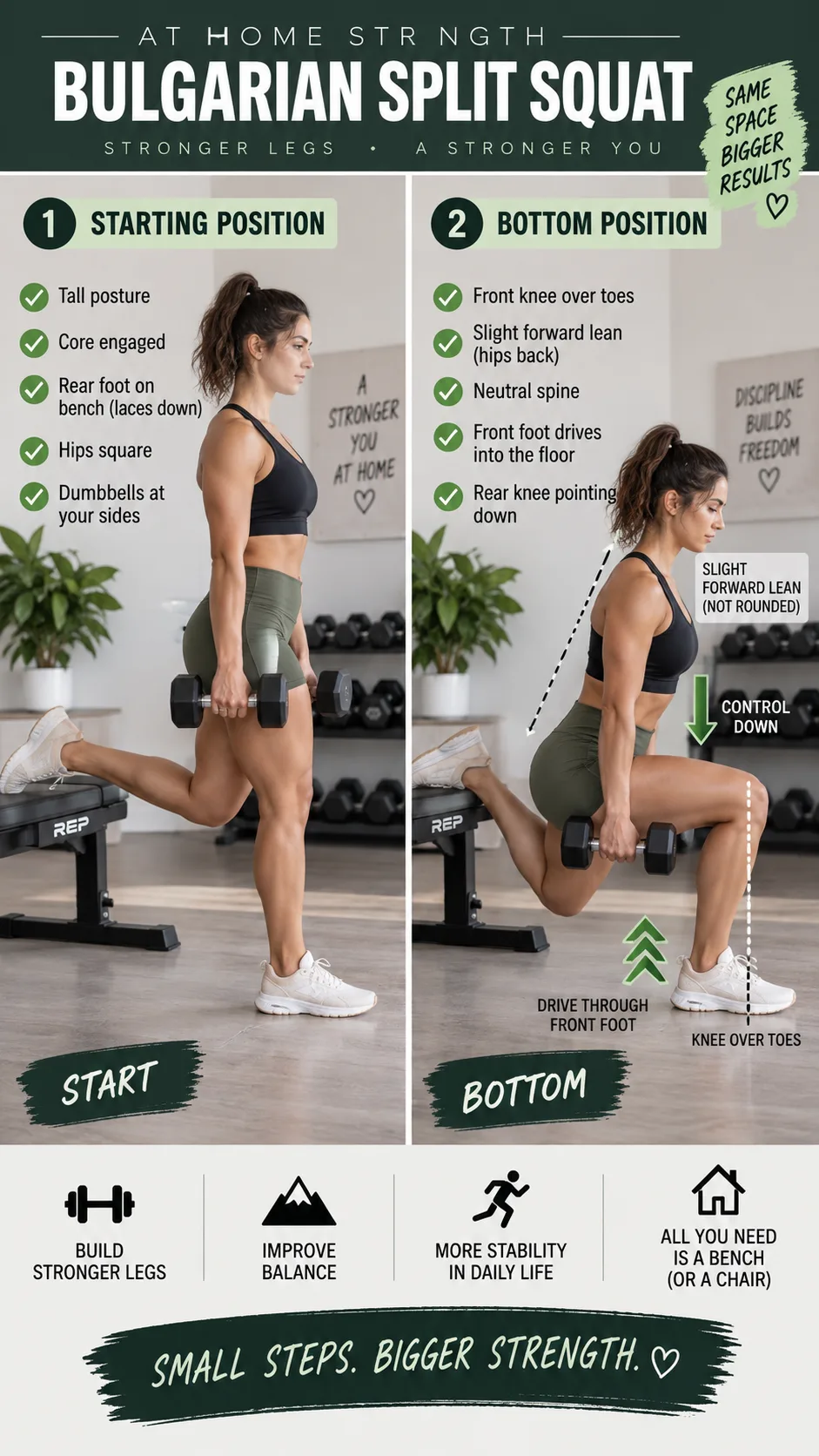
- Stand about two to three feet in front of your support. Start with your feet hip width apart.
- Place the top of one foot behind you on the support. Let your back foot relax instead of driving hard through it.
- Keep most of your weight over your front foot. Press your whole front foot into the floor.
- Lower your body straight down. Bend both knees and keep your front knee in line with your toes.
- Lean your torso slightly forward. Keep your spine long and brace your core.
- Drive through your front heel and midfoot. Squeeze your front glute as you return to standing.
- Finish all reps on one side. Then switch legs and prepare for the other glute to file its complaint.
The best setup for more glute growth
Take a longer stance when you want to put more work on your glutes. At the bottom of each rep, keep your front shin close to vertical or let it angle only slightly forward.
Move your hips back and down as you lower. That motion loads your glute more than a short, upright stance that puts most of the work in your quads.
Keep your front heel on the floor. If your heel rises, move your front foot a little farther forward or reduce your depth until you can control the position.
If you struggle to feel the right muscles, start with these glute activation drills that help every rep count. A few focused warm up sets can help you feel your glutes before you load the movement.
Watch a Bulgarian split squat tutorial before your first session
A quick visual demo can spare you a lot of trial and error. Watch the setup closely, then film one set from the side if you can. Your phone camera tells the truth, even when you would rather it did not.
Five Bulgarian split squat mistakes that steal your glute gains
Small setup mistakes can pull tension away from your glutes and make this exercise miserable. Fix these common problems before you add weight.
1. You stand too close to the bench
A short stance sends your front knee far forward and often makes your quads take over. Step your front foot farther away until you can lower with control and keep your heel down.
2. You push hard with your back leg
Your rear foot provides support. When you drive through that back leg, you take load away from your front glute and turn the exercise into an awkward two leg lunge.
3. You rush the lowering phase
Your glutes work hard as they control the descent. Take two to three seconds to lower, pause briefly near the bottom, then push up with purpose.
4. Your knee collapses inward
Your front knee should travel in the same direction as your toes. Gently guide your knee outward as you lower, especially when your hip feels unsteady.
5. You chase depth you cannot control
Deep reps can help when you keep your balance, alignment, and tension. Stop at a depth where you can hold your pelvis steady and keep your front foot firmly planted.
Want a closer form check? Read the subtle Bulgarian split squat mistakes that wreck knees and glutes before you add extra load.
How many Bulgarian split squats should you do?
For glute growth, train Bulgarian split squats one to three times a week. Start with bodyweight, learn the movement, and add resistance after you can finish every rep with control.
- Beginners: Do 2 to 3 sets of 8 to 10 reps per leg.
- Intermediate trainees: Do 3 to 4 sets of 8 to 15 reps per leg.
- Strength focus: Do 3 to 5 sets of 5 to 8 reps per leg with heavier load.
- Glute endurance focus: Do 2 to 4 sets of 12 to 20 reps per leg at a slower tempo.
Rest for 60 to 120 seconds after you train both sides. Take each set close to technical failure, but stop before your form collapses like a cheap deck chair.
The CDC physical activity guidelines encourage adults to do muscle strengthening activities at least two days each week. Pair Bulgarian split squats with other lower body movements to build a stronger, more complete program.
How to progress Bulgarian split squats without a gym
Progressive overload means asking your muscles to handle a little more over time. You do not need fancy equipment. You need a clear plan and honest reps.
- Add reps: Build from 8 clean reps to 15 clean reps per leg.
- Add load: Hold dumbbells, a backpack, water jugs, or a kettlebell.
- Slow your tempo: Take three to five seconds to lower on each rep.
- Add a pause: Hold the bottom position for one or two seconds.
- Increase range: Use a slightly lower support or improve your mobility so you can reach more depth.
- Use a front foot elevation: Put your front foot on a low step for more hip range.
Track your sets, reps, load, and effort in your notes app. This boring little habit beats guessing every time.
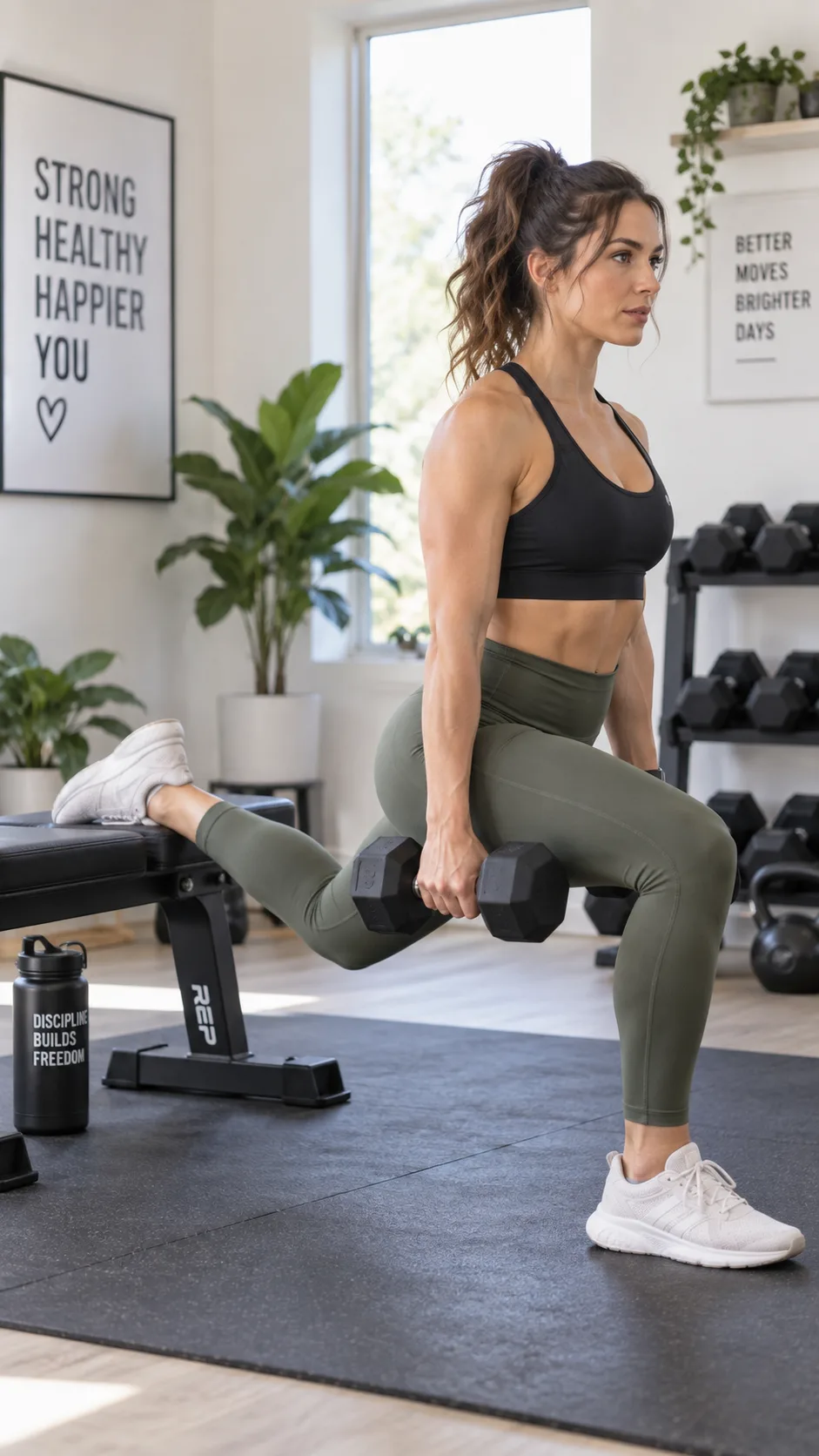
A simple at home glute workout with Bulgarian split squats
Do this workout twice each week, with at least one rest day between sessions. Start light enough to control every rep, then make the work harder over time.
- Glute bridges: Do 3 sets of 12 to 15 reps.
- Bulgarian split squats: Do 3 sets of 8 to 12 reps per leg.
- Romanian deadlifts: Do 3 sets of 8 to 12 reps.
- Bodyweight lateral lunges: Do 2 sets of 10 reps per side.
- Side lying hip abductions: Do 2 sets of 15 to 20 reps per side.
Bulgarian split squats train single leg strength, while Romanian deadlifts work your glutes in a stretched hip hinge position. Check your RDL form for stronger glutes if your lower back works harder than your hips.
Eat enough protein, recover well, and increase the challenge over time. For broader home programming, use this guide on how to grow glutes at home as your next step.
When you should modify or skip Bulgarian split squats
Choose a supported version when balance holds you back. Hold a wall, countertop, or chair with one hand so your glutes and legs can work without balance getting in the way.
Reduce your range of motion when you feel sharp pain in your knee, hip, ankle, or back. Muscle effort feels hard. Sharp joint pain tells you something different.
Talk with a qualified physiotherapist or healthcare professional if you have a current injury, recent surgery, ongoing joint pain, or major balance concerns. Your body deserves more than random internet bravery.
Final thoughts: Make every leg work for its dinner
Bulgarian split squats at home challenge your glutes with very little equipment. They train one side at a time, expose strength gaps, and create a lot of tension through a deep, controlled range of motion.
Use a long enough stance, keep pressure through your front foot, lower slowly, and progress with patience. Start at your next workout, stay with it for a few weeks, and let your regular squats wonder why they suddenly have competition 🙂